Gallup Regular Public Opinion Poll
52% Support Small Constituency System, 32% Support Medium Constituency System
President Yoon's Approval Rating Rises 1%p to 34%
Even if the total budget for parliamentary salaries is frozen, public opinion against increasing the number of National Assembly members exceeds 70%, according to a survey. President Yoon Suk-yeol's approval rating has slightly increased.
According to Gallup's regular survey conducted from the 21st to the 23rd (a telephone interviewer survey of 1,001 adults aged 18 and over nationwide), the public showed strong opposition to expanding the number of National Assembly members. Only 22% agreed that the number of members could be increased on the condition that the total budget for parliamentary salaries remains frozen. Meanwhile, 71% opposed increasing the number of members.
Without any preconditions such as freezing salaries, only 9% responded that the number of members could be increased by changing the system. Thirty percent believed the current quota of 300 members is appropriate, while 57% expressed the opinion that the number should rather be reduced. Although most respondents answered that the number of National Assembly members should be reduced, those in their 40s, supporters of the Democratic Party, progressives, and politically highly engaged groups were relatively more favorable toward expanding the number of members.
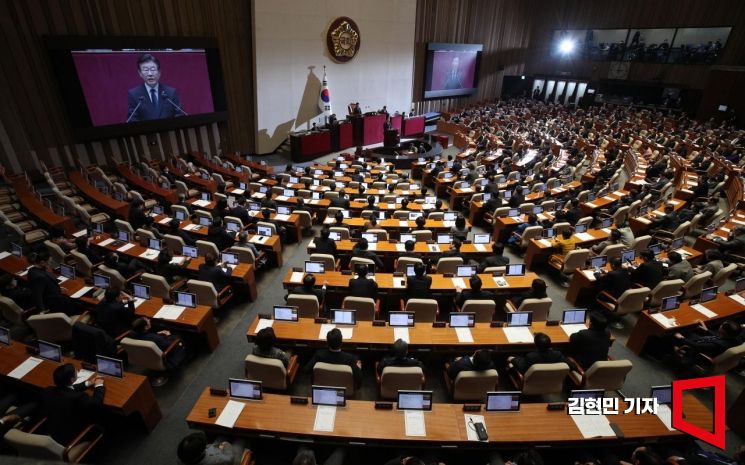 Lee Jae-myung, leader of the Democratic Party of Korea, is making a personal statement regarding the submission of a motion for his arrest at the plenary session held at the National Assembly in Yeouido, Seoul, on the 27th. Photo by Kim Hyun-min kimhyun81@
Regarding the electoral system, 52% supported maintaining the current single-member district system, while 32% favored switching to a multi-member district system.
Gallup explained, "The opposition to expanding the number of National Assembly members is based on the perception that the current quota of 300 is by no means small. Concerns about increasing the total budget for salaries are peripheral issues, and before discussing numerical expansion, it is necessary to seek qualitative improvements and ways to enhance trust."
President Yoon Suk-yeol's approval rating for his state affairs performance was 34%, up 1% from last week's survey. Negative evaluations decreased by 2 percentage points to 58%.
Among the reasons given for positive and negative evaluations of President Yoon's job performance, diplomatic relations with Japan accounted for a significant portion. Gallup stated, "This week, mentions of Japan and diplomatic relations increased significantly in both positive and negative evaluations of the president's job performance." Among those who supported President Yoon's state affairs performance (344 people), 18% cited improvement in relations with Japan. Conversely, among those who negatively evaluated President Yoon's performance (583 people), diplomacy (25%) and issues related to Japan, including forced labor compensation (23%), were cited as reasons.
In terms of party support, the Democratic Party's approval rating rose 2 percentage points from last week to 35%. The People Power Party's support remained the same at 34%. By political orientation, 68% of conservatives supported the People Power Party, and 60% of progressives supported the Democratic Party. Among respondents who identified themselves as centrists, 22% supported the People Power Party, 36% supported the Democratic Party, and 37% said they did not support any particular party.
For detailed survey methodology and results related to this poll, please refer to the website of the Central Election Survey Deliberation Commission.
© The Asia Business Daily(www.asiae.co.kr). All rights reserved.
![Clutching a Stolen Dior Bag, Saying "I Hate Being Poor but Real"... The Grotesque Con of a "Human Knockoff" [Slate]](https://cwcontent.asiae.co.kr/asiaresize/183/2026021902243444107_1771435474.jpg)















