The government has unveiled a plan to accelerate the promotion of the Korean pharmaceutical and bio industry, aiming to develop two 'blockbuster' new drugs with annual sales exceeding 1 trillion won by 2027, and to establish three global top 50 pharmaceutical companies with annual sales exceeding 3 trillion won.
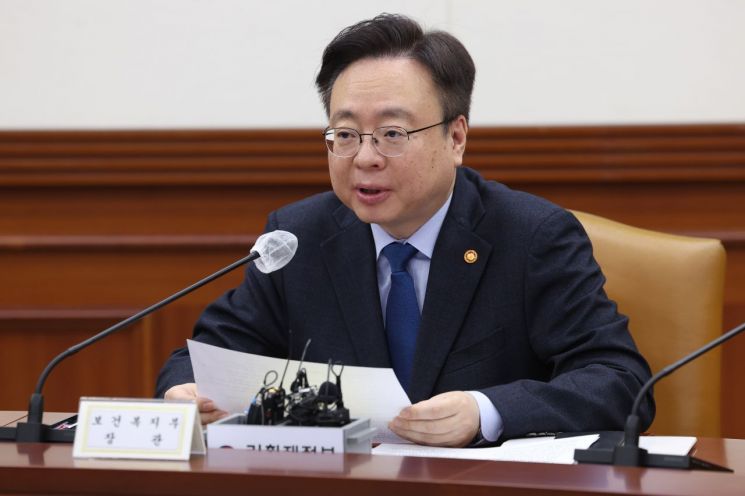
On the afternoon of the 24th, the Ministry of Health and Welfare held the Pharmaceutical Industry Promotion and Support Committee meeting at the Korea Pharmaceutical and Bio Association in Seocho-gu, Seoul, and deliberated and approved the "3rd Comprehensive Plan for the Promotion and Support of the Pharmaceutical and Bio Industry (2023-2027) for Advancing Korea as a Global Biohealth Hub." Through this plan, in addition to producing blockbuster new drugs and global top 50 pharmaceutical companies, the government aims to double pharmaceutical exports to $16 billion (approximately 20.5 trillion won) compared to 2022, create high-quality jobs in the pharmaceutical and bio industry, and achieve third place globally in clinical trials.
While the first comprehensive plan set the initial goal of shifting from a generic drug-centered industrial structure to fostering an industry focused on new drug R&D, and the second plan aimed to increase production capacity of biopharmaceuticals led by biosimilars and expand pipelines and technology exports, the third plan expresses a strong will to embark on full-scale global expansion under the theme of "Advancing Korea as a Global Pharmaceutical and Bio Hub."
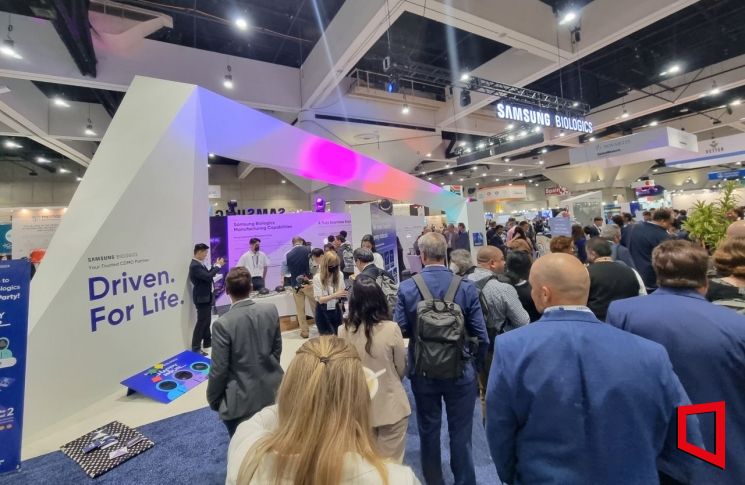 In June of last year, the Bio International Convention 2022 (BioUSA) was held at the San Diego Convention Center in the United States.
 [Photo by Lee Chunhee]
To achieve these goals, the plan has established four major sectoral tasks: research and development (R&D), investment and export support, talent cultivation, and systems and infrastructure.
First, regarding the creation of blockbuster new drugs, the plan envisions investing a total of 25 trillion won in public and private R&D by 2027 to develop 10 global new drugs. In addition, to prepare for potential new infectious disease pandemics that may arise again after COVID-19, support for vaccine development, including next-generation platforms such as messenger ribonucleic acid (mRNA), will continue to enable ultra-fast vaccine development. Research support will also be increased for intractable neurodegenerative diseases such as dementia and Parkinson's disease, as well as musculoskeletal disorders, which are rapidly increasing due to aging.
Furthermore, proactive support will be provided for new technologies and digital transformation, which have recently attracted attention in the pharmaceutical and bio industry. To secure new technologies, R&D will be actively supported for next-generation pharmaceutical and bio technologies such as genetically modified cell therapies, antibody-drug conjugates (ADC), and targeted protein degraders (TPD). To support new drug development using artificial intelligence (AI), the plan includes establishing a "Korean-style Rosetta Fold" capable of predicting protein structures and designing antibodies for antibody drugs, as well as promoting the "K-MELLODY" project, which effectively utilizes sensitive health and medical data distributed across institutions based on federated learning models.
To support these initiatives, the "K-Bio Vaccine Fund," which has been under formation since last year, will be expanded to a scale of 1 trillion won, and based on performance analysis, additional large-scale funds will be raised. Support will also be provided for domestic companies' investments and attracting foreign companies' investments into Korea through site and licensing support, as well as offering customized incentives.
Regarding overseas expansion, in response to the strengthening of industrial protectionism in major countries such as the United States, the government plans to form consultative bodies with related ministries for close coordination and activate diplomatic channels to prevent negative impacts on domestic pharmaceutical and bio companies. Additionally, the number of tenants supported at the "Korea Bio Innovation Center" established in Boston, USA, will be increased, and similar hubs will be established in Europe.
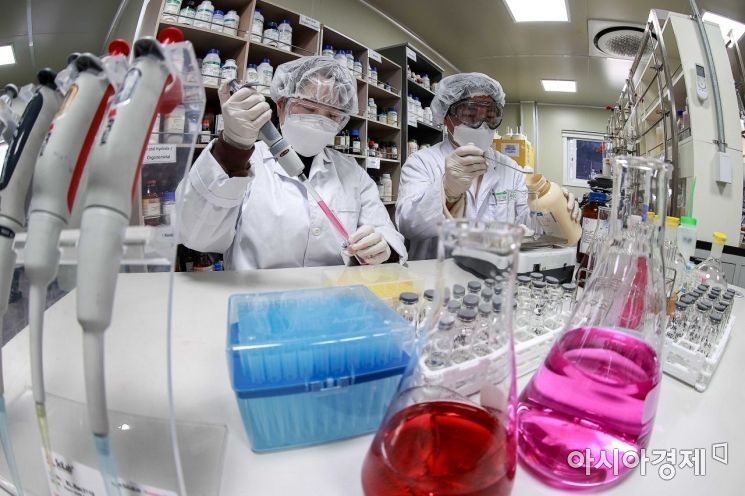 Researchers at a domestic bio venture company are focusing on new drug research. Photo by Jinhyung Kang aymsdream@
To address the chronic manpower shortage recently raised by the industry, the plan sets a goal to cultivate a total of 35,000 personnel over five years. In terms of production personnel, 16,000 will be trained through facilities such as the Korean-style National Institute for Bioprocessing Research and Training (K-NIBRT) in Songdo, Incheon, and the K-Bio Training Center in Osong, Chungbuk. For clinical and regulatory personnel, a total of 13,000 will be trained. Notably, in the regulatory science field, the plan aims to train 330 master's and doctoral-level personnel by 2025. Additionally, 4,000 IT-BT convergence talents and 2,000 physician-scientists and master's/doctoral-level talents will be cultivated.
For regulatory innovation and institutional support, the plan proposes establishing a Digital and Biohealth Innovation Committee under the Prime Minister's Office as a governance body. Regarding drug pricing, where the industry has continuously voiced concerns, a public-private consultative body will be formed to develop improvement measures that can reward innovation value.
However, concerns have been raised that the government's ambitious goals may be excessively high given that there are currently no blockbuster new drugs or top 50 pharmaceutical companies in Korea. In response, Jeong Eun-young, Director of the Health Project Policy Bureau at the Ministry of Health and Welfare, stated, "Recently, new drugs developed by domestic pharmaceutical companies have received favorable evaluations in global clinical trials and are attempting global expansion. There are about five to six new drugs expected to become blockbusters, and since the government is investing in R&D to create blockbuster new drugs, we believe achieving around two is possible." She added, "We expect the level of Korea's pharmaceutical and bio industry to grow to that extent."
Minister Cho Kyu-hong of the Ministry of Health and Welfare said, "The pharmaceutical and bio industry is a national essential strategic industry for public health and health security, and from an industrial perspective, it is a promising sector that creates high-quality, advanced jobs and continues to grow exports." He added, "The next five years are a decisive period for Korea to leap forward as a global pharmaceutical and bio hub, and through this comprehensive plan, we ask for the cooperation of related ministries, industry, and experts to realize bold innovation and investment."
© The Asia Business Daily(www.asiae.co.kr). All rights reserved.
![Clutching a Stolen Dior Bag, Saying "I Hate Being Poor but Real"... The Grotesque Con of a "Human Knockoff" [Slate]](https://cwcontent.asiae.co.kr/asiaresize/183/2026021902243444107_1771435474.jpg)

















