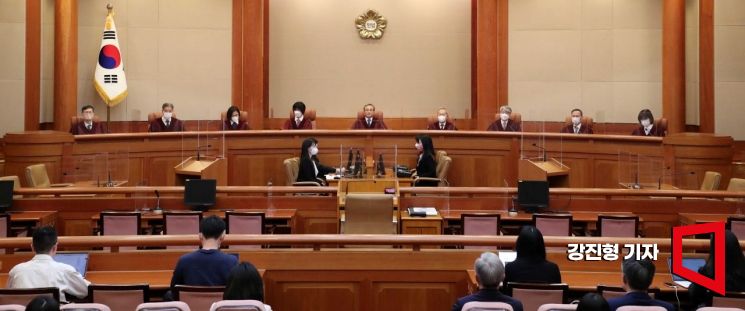
 On the 23rd, the day of the Constitutional Court's ruling on the authority dispute trial regarding the complete removal of the prosecution's investigative authority (Geomsuwanbak) bill, Yoon Nam-seok, Chief Justice of the Constitutional Court, is seated together with the Constitutional Justices at the Constitutional Court in Jongno-gu, Seoul.
 [Photo by Kang Jin-hyung aymsdream@]
The Constitutional Court ruled that although the authority of the People Power Party lawmakers, who were the opposition at the time, was partially infringed during the passage of the 'Complete Stripping of Prosecutorial Investigation Rights (Geomsu Wanbak)' bill led by the Democratic Party of Korea last year, the act of declaring the bill's passage is not considered a significant defect that would invalidate it.
During the legislative amendment process, the rights of People Power Party lawmakers, Minister of Justice Han Dong-hoon, and prosecutors were infringed, and four justices believed that the declaration of passage in the National Assembly plenary session was invalid. However, since this did not reach the majority of five justices, it did not become the court's official opinion, and the amended Prosecutors' Office Act and amended Criminal Procedure Act remain effective.
According to the legal community on the 24th, the Constitutional Court justices expressed completely opposing opinions based on their political leanings in two cases of jurisdictional disputes filed over the Geomsu Wanbak bill the previous day.
First, in the jurisdictional dispute case filed by People Power Party lawmakers Yoo Sang-beom and Jeon Ju-hye against the Chair of the Legislation and Judiciary Committee and the Speaker of the National Assembly, the court dismissed most claims with a 5 (dismissal) to 4 (acceptance) vote.
However, the court acknowledged that Min Hyung-bae, a Democratic Party lawmaker who originally proposed the Geomsu Wanbak bill, had 'disguised his party resignation' to be appointed as a member of the agenda adjustment committee. The court judged that Park Kwang-on, then Chair of the Legislation and Judiciary Committee, who overlooked this and submitted the bill to the committee and declared its passage, violated the National Assembly Act and the Constitution, infringing on the legislative review and voting rights of lawmaker Yoo and others.
The court dismissed the jurisdictional dispute petition filed by Minister Han and six prosecutors against the National Assembly with a 5 (dismissal) to 4 (acceptance) vote. It ruled that Minister Han had no restricted authority under the Geomsu Wanbak law and thus lacked standing to file the petition, and that the prosecutors had no possibility of rights infringement.
Minister Han and others argued that the constitutional provision on prosecutors' warrant application rights implies constitutional rights to investigation and prosecution. However, the majority of justices held that prosecutors' investigation and prosecution rights are statutory rights and cannot be infringed by the National Assembly's legislative amendments.
On the other hand, four justices dissented, arguing that prosecutors' investigation and prosecution rights are constitutional rights, and that both Minister Han and the prosecutors have standing. They held that the legislative amendments infringed on the constitutional investigation and prosecution rights and the authority of the Minister of Justice over prosecutors.
In both jurisdictional dispute cases, opinions were split 5 to 4 on all issues.
First, Chief Justice Yoo Nam-seok and Justices Moon Hyung-bae, Kim Ki-young, and Lee Seok-tae, who are classified as progressive, voted to dismiss all claims filed by People Power Party lawmakers and to dismiss the claims filed by Minister Han and the prosecutors. Chief Justice Yoo and Justice Kim are affiliated with the Uri Law Research Association and the International Human Rights Law Research Association, respectively, both chaired by Chief Justice Kim Myung-soo. Justice Lee Seok-tae is a former president of Minbyun (Lawyers for a Democratic Society).
Conversely, Justices Lee Jong-seok, Lee Young-jin, Lee Sun-ae, and Lee Eun-ae, classified as conservative or moderate, voted to accept all claims in both jurisdictional dispute cases. They judged that the rights of opposition lawmakers, as well as those of Minister Han and the prosecutors, were infringed, and that the legislative acts in both the Legislation and Judiciary Committee and the National Assembly plenary session should be invalidated or canceled. They regarded prosecutors' investigation and prosecution rights as constitutional rights.
When the Constitutional Court issues rulings declaring laws unconstitutional, accepts constitutional complaints, or decides on the dissolution of political parties, six justices' approval is required. However, in jurisdictional disputes, decisions are made by a majority of justices participating in the final hearing. Thus, the opinion of five justices becomes the court's official stance.
Ultimately, the opinion of Justice Lee Mi-seon, who held the casting vote, became the court's official opinion on all issues. Justice Lee, affiliated with the International Human Rights Law Research Association and nominated by former President Moon Jae-in, accepted only the claim by People Power Party lawmakers regarding the infringement of rights due to the Legislation and Judiciary Committee Chair's declaration of passage, while aligning with the progressive justices on the other claims.
Minister Han expressed his position on the court's decision, stating, "It is difficult to agree with the conclusion that it is unconstitutional and illegal but valid."
© The Asia Business Daily(www.asiae.co.kr). All rights reserved.

![User Who Sold Erroneously Deposited Bitcoins to Repay Debt and Fund Entertainment... What Did the Supreme Court Decide in 2021? [Legal Issue Check]](https://cwcontent.asiae.co.kr/asiaresize/183/2026020910431234020_1770601391.png)














