Major indices on the U.S. New York Stock Exchange started higher on the 23rd (local time) as they digested the results of the March Federal Open Market Committee (FOMC) regular meeting. Market expectations that the Federal Reserve (Fed) is nearing the end of its rate hike cycle have further expanded. Investors betting on the possibility of rate cuts within the year have also increased.
As of 10 a.m. at the New York Stock Exchange (NYSE), the Dow Jones Industrial Average was up 230.98 points (0.72%) from the previous close, trading around the 32,261 level. The large-cap-focused S&P 500 index rose 40.21 points (1.02%) to 3,977, while the tech-heavy Nasdaq index gained 183.30 points (1.57%) to 11,853.
Previously, investor sentiment, which had sharply frozen due to Fed Chair Jerome Powell's statement that "there will be no rate cuts this year" and Treasury Secretary Janet Yellen's remark that "comprehensive insurance will not be provided," has revived.
Currently, nine of the 11 sectors in the S&P 500, excluding utilities and consumer staples, are showing gains. In particular, interest rate-sensitive tech stocks have jumped nearly 2%, showing a notable rise. Netflix is trading about 9% higher than the previous close. Tesla also rose more than 3%. Meta Platforms (+2.56%), Amazon (+1.31%), Google Alphabet (+1.79%), and Microsoft (+1.69%) are also on the rise.
Meanwhile, Coinbase dropped 16% after opening following news that it received a warning from the Securities and Exchange Commission for securities law violations. First Republic Bank and PacWest Bancorp, which had been engulfed in crisis rumors after the Silicon Valley Bank (SVB) collapse, showed gains of around 4% and 1%, respectively, after selling pressure the previous day.
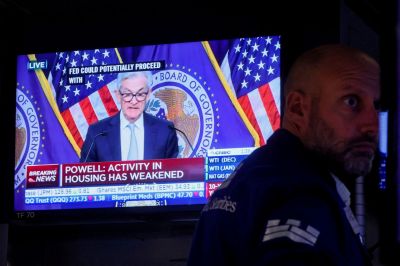
Investors are closely watching the Fed's future rate hike path as they digest the previous day's FOMC results. The March FOMC attracted attention as the Fed's first rate decision following the recent SVB collapse, which heightened concerns about the banking system crisis.
At the March FOMC, the Fed continued its tightening with a baby step (a 0.25 percentage point increase in the benchmark rate), but unlike the early-month forecast, it did not raise the year-end rate projection (median 5.1%) on the dot plot. Considering that the U.S. benchmark rate has risen to 4.75?5.0%, this effectively signals that one more 0.25 percentage point hike remains.
The removal of the phrase "ongoing increases" from the policy statement also reinforced this outlook. Instead, the FOMC added the phrase "some additional policy firming may be appropriate" to the statement. Wall Street analysts interpret this as "flexibility to pause rate hikes if necessary" and "one or two more 0.25 percentage point hikes going forward."
Currently, the market is divided between expectations of a rate hold and an additional baby step in May, with a slight tilt toward a hold. According to the Chicago Mercantile Exchange (CME) FedWatch tool, as of this morning, federal funds futures reflect about a 41% chance that the Fed will raise rates by 0.25 percentage points at the May FOMC. The probability of a rate hold stands at 58%, exceeding the hike probability.
Moreover, while Powell drew a line against a pivot within the year, the market is predominantly betting on the possibility of rate cuts by year-end. Many investors are wagering that the current 4.75?5.0% rate will fall to 4.25?4.5% by December. This is significantly below the median 5.1% rate indicated by the Fed's dot plot the previous day.
Matthew Hornbach, Head of Macro Strategy at Morgan Stanley, said, "The market will not rule out the possibility of rate cuts," noting that this possibility could increase if employment and inflation indicators slow down. Greg Basuk, CEO of AXS Investment, pointed out, "The Fed needs to thread the needle carefully, considering the banking sector situation and economic data."
Following the U.S. Fed, the Bank of England (BOE) and the Swiss National Bank (SNB) also raised rates simultaneously. The BOE raised its benchmark rate by 0.25 percentage points as expected. This marks the 11th consecutive hike since the rate hike cycle began in December 2021. Despite global concerns about banking risks following the SVB incident, the February consumer price index, released earlier, far exceeded expectations, which is interpreted as placing more weight on inflation easing. Soci?t? G?n?rale's George Garayo said, "Given inflation, this is not surprising."
The Swiss National Bank (SNB) implemented a 0.5 percentage point hike. The bank explained that the newly adjusted rate is at a level they consider necessary for price stability. This big step (a 0.5 percentage point hike) is seen as confirming the end of the financial turmoil triggered by Credit Suisse (CS), which had recently been engulfed in crisis rumors.
In the New York bond market, Treasury yields fell slightly. The 10-year U.S. Treasury yield is trading around 3.48%, and the 2-year yield is around 3.93%.
The weekly initial jobless claims released today fell short of expectations, confirming that the labor market remains robust. According to the U.S. Department of Labor, initial jobless claims for the week of March 12?18 totaled 191,000, down 1,000 from the previous week. This decrease was contrary to experts' expectations of a slight increase. Initial jobless claims are typically one of the earliest warning signs of an impending recession.
European stock markets are showing weakness. Germany's DAX index is trading down 0.08% from the previous close. The UK's FTSE is down 0.74%.
© The Asia Business Daily(www.asiae.co.kr). All rights reserved.
![Clutching a Stolen Dior Bag, Saying "I Hate Being Poor but Real"... The Grotesque Con of a "Human Knockoff" [Slate]](https://cwcontent.asiae.co.kr/asiaresize/183/2026021902243444107_1771435474.jpg)















