The Institute for Global Strategic Cooperation at Hankuk University of Foreign Studies (Director Hwang Jae-ho) and the Center for Contemporary Korean Peninsula Studies at Keio University in Japan held an event titled "The Path of Korean Diplomacy in the Indo-Pacific Era" on the 23rd at the Westin Chosun Hotel in Jung-gu.
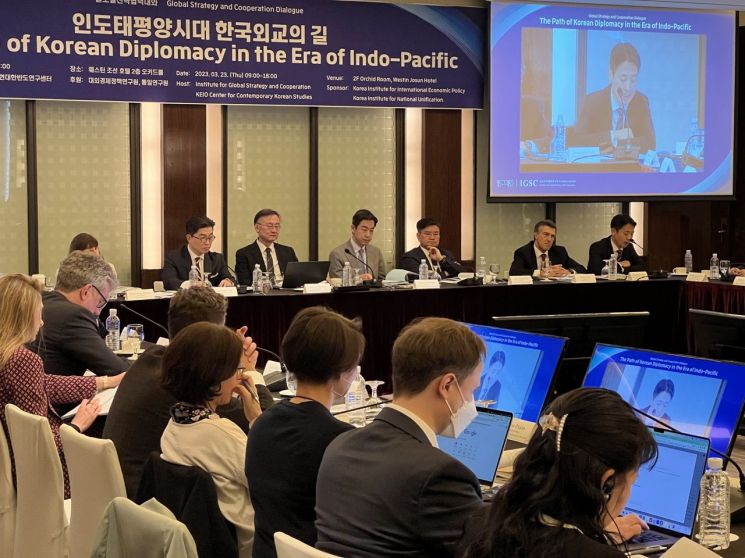 Participants at the event "The Path of Korean Diplomacy in the Indo-Pacific Era" are attentively listening to the presentation. Photo by Baek Jong-min
Attended by government officials from Korea, diplomatic envoys from Indo-Pacific related countries stationed in Korea, former officials, politicians, and scholars from various countries, the event discussed responses to the Indo-Pacific era as viewed by Korea and other nations. Kim Young-joo, Deputy Speaker of the National Assembly, gave a congratulatory speech, and the event drew great interest from attendees, with Yoon Sang-hyun of the People Power Party and Hong Ik-pyo of the Democratic Party participating as panelists.
On the day, Pang Gun, Counselor at the Chinese Embassy in Korea, read a prepared statement expressing strong dissatisfaction, saying, "The US-centered Indo-Pacific strategy excludes certain countries and divides them," but also stated that "Korea’s announced Indo-Pacific strategy emphasizes the basic principles of inclusion, trust, and reciprocity, and should signify respect for other countries without excluding any particular nation."
Counselor Pang criticized the US-centered Indo-Pacific strategy and the US-led Indo-Pacific Economic Framework (IPEF) as an Asia version of NATO and a regional framework that excludes China. He warned that attempts to exclude China would lead to outcomes similar to the global difficulties caused by environmental destruction.
Woo Jung-yeop, Director of Strategic Planning at the Ministry of Foreign Affairs, said, "Korea’s Indo-Pacific strategy is not targeted at any specific country but is an expression of the will to recognize the importance of emerging countries in the region and to expand engagement to maintain regional and global order." He also emphasized that Korea’s Indo-Pacific strategy is not a 'Korean version of the Indo-Pacific strategy,' nor is it an imitation or adoption of any particular country’s strategy, but a result created proactively by Korea.
Catherine Raper, Australian Ambassador to Korea, agreed that Korea’s Indo-Pacific strategy was not imposed externally, but avoided giving a specific answer when asked whether the introduction of nuclear submarines under the Aukus framework, promoted by the US, Australia, and the UK, might violate non-proliferation.
Director Hwang forecasted, “Following the Korea-US summit in April and the G7 summit in May, Korea’s Indo-Pacific strategy will be at the center of domestic and international attention and criticism,” and emphasized that "it is necessary to review the Indo-Pacific strategies of various countries and to find the strategic implications and lessons that Korea’s Indo-Pacific strategy as a global pivotal state provides."
© The Asia Business Daily(www.asiae.co.kr). All rights reserved.
![Clutching a Stolen Dior Bag, Saying "I Hate Being Poor but Real"... The Grotesque Con of a "Human Knockoff" [Slate]](https://cwcontent.asiae.co.kr/asiaresize/183/2026021902243444107_1771435474.jpg)















