"That Much Is Essential" vs "Times Are Different"
The public's opinion is divided over a question posed by an office worker asking a young person who cannot read numbers written in Chinese characters, "Aren't you ignorant?"
Recently, a post titled "Isn't it ignorant if you can't read numbers from 1 to 10 in Chinese characters?" was uploaded on the office worker community Blind.

Office worker A wrote, "I also don't know Chinese characters well. I can only read the Chinese characters in newspaper headlines," adding, "I sent materials from China to a partner company employee, and after looking at them for a while, they said they couldn't read Chinese because they didn't know the Chinese characters for 6, 7, and 9." He continued, "When I said this is common knowledge, they confidently said that Chinese characters were not mandatory in their time."
A said, "In middle and high school, we learned Japanese or Chinese, and even if not, shouldn't elementary school knowledge be enough to read numbers in Chinese characters?" He asked, "Even if I concede a hundred times that writing them is difficult, isn't this a bit ignorant?" He added, "There is a three-year age difference, but these days young people don't know this, and when they say I am a 'young old man' (young kkondae), I am just complaining."
More than half of the netizens supported the opinion that "it is indeed ignorant." Comments included, "One should at least know basic Chinese characters or the Chinese characters of their own name. Not being able to read numbers or dates does make one look ignorant," and "It's possible not to know Chinese characters, but the attitude toward dealing with it is more problematic. If it was simple Chinese characters, they should have at least shown the effort to look them up on the spot."
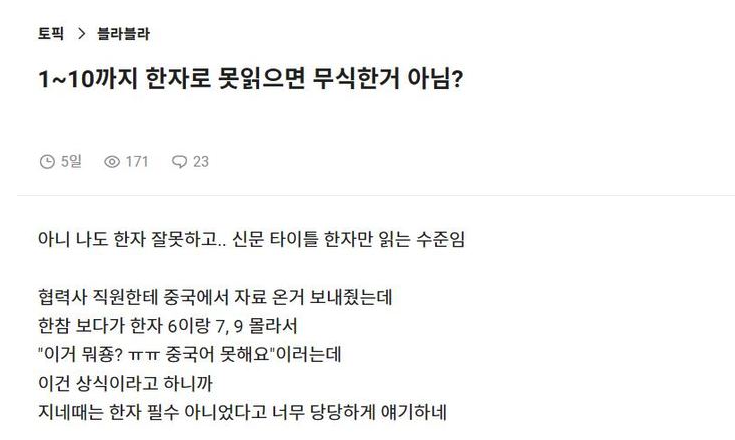 Recently, a post titled "Isn't it ignorant if you can't read numbers from 1 to 10 in Chinese characters?" was uploaded on the employee community Blind. [Photo by Blind]
On the other hand, some argued that "the decreased frequency of Chinese character use should be taken into account." One netizen commented, "Think about the sources of the common knowledge we learned. Isn't it just what we learned from media like dramas, what our parents taught us, and what we learned at school? If the media doesn't show it, and parents or schools don't teach it, it's natural not to know."
On February 11, another post appeared on an online community asking, "Is it embarrassing not to know Chinese characters?" Comments at the time included, "It's good to know, but it's not essential," "You can't just dismiss it because it's simply Chinese script. Korea is clearly a Chinese character cultural sphere," and "Knowing Chinese characters does improve literacy. There will come a day when you feel the need for it."
58.5% of the Standard Korean Language Dictionary is Sino-Korean Vocabulary
Meanwhile, since the 2020s, the lack of Chinese character vocabulary has emerged as a social issue. According to the National Institute of the Korean Language, among about 510,000 words listed in the Standard Korean Language Dictionary, 58.5% are Sino-Korean words. Native Korean words account for 25.5%, less than half of Sino-Korean words.
Due to the large number of Sino-Korean words in the Korean language, students generally have very poor competence regarding 'learning terms (learning tool words),' resulting in phenomena where they cannot understand the lessons themselves.
In response, the Ministry of Education established a subject called
© The Asia Business Daily(www.asiae.co.kr). All rights reserved.
![Clutching a Stolen Dior Bag, Saying "I Hate Being Poor but Real"... The Grotesque Con of a "Human Knockoff" [Slate]](https://cwcontent.asiae.co.kr/asiaresize/183/2026021902243444107_1771435474.jpg)
















