Declaration of the Vision for Fuel Cell Export Industrialization
The government has established a vision to achieve a cumulative fuel cell export value of 3 billion USD (approximately 3.85 trillion KRW) by 2030. It will implement the 'Fuel Cell Export Industrialization Support Strategy,' which includes three major strategies and seven key tasks such as advancing the domestic industrial base, enhancing global competitiveness, and providing customized overseas expansion support.
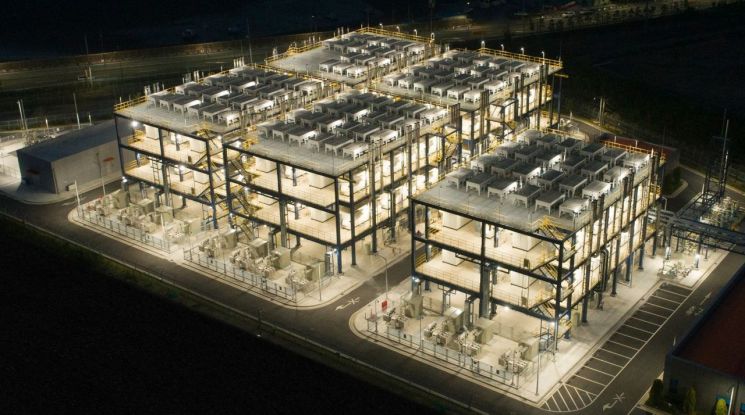
The Ministry of Trade, Industry and Energy and the Korea Hydrogen Fuel Cell Industry Association announced on the 23rd that they held the 'Fuel Cell Export Industrialization Vision Proclamation Ceremony' attended by Park Il-jun, the 2nd Vice Minister.
Fuel cells are devices that produce electricity and heat by reacting hydrogen and oxygen. As of the end of last year, Korea is the world's largest fuel cell power generation market with about 859 MW (megawatts) installed. The domestic industry has so far achieved overseas orders worth approximately 350 million USD (111.6 MW, China).
On this day, the government and the association presented a vision to actively foster fuel cells as a future energy new industry by 2030, aiming to achieve a cumulative export volume of 1 GW (gigawatt) and a cumulative export value of 3 billion USD, thereby accelerating the realization of an energy renaissance.
For fuel cell export industrialization, it is analyzed that not only quantitative expansion of exports but also qualitative growth must be achieved by diversifying export markets from the current China-centered market to the Middle East, Australia, Southeast Asia, the United States, and Europe, and by diversifying export items from main fuel cell equipment to core materials and components.
The industry plans to seek maintaining a super-gap in the fuel cell industry and securing a global market lead by expanding exports through region-specific customized strategies centered on the association, packaging exports linking main equipment sales with design, construction, operation, and social overhead capital (SOC), and promoting co-growth of large, medium, and small enterprises through cooperation in technology, workforce training, and marketing.
The government will promote the 'Fuel Cell Export Industrialization Support Strategy,' which includes three major strategies and seven key tasks: advancing the domestic industrial base, enhancing global competitiveness, and providing customized overseas expansion support. To maintain the industrial ecosystem and achieve economies of scale, it plans to create new markets based on self-generation demand in addition to policy markets such as hydrogen power generation bidding markets.
Additionally, it will review a pilot project for data centers using fuel cells as the main power source and encourage the installation of distributed fuel cells when establishing new industrial complexes in the metropolitan area. It will also promote discovering new demand linked to the defense industry, such as developing mobile field generators.
From 2024 to 2028, through the Pohang Fuel Cell Power Generation Cluster project with a total budget of 189 billion KRW, infrastructure such as company agglomeration complexes, material and component performance evaluation centers, and domestic demonstration pilot centers will be timely established to lay the foundation for industrial advancement.
When newly designating hydrogen specialized complexes scheduled for the second half of this year, it will consider including specialized complexes centered on fuel cells.
For core technology development investment in seven strategic hydrogen fields including fuel cells, policy financing such as preferential interest rates will be supported within an annual limit of 500 billion KRW, and tax benefits will be strengthened by designating major technologies as national strategic technologies.
The Ministry of Trade, Industry and Energy and the association will jointly operate a 'Fuel Cell Export Task Force (TF)' to resolve on-site difficulties related to exports faced by Korean companies.
Park Il-jun, the 2nd Vice Minister of the Ministry of Trade, Industry and Energy, said, "Fuel cells are a field where world-class manufacturing technology and operational capabilities have been accumulated, and they have very high potential to lead the energy renaissance by creating future growth engines through export expansion." He added, "We will closely communicate with the industry through the newly launched Korea Hydrogen Fuel Cell Industry Association and will spare no effort in providing necessary policies and support to back the industry's export expansion efforts, such as trade finance, marketing support, and resolving export difficulties."
© The Asia Business Daily(www.asiae.co.kr). All rights reserved.
![Clutching a Stolen Dior Bag, Saying "I Hate Being Poor but Real"... The Grotesque Con of a "Human Knockoff" [Slate]](https://cwcontent.asiae.co.kr/asiaresize/183/2026021902243444107_1771435474.jpg)
















