Jo Eung-cheon "First Suspension of Duties, Then Exception Resolution"
Ki Dong-min and Lee Su-jin (Proportional) Also Criticize Package Exception
The Democratic Party of Korea is facing a fierce backlash after applying the 'Article 80' exception clause to party leader Lee Jae-myung, who was indicted on charges related to preferential treatment and corruption in the Wirye New Town and Daejang-dong development projects, as well as allegations concerning donations to Seongnam FC. The party's decision to allow Lee to retain his leadership position was made swiftly following the prosecution's indictment, and criticism has arisen both inside and outside the party due to the simultaneous decision to maintain the party positions of lawmakers Ki Dong-min and Lee Soo-jin, who were indicted in connection with the Lime Asset Management scandal involving approximately 1.6 trillion won in redemption losses.
On the morning of the 23rd, Cho Eung-cheon, a non-Lee faction lawmaker, appeared on MBC Radio and criticized the party's decision the previous day by the party's executive committee to allow Lee to keep his party position, calling it a "fortress-like stance" and saying it was "excessive."
Immediately after the prosecution indicted Lee without detention on charges related to preferential treatment in the Wirye and Daejang-dong development projects and the Seongnam FC donation allegations, the Democratic Party convened the executive committee and applied the 'exception for political oppression' clause in Article 80 of the party constitution, which generally mandates suspension upon indictment, to decide to maintain Lee's position. Lawmakers Ki Dong-min and Lee Soo-jin (proportional representation), who were indicted on charges including receiving illegal political funds from Lime Asset Management, also retained their party positions on the grounds that the investigation was politically motivated.
According to the revised Article 80, Paragraph 3, amended last August, "In cases of political oppression or other unjust reasons, the executive committee may decide otherwise," and the prosecution's indictment was classified as "political oppression." The Democratic Party had also passed this amendment just two days before Lee took office, which had sparked controversy.
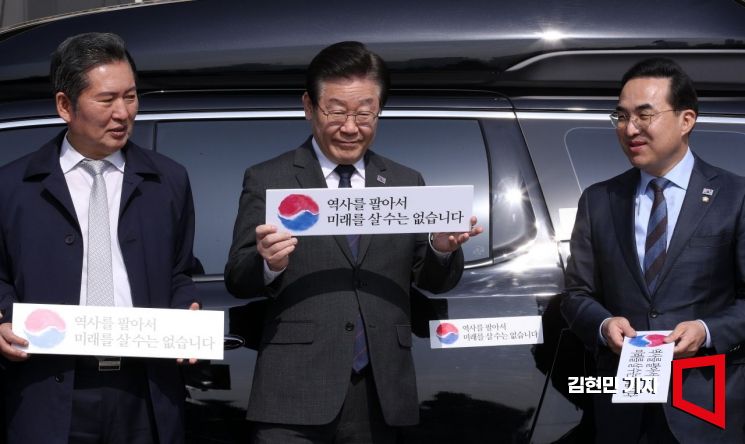 Lee Jae-myung, leader of the Democratic Party of Korea, is holding up a placard at the Taegeukgi Flag Raising Campaign event condemning submissive diplomacy toward Japan, held in front of the National Assembly main building on the 22nd. Photo by Hyunmin Kim kimhyun81@
Non-Lee faction lawmakers, who have pointed out the need to separate Lee's judicial risks from the party, strongly criticized the executive committee's decision. In particular, they argue that the party is recklessly shielding Lee following the narrowly defeated arrest motion against him last month. At that time, the pro-Lee faction was visibly unsettled by the mass defections of votes, and there are concerns that the party is now overly focused on protecting Lee to prevent the next arrest motion from possibly passing. Cho said, "The fallout from the rejection of the arrest motion is becoming too entrenched in a bulletproof stance," and criticized the timing, saying, "The executive committee was convened suddenly on the day of the indictment."
The application of 'Article 80' also raised questions about procedural legitimacy. Even if Paragraph 3, which allows exceptions in cases of 'political oppression,' is applied, it should have been preceded by the first step of 'suspension from duties' as stated in Paragraph 1, which applies to those who have received a suspension order. However, this step was bypassed. Cho pointed out, "There must be a suspension procedure, even if brief, before moving to Paragraph 3," and added, "Interpreting Article 80, Paragraphs 1 and 3, the person must have received a suspension order under Paragraph 1, but no such order was issued."
Criticism has also emerged that the decision to extend relief to Ki Dong-min and Lee Soo-jin alongside Lee, citing 'political oppression' investigations, was a 'package deal' to avoid the appearance of Lee Jae-myung being the sole beneficiary of protection. Both lawmakers were indicted on charges of receiving political funds from Kim Bong-hyun, former chairman of Star Mobility and the main culprit in the Lime fund scandal. Spokesperson Kim Eui-gyeom explained the decision to maintain their party positions by saying, "Unlike the prosecution's indictment, the defenses of Ki Dong-min and Lee Soo-jin were persuasively presented."
However, there are criticisms that it is unreasonable to view even these cases as 'opposition party oppression.' Um Kyung-young, director of the Sidae Spirit Research Institute, said, "If they wanted to apply the exception clause for 'political oppression,' they could have handled Lee's case separately, but bundling the three together does not align with the opposition party's need to uphold and enforce high moral standards." He added, "The Lime scandal occurred during the Moon Jae-in administration and has been concluded, so denying it is not only nullifying the party constitution but also undermining the judicial system."
© The Asia Business Daily(www.asiae.co.kr). All rights reserved.
![Clutching a Stolen Dior Bag, Saying "I Hate Being Poor but Real"... The Grotesque Con of a "Human Knockoff" [Slate]](https://cwcontent.asiae.co.kr/asiaresize/183/2026021902243444107_1771435474.jpg)















