Joining the Final Stage of the Electoral District Reform Resolution
Democratic Party Gwangju and Gyeongbuk Provincial Parties, People Power Party Jeonnam Provincial Party Support
Overcoming Winner-Takes-All, Expanding Proportionality, and Mitigating Regionalism Effects
The 'open-list multi-member constituency system' has been revived during the discussion of the resolution in the National Assembly's Special Committee on Political Reform. Given the strong voices from regions such as Honam and Yeongnam emphasizing the urgent need to introduce a multi-member constituency system to overcome regionalism, attention is focused on whether this will become a stumbling block in the future election law revision process.
According to political circles on the 23rd, during the full meeting of the Special Committee on Political Reform held the previous day, an option combining 'open-list multi-member constituencies + nationwide parallel proportional representation system' was added to the resolution to be submitted to the plenary session. This option was not included in the resolution originally adopted by the Political Law Improvement Subcommittee of the Special Committee. The amendment was created amid controversy over the proposal to increase the number of National Assembly members by 50 in the resolution adopted by the subcommittee, and this new option was added during that process.
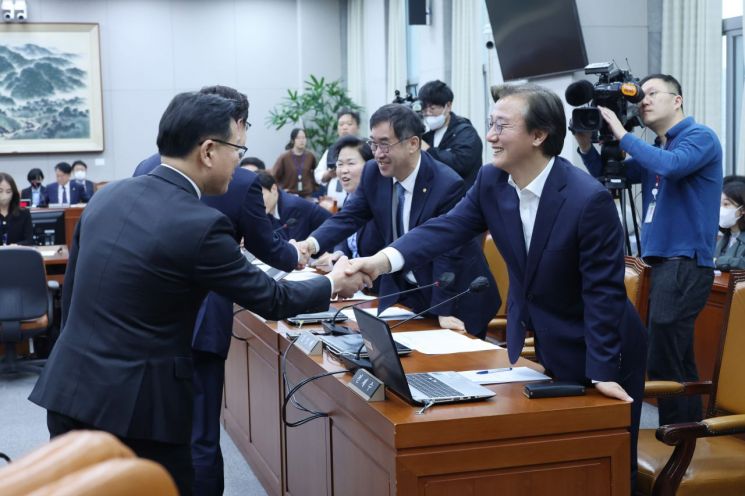
The option included in the Special Committee's resolution proposes switching from the current single-member constituency system to a multi-member constituency system with 4 to 7 members per district, where voters select both their preferred party and candidate. The winners are determined based on the proportion of votes each party receives, with seats allocated accordingly, and candidates with the highest votes within those seats are elected. This plan aims to convert votes that have previously been wasted?such as those for the People Power Party or Justice Party supporters in Gwangju, or Democratic Party supporters in Gyeongbuk?into votes that can actually elect candidates. It closely resembles the amendments to the Public Official Election Act proposed by Representatives Kim Sang-hee, Park Ju-min, and Lee Tan-hee.
Representative Jeon Jae-soo, the Democratic Party's secretary of the Special Committee, explained, "The multi-member constituency proposal was one of the options discussed by the Democratic Party's Political Innovation Committee," adding, "It was originally discussed but was excluded in the subcommittee and has now been included."
Multi-member Constituency System: Increasing Proportionality and Reducing Wasted Votes Without Increasing the Number of Assembly Members
Although the Special Committee describes the resolution as merely a 'formality' for the plenary committee's discussion, political circles are paying close attention because the proposal that passed through the Special Committee could become a major election law reform measure. The controversy over the National Assembly Speaker's advisory panel's proposal to increase the number of members to strengthen proportionality under the single-member constituency system has created an opportunity for the multi-member constituency system. A new alternative has emerged: a mixed urban-rural multi-member constituency system, where cities have large multi-member constituencies and rural areas have single-member constituencies.
Representative Park Ju-min of the Democratic Party, who proposed the Public Official Election Act amendment centered on the multi-member constituency system, told this publication in a phone interview, "Our country faces many challenges, such as many wasted votes and unresolved regionalism, but this proposal can increase proportionality and reduce wasted votes without increasing the number of assembly members." He added, "Although some say it is just a topic for discussion in the resolution, it is significant that the proposal has been thoroughly reviewed in the Special Committee and that members have had the opportunity to be briefed."
In fact, the multi-member constituency proposal has been a focus within the Democratic Party, the majority party in the National Assembly. During discussions on electoral district reform, the political consensus was that the multi-member constituency system could be an alternative to prevent wasted votes, strengthen proportionality, overcome regionalism, and respond to local extinction. Notably, the proposal's political reform symbolism is highlighted by calls for the introduction of the multi-member constituency system in Gwangju, considered the Democratic Party's stronghold, and Gyeongbuk, regarded as its weakest region. Previously, the Democratic Party's Gwangju City Party passed a political innovation plan centered on regional multi-member constituencies through its executive committee, and the Democratic Party's Gyeongnam Provincial Party also held a press conference on the 22nd urging the inclusion of the multi-member constituency system in election law reform discussions.
The People Power Party's Jeonnam Provincial Party and the Democratic Party's Gyeongbuk Provincial Party also included such content in a document titled 'Opinions Related to Electoral Districts in Rural and Fishing Villages,' which they submitted to the National Assembly Speaker and the Special Committee members the previous day.
According to the opinion document obtained by this publication, adopting the single-member constituency system would further entrench the current regionalism. The document criticizes both the single-member constituency system and the mixed urban-rural multi-member constituency system, stating, "In regions where a particular party's nomination almost guarantees election, the winner-takes-all electoral system swallows the voices of other parties and leads to the disappearance of politics." It also raises concerns about 'gerrymandering' due to frequent redistricting caused by population decline. For example, in Suncheon, the electoral districts are divided into Suncheon Gap and Eul by combining Gwangyang, Gokseong, and Gurye, while in Chuncheon, the districts are divided into Chuncheon Gap and Eul by combining Cheorwon, Hwacheon, and Yanggu.
People Power Party Jeonnam Provincial Party and Democratic Party Gyeongbuk Provincial Party Submit Opinion Document to Special Committee
These types of electoral districts differ not only in administrative boundaries but also in living areas and broadcasting zones. For instance, in the current Gyeongbuk Gunwi, Uiseong, Cheongsong, and Yeongdeok area, Gunwi belongs to the Daegu broadcasting zone, Uiseong to Andong, and Yeongdeok to Pohang. In cases of the single-member constituency system or the mixed urban-rural multi-member constituency system, which effectively maintains single-member districts in rural areas, regionalism is not improved, causing confusion over electoral districts and failing to resolve the issue of wasted votes.
Meanwhile, National Assembly Speaker Kim Jin-pyo, People Power Party Floor Leader Joo Ho-young, and Democratic Party Floor Leader Park Hong-geun agreed in a meeting on the same day to hold a plenary committee session for election law revision discussions and to process a single amended bill based on the Special Committee's resolution through bipartisan 'consensus' in writing.
© The Asia Business Daily(www.asiae.co.kr). All rights reserved.
![Clutching a Stolen Dior Bag, Saying "I Hate Being Poor but Real"... The Grotesque Con of a "Human Knockoff" [Slate]](https://cwcontent.asiae.co.kr/asiaresize/183/2026021902243444107_1771435474.jpg)















