Bank of Korea Financial Stability Report
Domestic Banks Have Sufficient Foreign Currency Reserves
However, Non-Bank Sector Risks May Increase
 Lee Chang-yong, Governor of the Bank of Korea, is answering questions from the press at the monetary policy direction press conference held at the Bank of Korea in Jung-gu, Seoul, on the morning of the 23rd of last month.
 [Image source=Yonhap News]
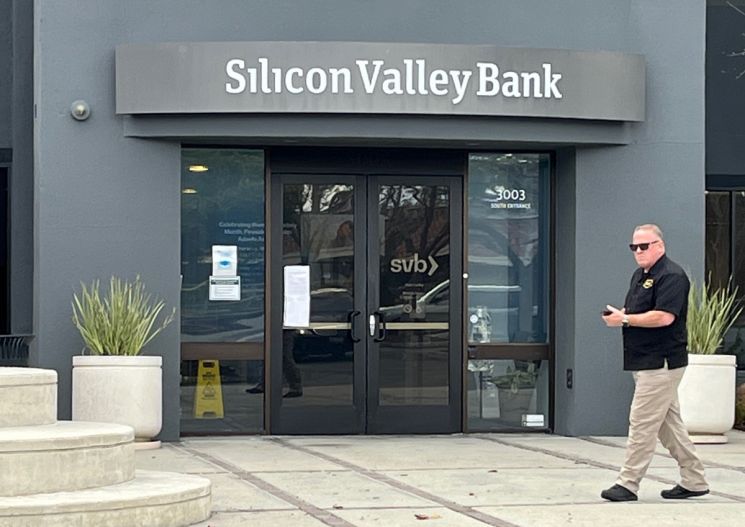
Although concerns about the global financial market are growing due to the bankruptcy of Silicon Valley Bank (SVB) in the United States, domestic financial institutions hold sufficient foreign currency liquidity reserves, so even if a large-scale outflow of foreign currency funds occurs, the damage is expected to be limited.
However, the Bank of Korea emphasized that continuous risk management is necessary as some non-bank financial institutions may be shaken if an extreme foreign currency liquidity shock occurs.
In the Financial Stability Report released on the 23rd, the Bank of Korea stated, "After examining the foreign currency liquidity risk and the capacity to withstand foreign currency outflow shocks by financial sector, the overall financial system was evaluated to have a sound foreign currency liquidity situation."
According to the Bank of Korea, the foreign currency Liquidity Coverage Ratio (LCR) of domestic banks was 132.5% in January this year, significantly exceeding the regulatory ratio (80%).
The LCR is the ratio of highly liquid assets held by banks to net cash outflows over 30 days. It shows how much foreign currency outflow a financial institution can withstand by selling highly liquid assets during a crisis.
The Bank of Korea explained, "Although foreign currency deposits may decrease if the trade balance deficit continues in the future, foreign currency liquidity risk has been continuously decreasing as the proportion of wholesale funds such as bonds and borrowings, which have a high outflow possibility, has been reduced since the global financial crisis."
Non-bank financial institutions such as securities companies and insurance companies also generally showed sound foreign currency liquidity ratios exceeding regulatory standards, but some risk concerns were identified.
Securities companies may face a sudden surge in foreign currency fund demand during a sharp decline in global stock indices, and specialized credit finance companies (SCF companies) mainly raise foreign currency through overseas bond issuance, so refinancing may become difficult if global issuance conditions deteriorate.
The Bank of Korea also conducted a "foreign currency liquidity stress test," which estimates foreign currency fund outflows and available amounts under stress scenarios to check the foreign currency liquidity status of domestic financial institutions.
As a result, even if a large-scale foreign currency fund outflow shock occurs, domestic financial institutions are estimated to generally hold sufficient foreign currency liquidity reserves (available amount minus outflow amount) to withstand the shock.
However, if volatility in the global financial market increases and difficulties in raising foreign currency funds intensify, foreign currency liquidity risks may expand in some non-bank financial institutions.
Insurance companies can respond to foreign currency outflow risks due to their large holdings of securities, and SCF companies are expected to have small foreign currency outflows due to the appropriate maturity diversification effect of issued bonds, but securities companies may have relatively low capacity to respond due to contingent foreign currency fund demand and other factors.
In particular, with the ongoing interest rate hikes by the U.S. Federal Reserve (Fed) widening the interest rate gap between Korea and the U.S., and concerns about a financial crisis following the SVB bankruptcy, the preference for safe assets is strengthening, so the possibility of a sudden outflow of domestic foreign currency funds cannot be ruled out.
The Bank of Korea emphasized, "Considering that some non-bank financial institutions may have weak response capabilities in the event of a severe foreign currency liquidity shock, it is necessary to continue monitoring, including stress tests focusing on non-bank financial institutions, and to strengthen efforts to expand borrowing agreements that can be utilized in times of crisis."
© The Asia Business Daily(www.asiae.co.kr). All rights reserved.
![Clutching a Stolen Dior Bag, Saying "I Hate Being Poor but Real"... The Grotesque Con of a "Human Knockoff" [Slate]](https://cwcontent.asiae.co.kr/asiaresize/183/2026021902243444107_1771435474.jpg)
















