Democratic Party Lawmakers Hold Special Law Forum on Space Aviation Agency on 22nd
Raise Need for Independent Central Administrative Agency, Not Subordinate Institution
Point-by-Point Rebuttal of Government Plan, Predict 'Thorny Path' for Legislation Within the Year
"The National Assembly is not a law enforcement agency. This is a century-long plan for the Republic of Korea's national space advancement. We need to design it well. It's not about holding back but about making it properly."
These were the words of Rep. Cho Seung-rae of the Democratic Party of Korea on the morning of the 22nd. Rep. Cho and other opposition lawmakers held a forum at the National Assembly Members' Office Building regarding the special law on the establishment of the Space Aviation Agency, which the government announced for legislative notice on the 2nd. They signaled a major offensive, addressing fundamental issues as well as minor tasks. If the government proceeds with establishing the Space Aviation Agency within this year as planned, significant challenges are expected ahead.
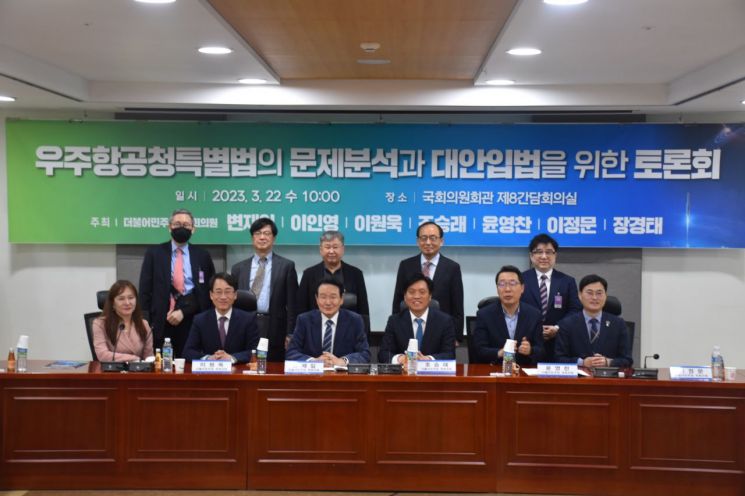
The opening salvo was fired by Professor Shin Heung-gyun of Kookmin University. As the president of the Korean Society of Air and Space Law, Professor Shin pointed out the problems of the special law in detail. The main point was that the agency should be established as an independent ministry, not as an institution under the Ministry of Science and ICT. Although the special law intends to grant the Space Aviation Agency comprehensive and coordinating functions for space policy, in reality, it is placed under the Ministry of Science and ICT, which imposes significant limitations. This results in no differentiation from the existing system and rather strengthens the authority of the Ministry of Science and ICT. He stated, "According to our Constitution and Government Organization Act, central administrative agencies under a specific ministry cannot have rule-making authority, and the rules for the Space Aviation Agency's operations will be enacted and interpreted by the Ministry of Science and ICT." He criticized, "The special law will expand the Ministry of Science and ICT's duties rather than guarantee comprehensive functions and will relatively reduce the duties of other ministries." He further argued, "Despite the need for an administrative agency with comprehensive space aviation functions in response to the expectations of the private space aviation industry, the legislative bill that allows the Ministry of Science and ICT to perform de facto comprehensive functions is inappropriate," adding, "Rather than comprehensive functions, performing the role of coordinating competition among administrative ministries might contribute to space aviation."
There were also criticisms that the special law failed to properly organize the role and function distribution between existing research institutions and the Space Aviation Agency. Professor Jang Young-geun of Korea Aerospace University said, "We need to create a space organization suitable for Korea's circumstances," and pointed out, "The Korea Aerospace Research Institute (KARI) has been conducting research and development for 30 years, so if the Space Aviation Agency is to become a research and development-centered institution, what will happen? Either upgrade KARI to the Space Aviation Agency or abolish it." He also warned, "The military and the Space Aviation Agency are separately conducting space development, which inevitably leads to duplication. Recently, the military has been conducting research that KARI did 30 years ago," emphasizing, "There is a need to coordinate and organize these overlaps."
There was also a point made that Korea should not simply follow the example of the United States, which spends over 30 trillion won in national budget and has a thriving private space industry. The purpose of the special law, which focuses on space industry activation and fostering the space economy, was criticized as misguided. Professor Lee Hyung-mok, emeritus professor at Seoul National University, said, "We need to present a vision of why space, and if it's only about industrial promotion, shouldn't the Ministry of Trade, Industry and Energy handle it? The space economy does not resonate with the Korean public," adding, "NASA emphasizes solving national challenges through space technologies obtained from space science research and planetary exploration. Approaching space development solely from an industrial perspective is not correct."
At the forum, opposition lawmakers clearly expressed their opposition to the government's special law and announced plans to submit alternative legislation, signaling a direct confrontation ahead. Rep. Cho said, "No one denies the need for a dedicated space agency," but added, "We cannot accept it unilaterally just because it was a presidential campaign pledge. We will submit our own bill to the National Assembly next week and engage in full discussions alongside the government's proposal." He also mentioned a plan to gradually strengthen space development governance, such as elevating the chairperson of the National Space Committee from the Prime Minister to the President, establishing a dedicated space agency directly under the President to oversee execution, and entrusting research and development (R&D) to existing research institutions like KARI, as was pledged by Democratic Party candidate Lee Jae-myung during the last presidential election.
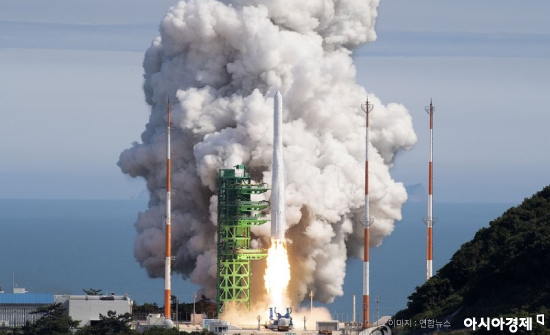
Rep. Jang Kyung-tae also stated, "There are opinions that the government's bill will not lead to the development of the space aviation industry but rather turn into another 'Space Science and Technology Agency,'" and argued, "Accurate and calm collection and review of as many opinions as possible are necessary." Rep. Byun Jae-il pointed out, "The bill does not reflect the characteristics of space development, which proceeds through intergovernmental cooperation, and the roles are ambiguous," adding, "It is difficult to expect the Ministry of Science and ICT's affiliated agency to serve as a space control tower encompassing the Ministry of National Defense, Ministry of Trade, Industry and Energy, National Intelligence Service, and others." He also mentioned, "There is controversy over whether the unprecedentedly generous privileges for hiring private experts are appropriate."
Faced with this concentrated attack, the Ministry of Science and ICT also struggled to explain. Cho Seon-hak, Director of the Mega Public Research Policy Division at the Ministry of Science and ICT, who attended the forum representing the government, cited NASA's establishment process as an example and explained, "We will significantly strengthen authority in personnel, organization, and budget compared to other agency-level organizations to guarantee independence, unify space administration, and secure the status of an independent ministry." He also clarified, "The chairperson of the Space Committee will be elevated to the President to have integrated and coordinating functions across ministries." He added, "Other agency-level organizations also broadly define their scope of work in their establishing laws. We will allocate specific duties and define roles through subordinate legislation in the future. During this process, we will continuously collect opinions from academia, experts, and industry."
© The Asia Business Daily(www.asiae.co.kr). All rights reserved.
![Clutching a Stolen Dior Bag, Saying "I Hate Being Poor but Real"... The Grotesque Con of a "Human Knockoff" [Slate]](https://cwcontent.asiae.co.kr/asiaresize/183/2026021902243444107_1771435474.jpg)
















