Resolution Without Expanding the Number of Assembly Members
Scheduled for Adoption by the Political Affairs Special Committee on the 22nd
Plenary Meeting to be Convened from the 27th
The National Assembly's Special Committee on Political Reform is expected to adopt a "Resolution on the Improvement of the National Assembly Election System" with the section on expanding the number of lawmakers removed. If the resolution is adopted at the plenary session, full-scale discussions on election system reform will begin at the National Assembly's plenary committee starting on the 27th.
On the 22nd, Jeon Jae-su, the Democratic Party's secretary of the Special Committee on Political Reform, told this publication in a phone interview, "Negotiations are underway regarding the wording of the resolution," adding, "If there are no major issues at the full committee meeting of the Special Committee on Political Reform held at 5 p.m., it will be adopted."
Earlier, the Subcommittee on Political Relations Law Improvement of the Special Committee on Political Reform accepted the proposal from the Speaker's Advisory Committee and suggested ▲Option 1: Single-member district system + regional and parallel proportional representation system ▲Option 2: Single-member district system + regional and semi-linked proportional representation system ▲Option 3: Large multi-member district system (urban-rural mixed district system) + regional and parallel proportional representation system. The problem was that the single-member district system options included a plan to increase the number of National Assembly seats by 50, which became controversial as it was accepted as an agreement between the ruling and opposition parties to increase the number of lawmakers.
The controversial section regarding the number of lawmakers will be removed. Rep. Jeon explained, "The part related to the number of lawmakers will be revised."
Kim Jin-pyo, the Speaker of the National Assembly, also appeared on CBS Radio's "Kim Hyun-jung's News Show" on the same day and said, "Options 1 and 2 are a good combination, but the wording regarding increasing the number of lawmakers will be changed slightly," adding, "The full committee's resolution will change the wording and remove things like 'plus 50' (an increase of 50 lawmakers)."
Although the controversy over the number of lawmakers has been temporarily excluded, the possibility remains that it could be revived during the National Assembly's discussions.
Among the election law amendment bills, several include provisions to increase the number of lawmakers to expand proportional representation seats (such as the bills by Kim Young-bae, Lee Tan-hee, and Lee Eun-joo). Speaker Kim also proposed increasing the number of lawmakers by 10 to expand proportional representation seats, based on freezing total personnel expenses and reducing constituency lawmakers, during a press briefing on the 21st.
If the resolution is adopted by the Special Committee on Political Reform, it will be adopted at the plenary session on the 23rd, followed by convening the plenary committee from next week. Regarding this, Speaker Kim said, "I have promised to participate (in the plenary committee), and negotiations are currently underway."
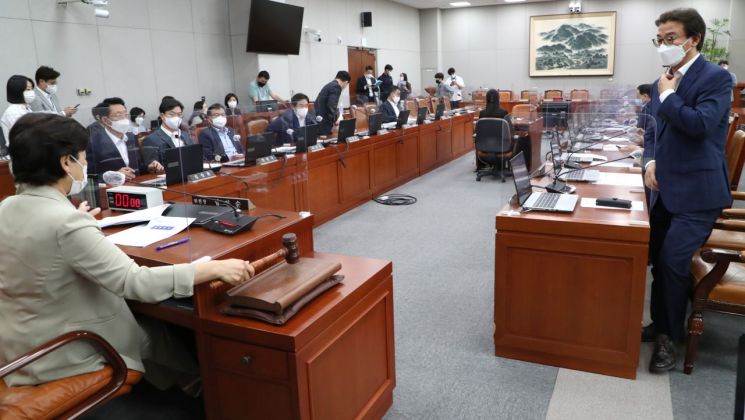
The floor leaders of the ruling and opposition parties previously agreed to open the plenary committee on the 27th to discuss election system reform. The plenary committee is a meeting where all National Assembly members, including the Speaker, participate. The Speaker's office stated, "Up to 60 people can participate in the discussions each day," and added, "We will raise the atmosphere for election system reform and increase public interest through live broadcasts and other means."
Regarding the operation of the plenary committee, Speaker Kim said, "Each lawmaker will consult with their respective parties, and the three main parties in the National Assembly will generally conduct discussions and negotiations to reach a consensus," adding, "I hope this will be the first step in institutionalizing so-called cooperation politics that creates dialogue and compromise, rather than politics that amplifies confrontation and conflict, which our politics is currently criticized for."
© The Asia Business Daily(www.asiae.co.kr). All rights reserved.