The government has judged that the semiconductor support law (CSA) guardrail provisions announced by the United States are favorable, considering that our companies in China can upgrade their technology. This decision comes as the U.S. will not impose restrictions on expanding production scale per wafer in countries of concern such as China through technological development. However, since external uncertainties such as U.S. export controls on semiconductor equipment to China still exist, the government plans to continue consultations with the U.S. side to ensure that our semiconductor industry receives sufficient support locally.
According to the Ministry of Trade, Industry and Energy on the 22nd, the CSA guardrail provisions announced by the U.S. the day before were evaluated to have resolved uncertainties for our semiconductor companies in China. Earlier, the U.S. Department of Commerce disclosed detailed regulations of the guardrail provisions designed to ensure that CSA subsidies are not used for purposes that undermine national security.
The core of the provisions limits semiconductor production capacity expansion in China by more than 5% for 10 years after receiving CSA investment subsidies. However, technological upgrades such as increasing production scale per wafer through technological development will not be regulated. An official from the Ministry of Trade, Industry and Energy explained, "The important point in the U.S. semiconductor support law is whether our companies can perform technological upgrades to continue operating production facilities in China," adding, "Since the relevant regulations were not included in this provision, uncertainties have been greatly reduced."
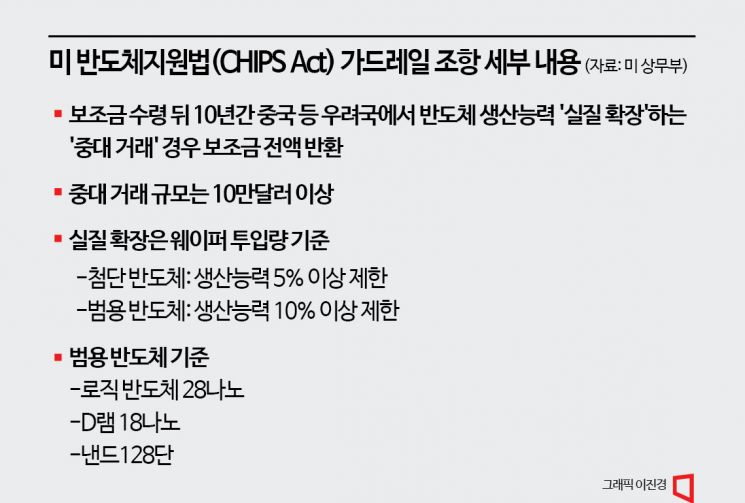
After reviewing the detailed guardrail regulations announced this time, the government judged that our companies can continue to maintain and partially expand production facilities operating in China, as well as perform technological upgrades. In particular, it is expected that additional production expansion will be possible depending on corporate strategies, as technological upgrades can increase the number of chips per wafer through increased integration density. Since the guardrail provisions include a 60-day public comment period, the government plans to communicate with the domestic semiconductor industry, analyze the detailed contents thoroughly, and conduct further consultations with the U.S. side.
However, concerns have not been completely resolved. Although the guardrail provisions do not restrict technological upgrades at Chinese factories, global semiconductor equipment companies are still subject to U.S. export controls on semiconductor equipment to China. Our semiconductor companies received a one-year grace period last October, but it is uncertain whether this grace period will be extended this year. Additionally, companies receiving CSA investment subsidies are subject to restrictions on joint research and technology licensing related to sensitive technologies and items concerning entities of concern and national security, which also requires careful review. The Ministry of Trade, Industry and Energy stated, "We plan to make every effort to consult with the U.S. Department of Commerce and other relevant authorities to minimize uncertainties and burdens that major issues such as U.S. export controls on semiconductor equipment to China impose on our semiconductor industry."
© The Asia Business Daily(www.asiae.co.kr). All rights reserved.
![Clutching a Stolen Dior Bag, Saying "I Hate Being Poor but Real"... The Grotesque Con of a "Human Knockoff" [Slate]](https://cwcontent.asiae.co.kr/asiaresize/183/2026021902243444107_1771435474.jpg)















