Deliberate Scar-Making Challenges Trend on Faces
Governments Worldwide Criticize "TikTok Neglecting Harmful Content"
Among Italian teenagers, a challenge that involves creating scars on the face through the Chinese video-sharing platform 'TikTok' is gaining popularity. Concerns are rising as dangerous challenges continue to spread among adolescents.
'French Scar Challenge' Imitating French Gangsters
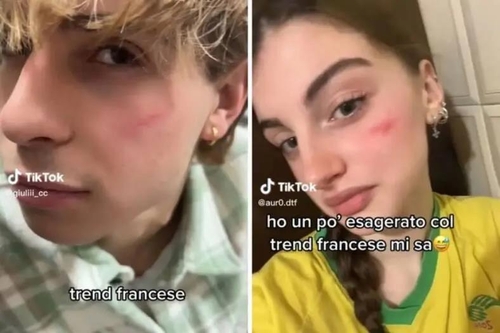
Recently, among Italian teenagers, a challenge has become popular where participants pinch each other's faces or pinch their own faces to artificially create scars.
The method mainly involves pinching the cheekbone area with fingers to burst the capillaries under the skin, creating a long, red bruise in the shape of a stripe.
This is called the 'French Scar Challenge' as it imitates the appearance of French gangsters.
The scars created this way disappear naturally after a few days, but in severe cases, laser treatment may be necessary. If done incorrectly, it can result in permanent scars.
In response, the Italian Competition Authority has launched an investigation, reporting that TikTok neglected harmful content that incites self-harm among teenagers.
'TikTok Challenges' Taking Teen Lives
The previously popular 'Blackout Challenge' involves choking or pressing the chest until unconsciousness to experience a sensation similar to hallucination. It is also called the 'Choking Challenge' or 'Pass Out Challenge.'
When oxygen to the brain is suddenly cut off by choking or chest compression, as in the 'Blackout Challenge,' the body cannot take defensive measures and falls into hypoxia. This poses risks of physical disabilities, seizures, and other functional impairments, and in severe cases, memory loss or death.
In December last year, 20 teenagers were reported dead due to the 'Blackout Challenge.'
The 'Sedative Challenge' involves several people taking sedatives together and seeing who stays awake the longest. In February, 15 elementary school students in Mexico were hospitalized due to sedative misuse.
This challenge also carries the risk of drug addiction and can cause symptoms such as nausea, rapid heartbeat, and difficulty breathing. In severe cases, it can lead to brain damage or death.
Other challenges include the 'Benadryl Challenge,' where large amounts of antihistamines are taken to induce hallucinations, and the 'Skull Breaker Challenge,' where two people simultaneously kick the calf of one person from the side to make them fall. These challenges have also caused deaths and brain injuries.
'TikTok Challenge' Fuels Theft Crimes
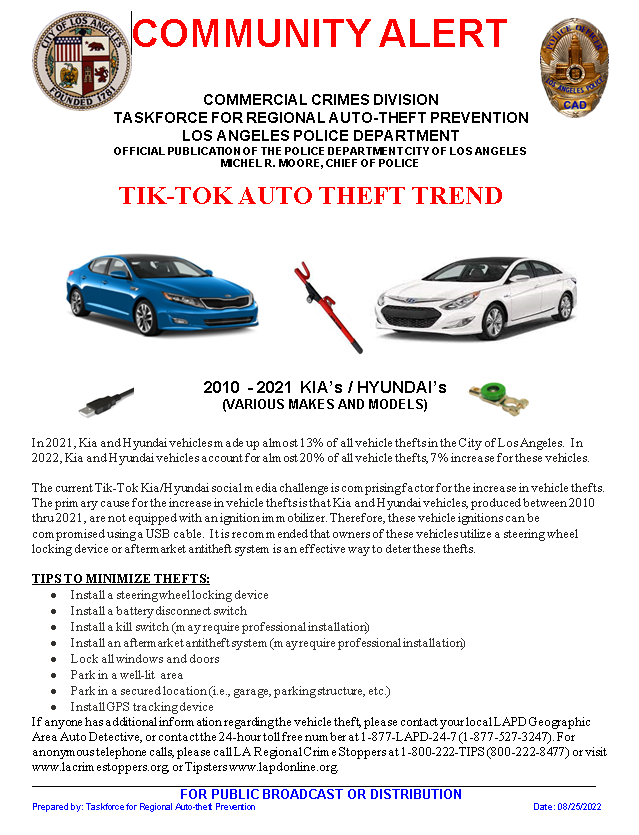
Last year, theft crimes targeting Hyundai and Kia vehicles became popular among American teenagers as the so-called 'Hyundai-Kia Challenge.' This was because a method to steal certain older models lacking anti-theft ignition control devices was shared on TikTok.
In Chicago, Illinois, over 7,000 Hyundai-Kia theft cases occurred last year, and in Minneapolis, Minnesota, vehicle thefts were linked to 5 murders and 265 car accidents. In New York State, six teenagers stole vehicles as part of the challenge, causing collisions that resulted in 4 deaths and 2 injuries.
This issue remains ongoing, prompting prosecutors from 23 U.S. regions to demand Hyundai and Kia strengthen their anti-theft measures.
South Korea's 'Fire Heart Challenge' Embracing Fire and Burn Risks
South Korea has also not escaped the trap of dangerous challenges. Alongside previously popular challenges, the recent 'Fire Heart Challenge' is spreading.
The 'Fire Heart Challenge' involves drawing hearts or a lover's initials on walls or floors with eye spray and then setting them on fire.
The eye spray that catches fire burns instantly, emitting flames.
This challenge mainly takes place on residential walls, and with the recent dry weather, frequent fires have become a bigger problem. Moreover, if the flames spread to hair or clothing, it can cause severe burns, making it very dangerous.
TikTok's Endless 'Playing Dumb'
TikTok faces criticism for negatively impacting minors' mental health due to the sharing of harmful and dangerous videos related to such incidents and challenges. It is explained that TikTok did not take special measures and indiscriminately exposed harmful videos, encouraging teenagers to participate.
In the U.S., parents of teenagers who died from the 'Blackout Challenge' have sued TikTok.
Parents pointed out that "due to TikTok's algorithm, the Blackout Challenge was deliberately and repeatedly exposed to children." They also claimed that TikTok failed to warn minors and parents about the existence of life-threatening harmful content.
In response, TikTok introduced a measure to limit service usage time for teenage users.
TikTok explained that to raise awareness about addiction among teenage users, after 60 minutes, a lock screen automatically appears, restricting usage. To continue using TikTok, users must enter a preset password.
However, this measure is not mandatory but depends on the choice of teenage users. TikTok said it would encourage teenagers who use the app for more than 100 minutes a day without selecting the 60-minute limit to set their own usage limits, but many doubt its effectiveness.
Additionally, since teenagers are a generation familiar with digital technology and are already adept at bypassing parental control devices, many argue that this measure will lack practical effectiveness.
© The Asia Business Daily(www.asiae.co.kr). All rights reserved.
![Clutching a Stolen Dior Bag, Saying "I Hate Being Poor but Real"... The Grotesque Con of a "Human Knockoff" [Slate]](https://cwcontent.asiae.co.kr/asiaresize/183/2026021902243444107_1771435474.jpg)

















