When the proposal to increase the number of National Assembly members by 50 faced public backlash and fizzled out, Speaker Kim Jin-pyo presented a compromise plan to reduce 10 constituency seats, increase proportional representation seats, and raise the total number of members by only 10, bringing the total to 310 seats.
On the 22nd, Speaker Kim said on 'CBS Kim Hyun-jung's News Show,' "Increasing the number of members is difficult because political distrust toward the National Assembly reaches 81%, so I think it can only be done within such a minimal scope," adding, "The advisory committee's proposal to increase by 50 members is a difficult idea."
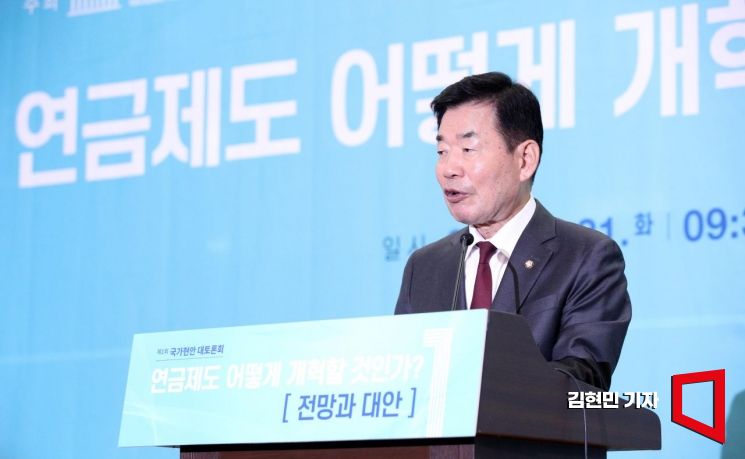 Speaker of the National Assembly Kim Jin-pyo is delivering a greeting at the 1st National Issues Grand Debate "How to Reform the Pension System" held at the National Assembly Members' Office Building in Yeouido, Seoul on the 21st. Photo by Kim Hyun-min kimhyun81@
Initially, the advisory committee directly under Speaker Kim proposed an electoral reform plan centered on increasing the number of members by 50, and the Political Reform Special Committee (PRSC) subcommittee decided to submit this plan to the plenary session. However, it fell apart as the People Power Party opposed the expansion of the number of members.
In response, Speaker Kim said, "If we go with a single-member district system, political reform cannot achieve all its goals at once, so how about reducing the number of constituency seats a bit?" He added, "Since proportional representation seats need to be increased, if we reduce about 10 seats there and if the ruling and opposition parties agree, we can say to the public, 'We have reduced about 10 seats, so please allow us to increase only 10 seats.' That would allow for a minimal increase in proportional representation."
Daegu Mayor Hong Joon-pyo expressed opposition to the discussion on expanding the number of National Assembly members, saying, "80 members are enough." In response, Speaker Kim said, "Compared to the OECD average, the number of National Assembly members in our country is somewhat low," adding, "But since we are already said to be on the threshold of a developed country, increasing the number a bit aligns with the overall principle of proportional representation." The OECD average is one member per 80,000 people, while in South Korea, it is one member per 170,000 people.
He also viewed the mixed urban-rural multi-member district system positively from the perspective of 'co-governance.' He said, "The proportion of people whose hometown is in the metropolitan area is only about 15% regardless of the region, and political decision-making is centered around hometown associations, so in a way, a mixed urban-rural system suits our country," adding, "If we move to a mixed urban-rural (multi-member district) system instead of a single-member district system, it can institutionalize multi-party systems and co-governance better."
One downside of the multi-member district system is the deepening of 'factional politics.' In particular, Japan returned to a single-member district system as factional politics worsened. Regarding this, Speaker Kim said, "In Japan, factional politics did not arise from the multi-member district system but rather from the old samurai tradition of 'oyabun' (boss)," adding, "Many European countries use multi-member district systems, and in those countries, such factional political problems do not seem to appear much."
© The Asia Business Daily(www.asiae.co.kr). All rights reserved.
![Clutching a Stolen Dior Bag, Saying "I Hate Being Poor but Real"... The Grotesque Con of a "Human Knockoff" [Slate]](https://cwcontent.asiae.co.kr/asiaresize/183/2026021902243444107_1771435474.jpg)















