"Must Benchmark Japan's Reduction Strategy"
"Urgent Development of Korea-style International Reduction Model"
"Urgent Development of Korea-style International Reduction Model"
A claim has been made that, to achieve global carbon reduction, international reduction projects should be expanded by increasing intergovernmental agreements like Japan.
The Federation of Korean Industries (FKI) stated on the 22nd that Korea should benchmark Japan's international reduction strategy, which proactively responded to the 'Paris Agreement' framework, and work on developing a Korean-style international reduction model and strengthening international cooperation between Korea and Japan.
Japan prepared in advance for the launch of the Paris Agreement framework established in 2015 and has internationally expanded its self-developed international reduction model, the Joint Crediting Mechanism (JCM), over about 10 years since 2013.
The basic structure of the JCM is that when Japanese companies engage in greenhouse gas reduction activities in countries that have signed agreements, the reduction results are shared through negotiations between the two countries. Japan has signed bilateral agreements with a total of 25 countries and is conducting 76 international reduction projects in 15 countries (as of November 2022).
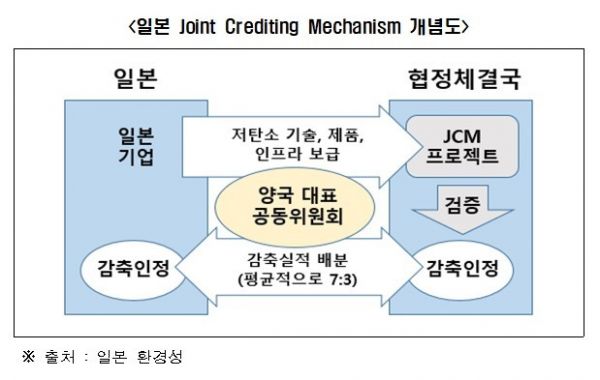
In the report submitted to the United Nations Framework Convention on Climate Change (UNFCCC) on the enhanced greenhouse gas reduction target (NDC), Japan specified that it aims to secure up to 100 million tons of international reduction results through the JCM by 2030.
Korea had previously targeted 33.5 million tons of international reduction by 2030 but raised this target to 37.5 million tons on the 21st. However, the only country with which Korea has signed an international reduction project agreement is Vietnam, and the only achievement so far is a partial securing of reduction results (110,000 tons) through equity investment in a biogas power generation project in Uzbekistan earlier this year.
The FKI explained, "It is necessary to consider large-scale international reduction projects utilizing nuclear technology, where Korea has strengths," adding, "While nuclear power was not recognized as a reduction method under the Kyoto Protocol framework, the Paris Agreement framework does not impose special technical restrictions."
Furthermore, in line with recent improvements in Korea-Japan relations, it called for the resumption of cooperation with Japan for carbon reduction and urged the reopening of government-level working communication channels such as the 'Korea-Japan Environmental Cooperation Joint Committee,' which has been suspended since 2018.
Choo Kwang-ho, head of the Economic and Industrial Headquarters at FKI, emphasized, "Although some criticism argues that domestic reduction should take priority over expanding international reduction projects, the Paris Agreement framework rather encourages various forms of international reduction activities through voluntary cooperation between countries," adding, "It is necessary to qualitatively and quantitatively expand future international reduction projects to help expand overseas opportunities for our companies and to leap forward as a global carbon-neutral hub country."
© The Asia Business Daily(www.asiae.co.kr). All rights reserved.
![Clutching a Stolen Dior Bag, Saying "I Hate Being Poor but Real"... The Grotesque Con of a "Human Knockoff" [Slate]](https://cwcontent.asiae.co.kr/asiaresize/183/2026021902243444107_1771435474.jpg)















