Government Plans to Reduce Allocations Despite Increasing Factory Emissions
Free Allocations at 3.74 Million Tons, Offset and Additional Allocations Still 2.99 Million Tons Short
Applying Last Year's Closing Price Equals 47.9 Billion Won... Samsung Electronics "Minimize Emission Permit Purchases"
Samsung Electronics emitted 3.74 million tons more greenhouse gases than the government’s allocated emission allowances last year. Even after receiving additional allocated emission permits and having external greenhouse gas reduction achievements recognized, the company still needs to secure 2.99 million tons more emission permits. Rather than adopting a strategy of reducing emissions below the government allocation to sell permits on the market when permit prices rise, Samsung Electronics has decided to focus on reducing emissions itself. However, it is expected to become increasingly difficult to reduce greenhouse gases as the company plans to invest 300 trillion won over 20 years to build five more foundry (semiconductor contract manufacturing) plants.
Under the Emissions Trading Act, companies must submit an emission statement to the government. After the government reviews the statement and records the emissions in the registry, companies must purchase and submit emission permits equivalent to the certified emissions. If the emission permits are less than the certified emissions, companies must pay a fine of up to three times the average market price of emission permits.
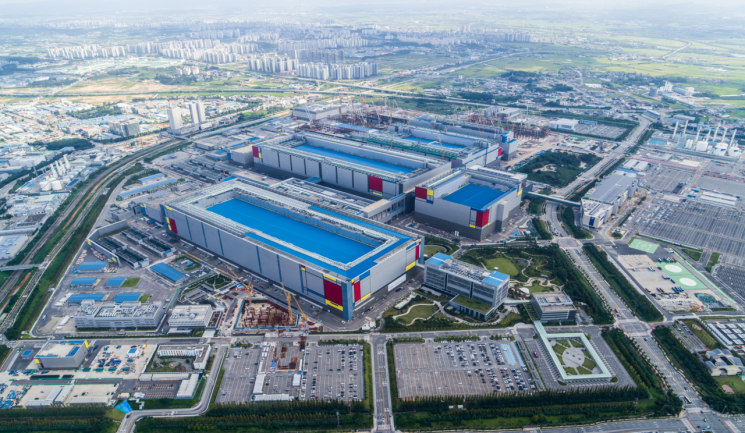
Samsung Electronics emitted 15.21 million tons of greenhouse gases last year. Even combining the government’s free allocation of 11.47 million tons, offset emission permits (KCU) of 760,000 tons, and additional allocated permits of 5,372 tons, the company still needs to secure an additional 2.99 million tons of emission permits. KCUs are certificates of greenhouse gas reduction activities outside the workplace converted into physical permits. The emission permits commonly traded on the market are called KAUs, and 1 KAU has the same effect as 1 KCU.
Additional allocated permits refer to emission permits that companies secure additionally by reporting new facility expansions to the Korea Environment Corporation. Based on the additional 2.99 million tons of permits needed and using the government’s calculation formula with last year’s year-end closing price (16,000 won per ton), the simple calculation of Samsung Electronics’ emission permit cost is 47.9 billion won. An official from the Ministry of Environment stated, "The amount of greenhouse gas emission permits purchased in the relevant year should be calculated by subtracting not only the free allocation but also additional allocations and KCU submissions from the actual emissions."
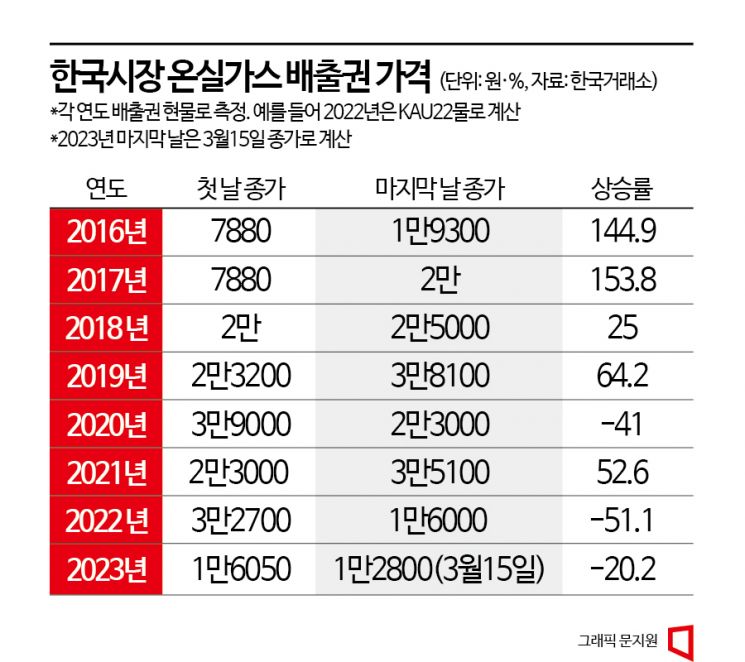
The problem is that government free allocations are decreasing while Samsung Electronics’ greenhouse gas emissions are increasing. The government has been criticized for allocating too many emission permits to companies. It is pointed out that companies do not actively engage in greenhouse gas reduction activities but still have surplus permits to sell to companies lacking permits. The government has accepted the criticism and announced plans to increase the current 10% proportion of paid emission allocations. Increasing the proportion of paid allocations is equivalent to reducing free allocations. This is why Samsung Electronics cannot be complacent even though it is classified as a free allocation industry (semiconductor manufacturing). The fact that the European Union (EU) has a paid allocation proportion as high as 70% is also not negligible. Matching the EU’s paid allocation proportion would increase the cost of purchasing emission permits by seven times.
On the other hand, Samsung Electronics is in a position where it must increase production. Perfluorocarbons used in semiconductor cleaning and etching processes and sulfur hexafluoride used in deposition processes are greenhouse gases managed by emission permits. The more semiconductor production increases, the more emissions inevitably rise. Last year, the DS (semiconductor) division accounted for 89.7% of Samsung Electronics’ greenhouse gas emissions. The DS division must invest in facilities even if emission permit costs increase. This is because it believes that catching up with the production capacity of Taiwan’s TSMC, the world’s number one foundry, is necessary to narrow the market share gap of about four times.
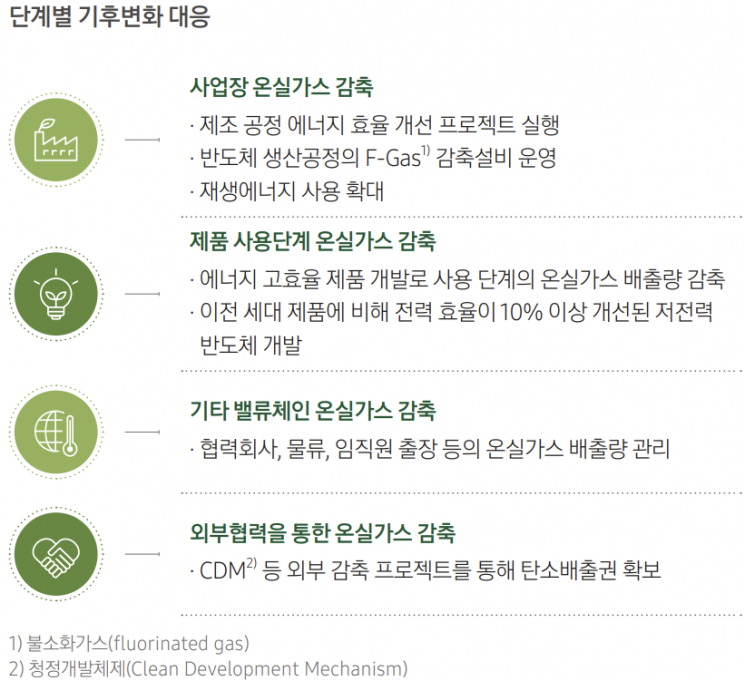
Samsung Electronics has decided to reduce emissions themselves rather than adjusting emissions to resell based on emission permit prices. To this end, the company declared in September last year that it would join RE100. RE100 is a global campaign to source 100% of electricity from renewable energy by 2050. In 2018, it installed solar and geothermal power facilities covering 63,000㎡ at its Suwon, Hwaseong, and Pyeongtaek campuses. In 2021, it purchased 490 GWh of renewable energy. The 490 GWh is roughly equivalent to the monthly electricity consumption of about 1,618,892 households in Seoul, based on a four-person household.
In last year’s Sustainability Management Report, the company stated, "Since the price of greenhouse gas emission permits is directly linked to business competitiveness in the semiconductor industry, which consumes a large amount of electricity, it is included in the company-wide risk management system and is being managed," adding, "We will minimize the purchase of emission permits through greenhouse gas reduction activities."
© The Asia Business Daily(www.asiae.co.kr). All rights reserved.
![Clutching a Stolen Dior Bag, Saying "I Hate Being Poor but Real"... The Grotesque Con of a "Human Knockoff" [Slate]](https://cwcontent.asiae.co.kr/asiaresize/183/2026021902243444107_1771435474.jpg)


















