Proposed De Facto Working Hours Cap at State Council Meeting
Urged Strict Response to Abuse of Comprehensive Wage System
Labor Reform Responsibility Also Changed to 'Senior' Chief of National Policy Planning
To Secure Momentum and Strengthen Party-Government Consultations
President Yoon Suk-yeol stated on the 21st, "I still believe that working more than 60 hours per week is excessive from a health protection perspective," directly expressing his opinion on the reconsideration of the working hours system reform plan (reform plan), which centers on a maximum of 69 working hours per week, and the cap on working hours. It is interpreted that President Yoon personally stepped in to calm the controversy as presidential office officials had repeatedly engaged in public persuasion since last week, but the debate did not subside.
In his opening remarks at the Cabinet meeting held at the Yongsan Presidential Office that morning, President Yoon said, "There should be no suspicion or anxiety regarding workers' health rights, rest rights, and fair compensation through the prevention of abuse of the comprehensive wage system."
This was the first time in a month since the presidential office live-streamed President Yoon’s remarks at the Cabinet meeting on the 21st of last month, expressing determination to eradicate illegal activities at construction sites and labor reform. As public opinion toward the presidential office and government became unfavorable, President Yoon personally took time to explain, fearing a weakening of national governance momentum.
Regarding the reform plan, after President Yoon first instructed on the 14th to reconsider the bill promotion by listening to the opinions of the MZ generation (born from the early 1980s to early 2000s), senior officials at the vice-minister level or higher announced their positions alternately four times, totaling six statements. The government also met with the MZ generation’s new labor union, which issued a statement opposing the maximum 69 working hours per week, to gather opinions.
However, criticism has not subsided due to inconsistent remarks about the cap on working hours. On the 16th, Ahn Sang-hoon, Senior Secretary for Social Affairs, conveyed President Yoon’s view that working more than 60 hours a week is excessive, but presidential office officials later clarified that they were explaining working hours flexibility and that the 60-hour workweek was not meant to be a cap.
Despite these announcements, the deteriorated public opinion is directly reflected in President Yoon’s approval rating for national governance. According to a public opinion poll conducted by Realmeter commissioned by Media Tribune from the 13th to the 17th, surveying 2,505 voters nationwide, President Yoon’s positive evaluation of his governance dropped 2.1 percentage points from the previous week to 36.8%. This marks a decline for two consecutive weeks (42.9% → 38.9% → 36.8%). Negative evaluations of President Yoon rose by 1.5 percentage points to 60.4%. Notably, negative evaluations increased by 4.3 and 4.9 percentage points among the core support generations of those in their 60s and 70s or older, respectively. (The sampling error is ±2.0 percentage points at a 95% confidence level, with 97% wireless and 3% wired methods, and a response rate of 3.2%. For more details, refer to the Central Election Poll Deliberation Commission website.)
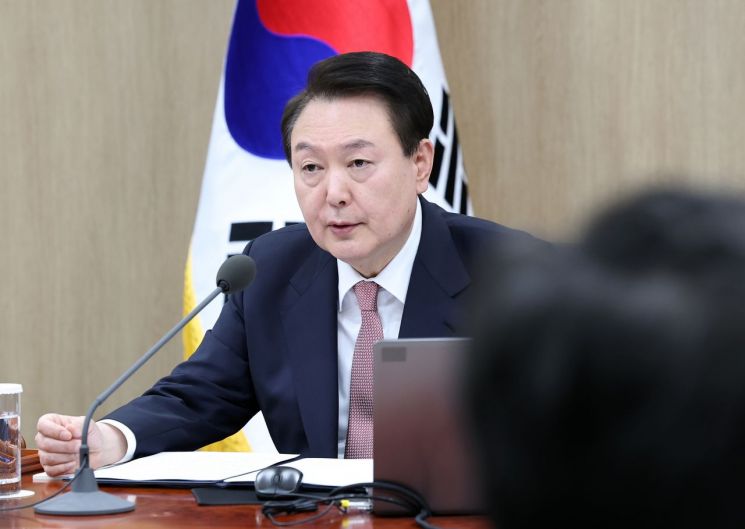
In response, President Yoon reiterated that the working hours reform is aimed at securing labor demand and choice rights for both labor and management, effectively providing guidelines on working hours. He emphasized again, "If the upper limit of weekly working hours is not set, it is realistically difficult to protect the health rights of vulnerable workers," adding, "Simply allowing the labor-management agreement range on working hours to be freely set on a monthly, quarterly, semi-annual, or annual basis instead of weekly will broaden the choices for both sides and allow flexible responses to labor demand."
At the Cabinet meeting that day, President Yoon also urged Cabinet members and presidential office aides to carefully consider the impact on vulnerable workers with low bargaining power regarding working hours flexibility and to formulate policies meticulously. A senior presidential office official said, "During the Cabinet meeting, he instructed to make thorough measures to protect vulnerable workers who have low bargaining power with management." This reflects the need for the government to respond thoroughly, given the widespread dual structure of the labor market and the potential for abuse of the comprehensive wage system.
To further secure momentum for labor reform, including the working hours reform, President Yoon also changed the person in charge of labor reform within the presidential office. The official said, "President Yoon recently transferred labor reform responsibilities from Senior Secretary for Social Affairs Ahn Sang-hoon to Senior Secretary for National Planning Lee Gwan-seop." This decision was made because Lee, as the senior among the secretaries and the one overseeing policy, needs to communicate closely with the government and ruling party to accelerate core policy promotion and eliminate side effects. On the 19th, Kim Dae-gi, Chief of Staff to the President, emphasized communication with the ruling party at a high-level party-government meeting, stating, "We will strengthen efforts to consult with the party on policies promoted by each ministry to preemptively filter out expected side effects."
© The Asia Business Daily(www.asiae.co.kr). All rights reserved.
![Clutching a Stolen Dior Bag, Saying "I Hate Being Poor but Real"... The Grotesque Con of a "Human Knockoff" [Slate]](https://cwcontent.asiae.co.kr/asiaresize/183/2026021902243444107_1771435474.jpg)















