National Assembly Foreign Affairs Committee Current Issues Report... Evaluation of Korea-Japan Summit
"Continued Trustful Dialogue Between Leaders on the Occasion of G7"
Foreign Minister Park Jin stated that as follow-up measures after President Yoon Seok-yeol's visit to Japan, "we will continue shuttle diplomacy such as Japanese Prime Minister Fumio Kishida's return visit within this year and activate high-level exchanges and communication."
Minister Park said at the Foreign Affairs and Unification Committee plenary session on the 21st that through President Yoon's visit to Japan, "we have laid the foundation for cooperation by enhancing trust between the leaders and confirmed a consensus on future-oriented relationship development."
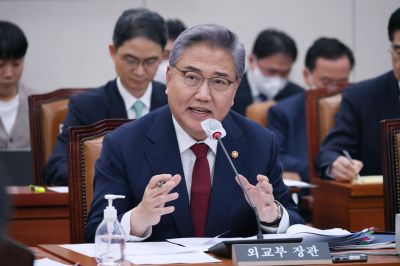 Foreign Minister Park Jin is responding to questions from lawmakers at the Foreign Affairs and Unification Committee plenary session held at the National Assembly on the afternoon of the 21st. [Image source=Yonhap News]
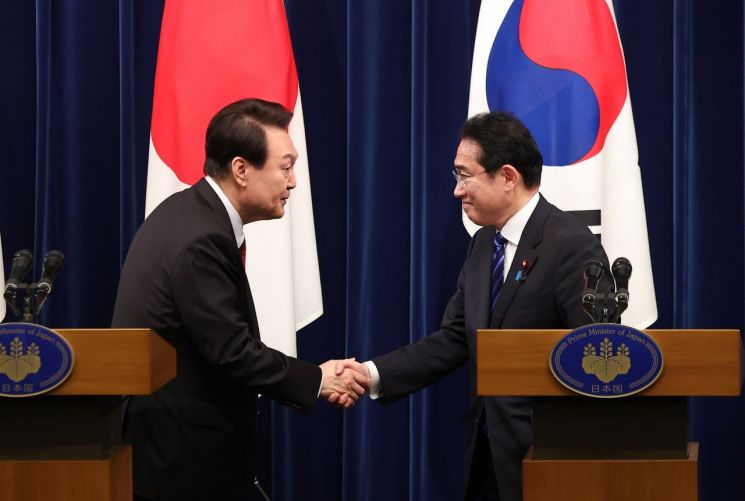
President Yoon held a summit with Prime Minister Kishida in Tokyo on the 16th-17th, just ten days after announcing a Korean-led solution to forced labor issues. Shuttle diplomacy, where the leaders of Korea and Japan visit each other bilaterally rather than attending multilateral meetings, was last conducted during Prime Minister Yoshihiko Noda's visit to Korea in October 2011 and President Lee Myung-bak's visit to Japan in December of the same year.
Currently, President Yoon has also been invited to the G7 summit to be held in Hiroshima in May, where Japan is the chair country. Regarding this, Minister Park mentioned, "We will continue the dialogue of trust and cooperation between the two leaders through the visit during the Hiroshima G7 summit."
Minister Park also emphasized, "This bilateral visit to Japan was realized after 12 years and provided an opportunity to lay the foundation for contributing to peace in Northeast Asia and the world through strengthened cooperation between the two countries," adding, "We will strive to normalize Korea-Japan relations to inspire new pride among our people and bring great benefits to our citizens and businesses."
Furthermore, the Ministry of Foreign Affairs mentioned that it has completed full normalization measures by removing institutional instability of the Korea-Japan General Security of Military Information Agreement (GSOMIA). Minister Park said, "We will also promptly pursue the shortest possible return to the whitelist measures." Although Korea and Japan's trade authorities announced the lifting of Japan's export restrictions on Korea and Korea's withdrawal of the World Trade Organization (WTO) complaint just before the summit, the mutual exclusion from the whitelist (a list of countries receiving simplified export procedures) has not yet been restored.
Meanwhile, Minister Park reaffirmed the position that the forced labor 'third-party compensation' solution through the Foundation for Victims of Forced Mobilization under Japanese Colonial Rule (hereinafter the Foundation) is "not the 'end' of problem-solving but a true 'beginning'." He said, "Japan has stated that it does not take a specific stance on voluntary contributions from the private sector," and added, "We hope that the private sector, including the business community, will voluntarily contribute for the future-oriented development of Korea-Japan relations."
To ensure smooth implementation of the solution, sincere efforts will continue to contact victims and their families individually to provide explanations and increase understanding. It was explained that a separate task force (TF) established within the Foundation and the board of directors will review and approve the payment of judgment funds and distribute them to the plaintiffs.
© The Asia Business Daily(www.asiae.co.kr). All rights reserved.
![Clutching a Stolen Dior Bag, Saying "I Hate Being Poor but Real"... The Grotesque Con of a "Human Knockoff" [Slate]](https://cwcontent.asiae.co.kr/asiaresize/183/2026021902243444107_1771435474.jpg)
















