"Labor Cost Freeze, Efforts to Reduce Constituencies
May Announce About 10 Additional Seats to the Public"
Winner-Takes-All Is the Biggest Problem
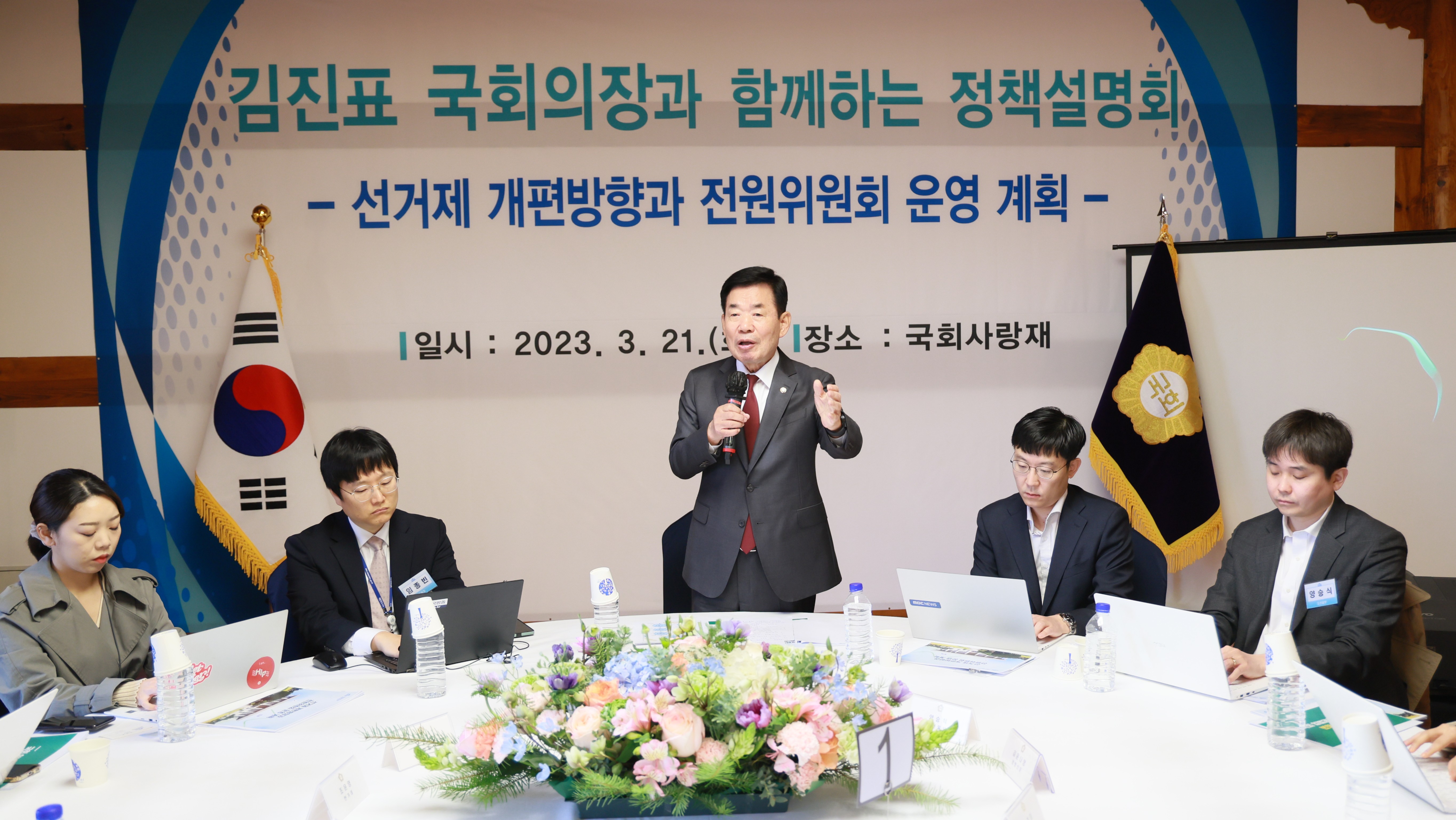
Speaker of the National Assembly Kim Jin-pyo expressed on the 21st that the controversy over the expansion of the number of National Assembly members is a 'misunderstanding.' He also revealed a plan to persuade an increase of about 10 seats in the number of members, based on political efforts such as maintaining the single-member district system, reducing constituencies, and freezing personnel expenses.
At the 'Policy Briefing on the Election System Reform Plan and the Operation Plan of the Plenary Committee' held at the National Assembly that day, Speaker Kim addressed the controversy over the proposal to expand the number of members by 50 seats, saying, "National Assembly members are not fools," and explained, "The misunderstanding arose because the National Assembly Political Reform Special Committee reflected the plan to increase the number by 50 seats, which was proposed by the Speaker's Advisory Committee."
Kim said, "The advisory committee can give opinions, but it was said that it is not easy," and added, "Both the ruling and opposition parties' special committee members and the bipartisan group of lawmakers share the same view."
When asked whether the majority of lawmakers prefer the current single-member district system, he said, "Although the single-member district system seems advantageous right now, once the political landscape changes, they will understand the risks of the single-member district system well," and added, "Currently, lawmakers know only about 50% of the election system issues out of 100%, but this will change through discussion."
Regarding the mixed urban-rural electoral system, he explained that proportionality can be strengthened while maintaining the current number of seats. Kim said, "Adopting the mixed urban-rural system would be a significant change, so reducing about 20 to 25 constituencies without much burden can be done discreetly," and added, "If about 23 seats are added to the existing 47 proportional representation seats, it becomes 70 seats. By dividing proportional representation into 6 to 7 regions and applying open regional parallel systems, the constituency election system can be supplemented."
In the case of maintaining the single-member district system, he said, "According to the Constitutional Court ruling, the population disparity must be maintained at a 2:1 ratio due to the equality of votes issue, but regional disparities have widened," and stated, "In the process of narrowing this gap, about 10 constituencies may be reduced. Adding these 10 seats to the existing proportional representation would make 57 seats, and if lawmakers freeze their salaries and operate with the personnel expenses of 300 people divided among 310 members, efforts could be made to increase about 10 seats, which can be communicated to the public."
He emphasized the necessity of election system reform. He said, "The biggest problem with the current election system is the high rate of wasted votes," and added, "Under the current rules of the game, politics inevitably aims to win, and this method maximizes the consolidation of support within factions." Kim pointed out, "Due to the characteristics of the single-member district system where winning by just one vote more than the opponent leads to victory, the winner-takes-all system has solidified a two-party structure. Since democratization, the average wasted vote rate in elections from the 12th to the 21st National Assembly was a staggering 49.98%, creating a distorted political structure where half of the people's will is ignored."
He also criticized that the winner-takes-all political structure has even corrupted the proportional representation system. He explained that the original purpose of introducing proportional representation was to create a political structure that could represent diverse political forces, but "institutionalizing cooperation has been hindered by the two-party system, and the winner-takes-all structure has ruined proportional representation, turning it into a tool for securing factional warriors." He added, "The proportional representation system must be reformed to represent political diversity," and said, "Even if the current single-member district system is maintained, strengthening and supplementing proportional representation alone could improve politics compared to now."
Kim said, "We need to create a plan that is one or two steps better than the current system, but no one can declaratively say this," and added, "That is why we considered the plenary committee, and if each lawmaker conducts simulations, a common denominator can be created." He said, "It is difficult for a few members of the Political Reform Special Committee to conclude election system reform, which is directly related to the interests of individual lawmakers," and emphasized, "Since election system reform involves creating competition rules in which lawmakers themselves participate, it should be discussed in a plenary committee involving all 300 members, and the plenary committee will be operated based on the three principles of speed, concentration, and deliberation."
© The Asia Business Daily(www.asiae.co.kr). All rights reserved.
![Clutching a Stolen Dior Bag, Saying "I Hate Being Poor but Real"... The Grotesque Con of a "Human Knockoff" [Slate]](https://cwcontent.asiae.co.kr/asiaresize/183/2026021902243444107_1771435474.jpg)















