"Still, it arrived faster than the South-North unification."
Apple Pay has finally landed in South Korea. It has been 9 years since its global service first launched in 2014. During that time, the domestic smartphone and simple payment market has been almost monopolized by Samsung Galaxy. Attention is focused on whether Apple Pay will act as a variable that changes the Galaxy dominance system and the simple payment market landscape.
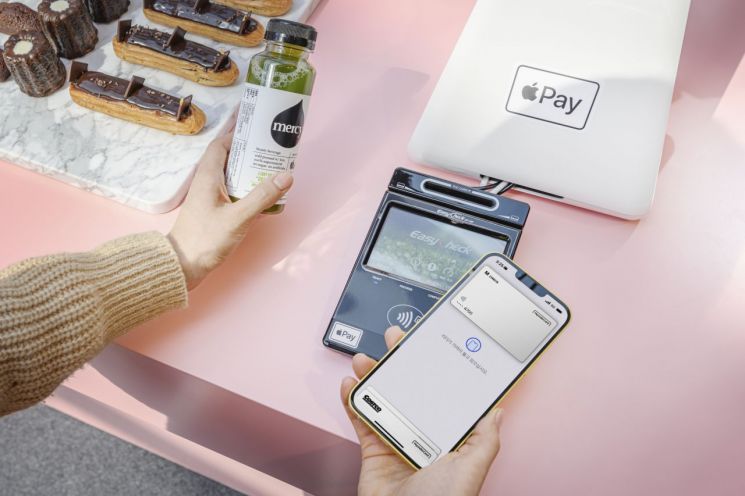
Dunkin Allbee, Head of Apple Pay International, announced at the Apple Pay launch event held on the 21st at Hyundai Card Understage in Yongsan-gu, Seoul, "Apple Pay can be used through iPhone, Apple Watch, iPad, and Mac."
Hyundai Card users can add their cards to Apple Pay and make online, offline, and in-app payments not only at domestic merchants but also at millions of merchants worldwide that support Apple Pay. In South Korea, it can be used at offline merchants such as Costco, Twosome Place, Lotte Department Store, Homeplus, convenience stores, as well as applications (apps) and websites like Baedal Minjok, Musinsa, GS SHOP, Paul Bassett, and Lotte Cinema.
On Apple devices, users can open the Wallet app, click the ‘+’ button, and easily add cards to Apple Pay by following the guided steps. Alternatively, users can click the ‘Add to Apple Wallet’ button in the Hyundai Card app and follow the instructions to set up a valid Hyundai Card for Apple Pay.

Jung Tae-young, Vice Chairman of Hyundai Card, who attended the event, explained, "Hyundai Card is a company very proud of its design, but we removed all of Hyundai Card’s unique designs from Apple Pay displayed on the iPhone and tried hard to fully convey only Apple’s feel. We did this because we understand the hearts of iPhone users who have waited a long time."
The method of using Apple Pay is fast and simple. Double-click the side button (or the home button for Touch ID devices), then hold the iPhone or Apple Watch close to the NFC payment terminal. When making payments on Safari, iOS 16 and later versions of other web browsers, or in-app payments, there is no need to create an account, enter a password, or input payment information. Dunkin Allbee explained, "All Apple Pay payments are authenticated through the user’s Face ID, Touch ID, or device password, so it is secure."
However, Apple Pay lacks versatility. First, Apple Pay cannot be used as a transportation card. In other words, it cannot be used for buses or subways. Also, it is not available at most small stores in South Korea. Apple Pay cannot be used at stores without NFC payment terminals, and only about 10% of the 2.9 million domestic credit card merchants have NFC terminals. Most domestic stores use MST (Magnetic Secure Transmission) terminals. Samsung Pay supports both NFC and MST, meaning Samsung Pay can be used wherever credit cards are accepted.
However, Apple and Hyundai Card expect the spread of NFC terminals to accelerate quickly, given the considerable number of iPhone users in South Korea. Jung Tae-young, Vice Chairman of Hyundai Card, said, "It was frustrating and regrettable that NFC terminal deployment was not progressing well in Korea, but I think we have taken a big step today. Just this morning, 170,000 Hyundai Card users registered for Apple Pay," adding, "Today will be an important milestone for Korean payments."
In response to the launch of Apple Pay, Samsung Electronics has started linking with Naver Pay and Kakao Pay. They are building a joint front with major operators to lock in customers. One of the strengths of Galaxy smartphones in the domestic market has been the simple payment service ‘Samsung Pay.’ Although related operators are on high alert due to the launch of Apple Pay, the actual impact is expected to be limited. It is predicted to grow based on iPhone users rather than having broad scalability.
In China, which introduced Apple Pay before South Korea, local simple payments such as Alipay and WeChat Pay have already dominated the market, resulting in low usage rates. Japan also introduced Apple Pay in 2016 but was overshadowed by PayPay and QuickPay. Counterpoint Research forecasted that by the end of this year, Apple Pay’s daily total transaction amount in South Korea will reach 100 billion KRW. It predicted that Apple Pay will secure a 15% market share in the domestic simple payment market in 2024.
© The Asia Business Daily(www.asiae.co.kr). All rights reserved.
![Clutching a Stolen Dior Bag, Saying "I Hate Being Poor but Real"... The Grotesque Con of a "Human Knockoff" [Slate]](https://cwcontent.asiae.co.kr/asiaresize/183/2026021902243444107_1771435474.jpg)
















