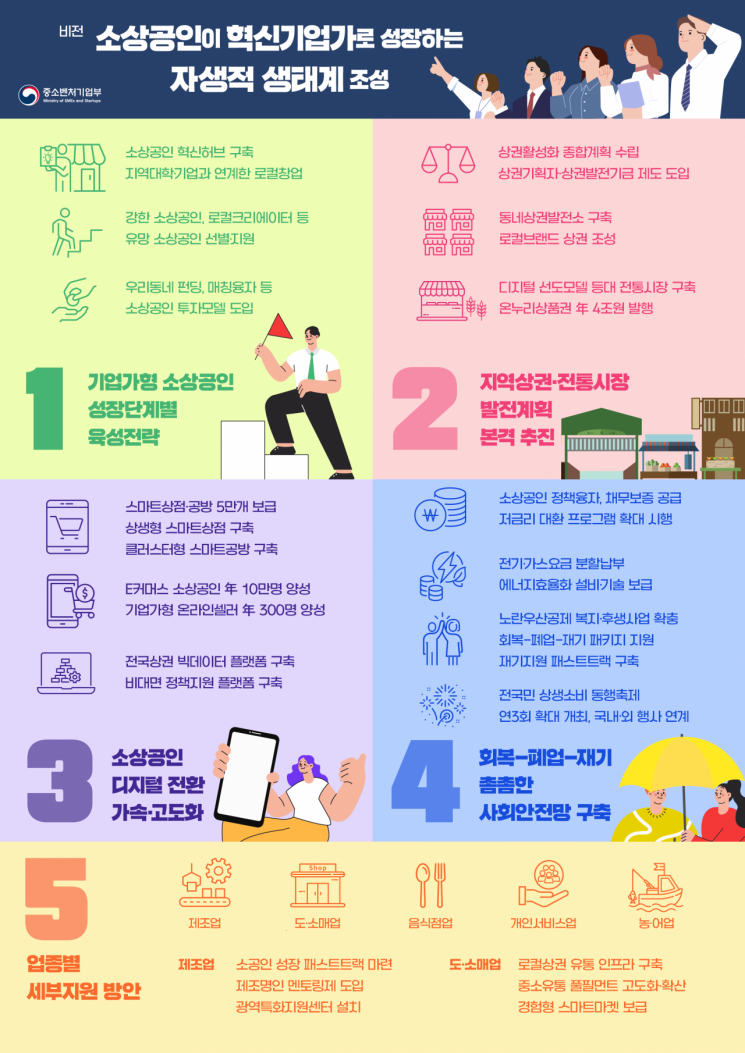
The government will provide tailored support in stages to help small business owners grow into innovative entrepreneurs. It has also prepared measures to enable small business owners to build self-sustainability, including digital transformation and low-interest loan support.
The Ministry of SMEs and Startups announced the "2023-2025 Basic Plan for Supporting Small Business Owners" at the Cabinet meeting on the 21st. This basic plan is a statutory plan established every three years under Article 7 of the Small Business Act.
Over the next three years, the Ministry plans to focus on five key strategies: ▲ nurturing entrepreneurial small business owners by growth stage ▲ promoting regional commercial districts and traditional market development plans ▲ digital transformation of small business owners ▲ establishing a detailed social safety net including recovery, closure, and restart ▲ and detailed support by industry.
First, the Ministry will create a stage-by-stage support system from startup to growth and leap. It plans to discover promising small business owners and nurture local companies led by entrepreneurs expanding globally.
At the startup stage, on-site education and training will be expanded at 17 new business startup academies nationwide. A new "Small Business Innovation Hub" will be established to discover prospective entrepreneurs with creative ideas.
At the growth stage, promising small business owners will be selected by type, such as "Strong Small Business Owners" and "Local Creators." Focused support for commercialization and funding will help them advance their business models and expand their business scale.
At the leap stage, new investment systems suitable for small business owners will be introduced alongside projects like "Our Neighborhood Funding" and "Matching Loans." The plan is to create an investment environment that attracts private capital to promising small business owners, promoting scale-up.
Centered on leading local companies, a "Local Brand Commercial District" with attractive stories linked to regional industry, culture, and content will be built, making it a place everyone wants to visit.
To support the development of commercial districts, institutional foundations will be established by introducing commercial district planners and commercial district development funds that promote the inflow of private innovators and capital.
Support will be provided in stages for commercial district planning, revitalization, and follow-up management, and the "Commercial District Building Project" will be promoted to inject new vitality into commercial districts through public-private collaboration.
For traditional markets, win-win agreements with IT conglomerates will be signed, and digital infrastructure such as dedicated digital personnel and delivery facilities will be supported. Two "Lighthouse Traditional Markets" will be created as leading models that achieve meaningful results through digital transformation.
Onnuri gift certificates will be issued at 4 trillion KRW annually to revitalize traditional market sales. Existing support policies, such as improving accessibility and safety of traditional markets through parking environment improvements and fire insurance, will also be steadily implemented.
By 2025, 50,000 smart stores and workshops will be distributed, and 100,000 "E-commerce Small Business Owners" expanding their business areas online will be nurtured annually.
Advanced forms of smart stores will also be established, such as "Win-win Smart Stores," where large companies transfer leading technology and know-how and share costs, and "Smart Store Model Shops" that introduce various smart technologies by industry. Additionally, a nationwide commercial district big data platform will be built to consolidate commercial district information dispersed across institutions, enabling small business owners to analyze their management environment using data and create new business models.
This year, 3 trillion KRW in policy loans and 25 trillion KRW in credit guarantees will be provided, along with a low-interest refinancing program worth 9.5 trillion KRW from this year through next year. To resolve financial difficulties of small business owners and support debt adjustment for those struggling with loan repayment, a fresh start fund will be provided. To ease the burden caused by interest rate and public utility fee increases, policy loans will be rapidly executed at about 78.3% in the first half of the year. In the second half, household credit loans of self-employed individuals affected by COVID-19 who face management difficulties will also be partially included in the refinancing target.
A "Small Business Growth Fast Track" will be created to nurture small manufacturers with innovative technologies, and a "Local Distribution Infrastructure" will be established to strengthen the logistics competitiveness of wholesale and retail small business owners. In addition, customized support measures by industry, including restaurants, personal services, and agriculture and fisheries, will be promoted.
Minister Lee Young of the Ministry of SMEs and Startups said, "Until now, small business owners were generally perceived as starting businesses for livelihood and needing government protection. Now, we will make small business owners be regarded as seeds of growth that can advance into venture and unicorn companies."
© The Asia Business Daily(www.asiae.co.kr). All rights reserved.
![Clutching a Stolen Dior Bag, Saying "I Hate Being Poor but Real"... The Grotesque Con of a "Human Knockoff" [Slate]](https://cwcontent.asiae.co.kr/asiaresize/183/2026021902243444107_1771435474.jpg)
















