At the State Council Meeting: "We Must Overcome the Past"
Emphasizing the Need to Improve Korea-Japan Relations
Directly Addressing Critical Public Opinion
Frequent Meetings to Find Cooperation Measures
Instructions to Restore the White List Process
President Yoon Suk-yeol emphasized the need to improve Korea-Japan relations on the 21st, regarding last week's Korea-Japan summit, stating, "We must face and remember the past. However, we must not be held back by the past." As public criticism of the Korea-Japan summit grew strong, officials from the presidential office engaged in a public persuasion campaign, but as the controversy persisted, it is interpreted that President Yoon himself stepped in to calm the situation.
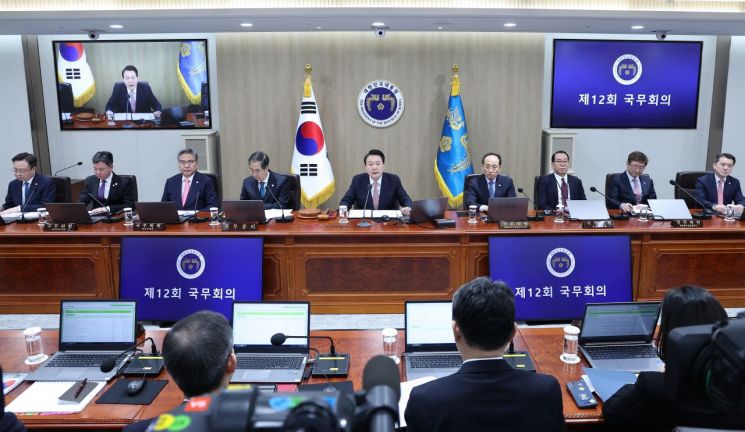
In his opening remarks at the Cabinet meeting held at the Yongsan Presidential Office that morning, President Yoon quoted a famous saying by the late British Prime Minister Winston Churchill, who led the Allies to victory in World War II: "If we compete the present and the past against each other, we will surely miss the future," expressing this view.
He first addressed the deteriorated Korea-Japan relations over the years, mentioning shuttle diplomacy suspension, the dissolution of the Reconciliation and Healing Foundation, semiconductor export regulations and exclusion from the whitelist following the 2018 Supreme Court forced labor ruling, and the General Security of Military Information Agreement (GSOMIA). President Yoon said, "However, we could not just stand by and watch. Amid the increasingly fierce US-China strategic competition, the global supply chain crisis, and the heightened North Korean nuclear threat, the need for Korea-Japan cooperation has grown even more."
Referring to past government cases that fostered a reconciliation atmosphere between Korea and Japan, such as the 1965 Korea-Japan normalization agreement and the 1998 Kim Dae-jung-Obuchi declaration, he described them respectively as "the driving force behind the remarkable development of the Korean economy" and "the cornerstone for pioneering a shared future of peace and prosperity." He claimed that the current compensation plan, which centers on third-party payment, satisfies the content of the 1965 normalization agreement and the individual claims of forced labor victims recognized by the 2018 Supreme Court plenary session.
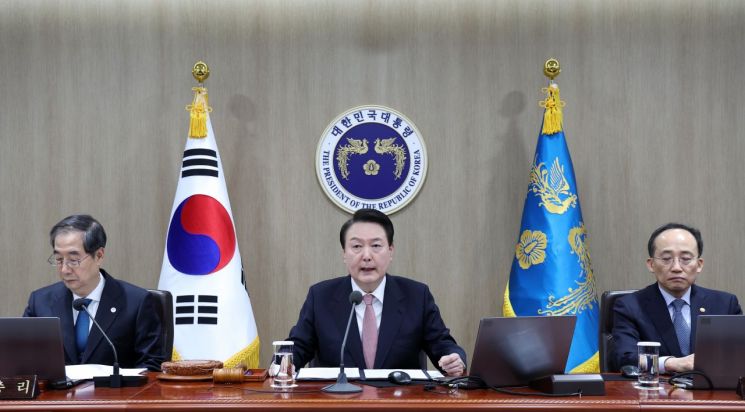
President Yoon stated, "The 1965 Korea-Japan Basic Treaty and Korea-Japan Claims Agreement are based on the principle that the Korean government collectively represents the individual claims of its citizens and receives Japanese support funds. Under this principle, successive governments have strived to heal the pain of forced labor victims and ensure appropriate compensation," mentioning the 9.2 billion won from the claims fund in 1974 and the government's payment of 650 billion won in 2007.
He also clearly stated that Korea-Japan relations must move beyond the past, citing the improvement of relations between France, an Allied power during World War II, and Germany, which was part of the Axis powers. President Yoon urged, "Even if disagreements arise at times, Korea and Japan must meet frequently, communicate, resolve issues, and seek cooperation measures."
Furthermore, he referred to the 1972 Beijing Joint Communiqu? on normalization of diplomatic relations announced by Chinese Premier Zhou Enlai and Japan, which stated, "The responsibility for the war lies with certain militaristic forces, so they must be distinguished from the general public," mentioning the case of waiving war damage compensation such as for the Nanjing Massacre, and emphasized, "We must face Japan confidently and proudly."
Following this summit, the two countries are expected to enhance their joint interests and strengthen cooperation on key issues such as export recovery related to economic security in technology and energy, and the establishment of an economic security dialogue at the level of the National Security Council (NSC). President Yoon said, "I will proactively instruct the Minister of Industry today to initiate the necessary legal procedures to restore Korea's whitelist status for Japan."
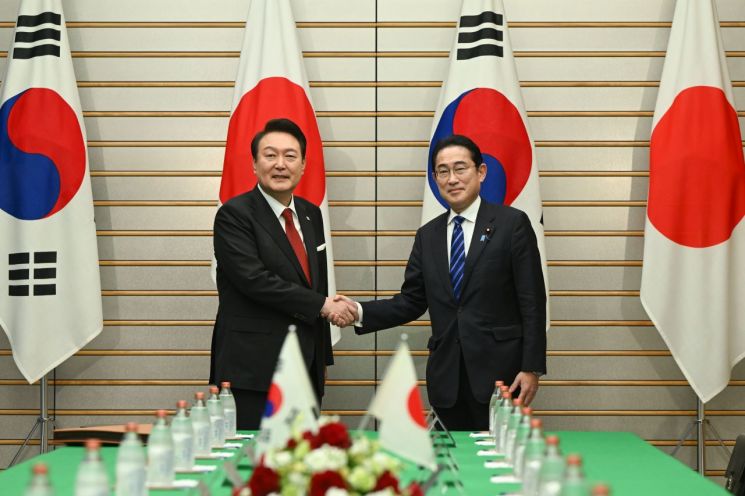
He also mentioned that through cooperation between the economic sectors of both countries, there is an opportunity to jointly enter the global order market with the world's best competitiveness by creating the world's top semiconductor advanced innovation base, as well as in construction, energy infrastructure, and smart city projects.
Regarding GSOMIA, he said, "I judged that perfect information sharing between Korea and Japan on North Korean nuclear and missile issues is urgent, so at the Korea-Japan summit, I declared the complete normalization of GSOMIA proactively without any preconditions," adding, "The Ministry of National Defense and the Ministry of Foreign Affairs have also implemented the necessary legal measures."
The presidential office's live broadcast of President Yoon's opening remarks at the Cabinet meeting was the first in a month since last month's 21st, when he expressed his determination to eradicate illegal activities at construction sites and labor reform. As public opinion toward the presidential office and government became uneasy, fearing a weakening of national governance momentum, President Yoon devoted about 20 minutes?roughly three times longer than usual Cabinet opening remarks?to provide explanations.
Regarding the Korea-Japan summit held during President Yoon's visit to Japan on the 16th and 17th, there is strong opposition to the government's policy to settle the issue with the current compensation plan while the plaintiff companies have not yet participated. Protests demanding the invalidation of the compensation plan, led by opposition parties and civic groups, and a national mass by the Catholic Priests' Association for Justice were held over the weekend.
Meanwhile, concerning the working hours system reform plan, which sparked controversy over a maximum 69-hour workweek, President Yoon said, "There must be no suspicion or anxiety regarding workers' health rights, rest rights, and fair compensation through prevention of abuse of the comprehensive wage system," adding, "There has been some controversy recently about the maximum weekly working hours. My view remains unchanged that working more than 60 hours per week is excessive from a health protection perspective," suggesting a review of existing policies and a re-examination of the upper limit on working hours.
© The Asia Business Daily(www.asiae.co.kr). All rights reserved.
![Clutching a Stolen Dior Bag, Saying "I Hate Being Poor but Real"... The Grotesque Con of a "Human Knockoff" [Slate]](https://cwcontent.asiae.co.kr/asiaresize/183/2026021902243444107_1771435474.jpg)

















