The 1st National Carbon Neutrality and Green Growth Basic Plan
Presentation of 2030 Greenhouse Gas Reduction Targets and Implementation Measures
The government has set annual targets for achieving the 2030 national greenhouse gas reduction goal for the first time and disclosed them on the 21st. The main point is to raise the share of nuclear power by 2030 compared to the previous plan, increasing the reduction target for the energy transition sector from 44.4% to 45.9% compared to 2018, while reducing the industrial sector target from 14.5% to 11.4%.
On the same day, the government announced the '1st National Carbon Neutrality and Green Growth Basic Plan (2023?2042) government draft,' which includes detailed implementation measures to achieve the 2030 national greenhouse gas reduction target.
The Basic Plan is the highest-level statutory plan on carbon neutrality and green growth, established for the first time following the enactment of the Carbon Neutrality Basic Act (enforced in March 2022). It serves as a blueprint reflecting the Yoon Seok-yeol administration's commitment and policy direction for implementing carbon neutrality and promoting green growth.
Adjustment of Reduction Targets by Sector... Energy Transition 44.4→45.9%, Industry 14.5%→11.4%
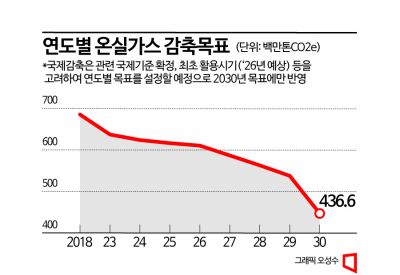
For the energy transition sector, the target was raised from 149.9 million tCO₂e (44.4% compared to 2018) to 145.9 million tCO₂e (45.9%) to further reduce greenhouse gases through a balanced energy mix combining nuclear power and renewable energy, and accelerating the transition to clean energy such as solar power and hydrogen. Specifically, the share of nuclear power generation will increase from 27.4% in 2021 to 32.4% in 2030, and the share of renewable energy generation will rise from 7.5% to 21.6%+α during the same period.
Conversely, the industrial sector's reduction target was eased from 222.6 million tCO₂e (14.5%) to 230.7 million tCO₂e (11.4%) considering realistic domestic conditions such as raw material supply and technological outlook. To support the commercialization of reduction technologies by companies, the government plans to establish a technology innovation fund, expand subsidies and loans, and provide incentives such as expanding emission efficiency-based allocations in the greenhouse gas emissions trading system to encourage voluntary reduction activities.
In the Carbon Capture, Utilization, and Storage (CCUS) sector, the absorption target was raised from 10.3 million tCO₂e to 11.2 million tCO₂e, reflecting the potential to increase greenhouse gas absorption through the expansion of domestic carbon storage sites.
In the hydrogen sector, emissions are expected to increase slightly due to the rise of blue hydrogen, while the five sectors of buildings, transportation, agriculture/fisheries, waste, and sinks maintain the existing NDC targets.
Additionally, as a supplementary means for domestic reductions, the government plans to flexibly utilize international reductions by discovering international reduction projects and expanding public-private cooperative investments, thereby expanding the global participation of domestic companies possessing excellent reduction technologies.
Focused Development of Low-Carbon Materials, Components, Equipment, and Energy New Industries... Establishment of Safety Nets for Vulnerable Groups
The government presented six major sectors and 45 tasks as policies for transitioning to a carbon-neutral society alongside greenhouse gas reduction. Aiming for green growth, it plans to develop 100 core Korean carbon-neutral technologies and establish research and development zones as carbon-neutral forward bases. Primarily, new industries involving low-carbon materials, components, equipment, and energy such as secondary batteries and semiconductors will be fostered. Simultaneously, academic departments and specialized graduate schools for professional workforce training will be operated.
To proactively respond to abnormal climate phenomena, the meteorological observation system will be strengthened. A health and welfare safety net will be established by reducing burdens on vulnerable groups and setting up emergency monitoring systems. Regions facing industrial and employment crises due to carbon neutrality will receive proactive support, and damage to existing workers and companies will be minimized through retraining programs for incumbent workers.
Related policies will be implemented under regional leadership rather than by the central government. To this end, local governments' capabilities and infrastructure will be strengthened through the establishment of basic plans, expansion of carbon neutrality support centers, and creation of carbon-neutral cities.
The budget allocated for achieving carbon neutrality and green growth will reach 89.9 trillion KRW over the next five years. The fiscal growth rate from 2023 to 2027 is projected at an average annual rate of 11.5%, surpassing the past five years' average of 8.0%. Notably, 54.6 trillion KRW will be spent solely on greenhouse gas reduction, including developing core technologies for the carbon-neutral industry and providing subsidies for electric and hydrogen vehicles. The climate adaptation sector will receive 19.4 trillion KRW, and green industry growth will be allocated 6.5 trillion KRW.
Meanwhile, the '2050 Carbon Neutrality and Green Growth Committee' and the Ministry of Environment will jointly hold a public hearing on the 22nd to gather public opinions on the government draft of the Basic Plan, which includes the national carbon neutrality and green growth strategy, mid- to long-term greenhouse gas reduction targets (2030 NDC), and policy measures.
© The Asia Business Daily(www.asiae.co.kr). All rights reserved.
![Clutching a Stolen Dior Bag, Saying "I Hate Being Poor but Real"... The Grotesque Con of a "Human Knockoff" [Slate]](https://cwcontent.asiae.co.kr/asiaresize/183/2026021902243444107_1771435474.jpg)















