Political Relations Act Resolution: Ruling and Opposition Seek Compromise
Amendments Expected on Lawmakers' Number, Political Reform Special Committee to Adopt Resolution
Ruling and Opposition Clash Over Resolution Adoption
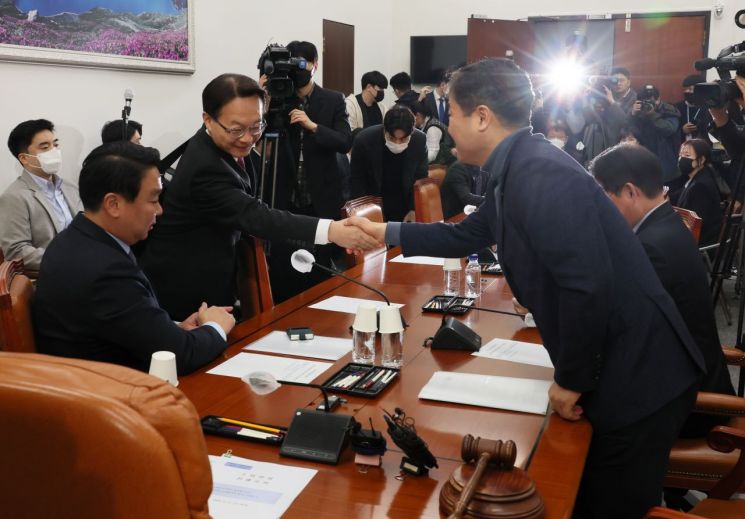
Although the ruling and opposition parties clashed over the issue of expanding the number of National Assembly members, the convening of the National Assembly's Committee on Rules and Administration for the revision of the election law is expected to proceed smoothly as both sides seek a compromise. However, the final possibility of agreement remains uncertain due to widely divergent opinions on the election law revision.
On the 21st, Jeon Jae-soo, the Democratic Party's secretary of the National Assembly's Special Committee on Political Reform, appeared on MBC Radio's 'Kim Jong-bae's Focus' and introduced that compromise discussions between the ruling and opposition parties are ongoing regarding the Special Committee's resolution. Jeon said, "Through yesterday's proposal, we agreed that if the People Power Party's plan is delivered based on the resolution adopted by the Political Relations Act subcommittee, the Democratic Party will provide its opinions on it. By exchanging views like this, we agreed to adopt the coordinated plan without debate at tomorrow's full Special Committee meeting, pass it at the plenary session on the 23rd, and activate the full committee on the 27th." He added, "If the People Power Party's plan arrives this morning, the Democratic Party will review it."
Earlier, the People Power Party leadership criticized the expansion of the number of assembly members included in the resolution passed by the Political Relations Act subcommittee on the 17th, stating, "Under no circumstances will we allow an increase in the number of members." Jang Dong-hyuk, the People Power Party floor spokesperson, said on the same radio program, "We are actively considering a plan that does not increase the number of seats, whether it is a single-member district system or a parallel system with proportional representation, and have requested that a new plan be approved at the full committee meeting to prevent public misunderstanding."
Oh Young-hwan, the Democratic Party floor spokesperson, explained at the party's floor meeting that "The Democratic Party also knows that it is impossible to push for an increase in the number of members without public consent, and the majority opposes it," adding, "It is burdensome to adopt two plans that include an increase in the number of members as resolutions, so this will be discussed at tomorrow's full Special Committee meeting."
Jeon expressed suspicion about why the expansion of the number of assembly members suddenly became a controversial issue. He pointed out, "It has become a strange situation where the People Power Party itself decides and then reverses its own decision." He said, "On the 16th, the day before the resolution was adopted, the People Power Party held a party caucus meeting, but since they could not decide on a party stance, they agreed to refer the matter to the advisory committee directly under the Speaker of the National Assembly and discuss it at the full committee. As a result, the Political Relations Act subcommittee passed it. The subcommittee chairman is also from the People Power Party." In other words, the People Power Party tried to overturn a decision that was made according to the caucus resolution at the subcommittee.
On the other hand, spokesperson Jang explained on the same radio program, "At the party caucus meeting, the People Power Party clearly stated that an expansion of the number of members is absolutely not allowed, whether it is a single-member district system or a large multi-member district system."
In response, Jeon rebutted, "That makes no sense. So, they concluded at the caucus meeting that they would discuss the three advisory committee plans without even looking at them? Does that make sense?"
He also pointed out that the resolution itself is more of a formality needed for discussion at the full committee rather than focusing on its content. Jeon explained, "The content of the resolution is not important; the formality is necessary to discuss it at the full committee." In other words, the resolution's content is not something to be overly concerned about.
Even if the full committee is convened beyond the Special Committee on Political Reform, there is still a long way to go before the election law revision is finalized.
Jeon explained, "At the full committee, all 300 members of the National Assembly will be allowed to speak for at least five minutes each about the election system," adding, "All these speeches will be collected, common denominators will be extracted and categorized into several types, and then negotiations will be held between the leadership of the two major parties to finalize the election system according to a timetable." Regarding this, he said, "(The Democratic Party) will do its utmost to allow members to express their sincere opinions and to draw out common denominators," adding, "We will put our heads together to create an election system that is at least a little more advanced than the current one, with all discussions pouring out."
However, differences remain significant regarding the direction of electoral district reform. Spokesperson Jang said, "Many members attending the caucus agreed with moving toward a large multi-member district system," but added, "The large multi-member district system is the biggest point of contention between the ruling and opposition parties." Jeon also said, "People have different thoughts about the election system," adding, "It is impossible to unify into one party stance, and broadly categorized, there could be two types, or narrowly, 10 to 20 different plans could be made."
Jo Hae-jin, chairman of the Political Relations Act subcommittee, said on SBS Radio's 'Kim Tae-hyun's Political Show' that "There is no fixed plan," adding, "The basic stance is that we should return to the state of the 20th National Assembly." However, he added, "There is talk within the party that a rural-urban mixed large multi-member district system could be considered."
© The Asia Business Daily(www.asiae.co.kr). All rights reserved.
![Clutching a Stolen Dior Bag, Saying "I Hate Being Poor but Real"... The Grotesque Con of a "Human Knockoff" [Slate]](https://cwcontent.asiae.co.kr/asiaresize/183/2026021902243444107_1771435474.jpg)















