Research on Advanced Measures for the Emissions Trading System
South Korea Regulates Electricity Usage through Emissions Trading System
Europe Has No Regulations and Even Provides Electricity Bill Subsidies
On the 21st, the Korea Chamber of Commerce and Industry (KCCI) argued that "indirect emissions should be excluded from the greenhouse gas emissions trading system, and benefits for the use of renewable energy power should be expanded to support our companies' carbon neutrality and energy transition." South Korea regulates Scope 2 emissions, which are indirectly generated from carbon and thermal power usage, through the emissions trading system. Europe and the United States, however, do not regulate indirect emissions. In fact, Europe provides electricity bill subsidies to companies.
In the report titled ‘Study on the Advancement of the Domestic Greenhouse Gas Emissions Trading System’ released on the same day, KCCI stated, "Domestic companies are burdened by the double hardship of electricity price increases and indirect emissions regulations under the emissions trading system."
The greenhouse gas emissions trading system is a scheme where the government allocates a certain amount of greenhouse gas emission allowances (emission permits) to companies, and companies can trade any surplus or deficit among themselves. It started in January 2015 and is currently in its third phase (2021?2025).
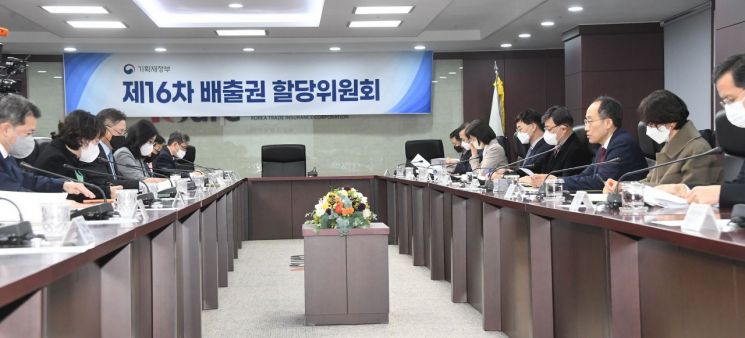 In November last year, the 16th Emission Allowance Allocation Committee was held at the Korea Trade Insurance Corporation in Jongno-gu, Seoul, chaired by Deputy Prime Minister and Minister of Economy and Finance Choo Kyung-ho.
 [Photo by Ministry of Economy and Finance]
Europe provides electricity bill subsidies to power-intensive industries such as steel, chemical, and non-ferrous metals. This is to prevent 'carbon leakage,' which occurs when increased production costs due to electricity price hikes caused by the emissions trading system lead companies to relocate production.
Carbon leakage refers to the relocation of companies, production facilities, or production volumes from regions with strict carbon regulations to regions with weaker regulations.
Germany plans to support electricity bills until 2030 in accordance with European Union (EU) directives. In 2020, it provided a total of 833 million euros (approximately 1.17 trillion KRW) to 325 companies (893 business sites).
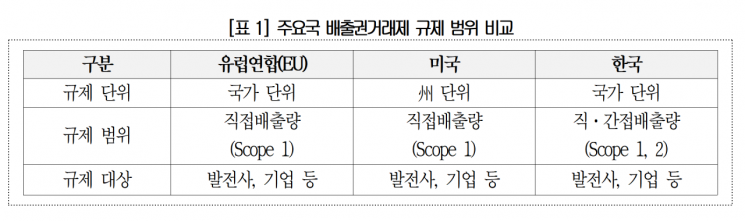 Comparison of Major Countries' Emissions Trading Scheme Regulatory Scopes
 [Image provided by Korea Chamber of Commerce and Industry]
Large company A has already been using 100% renewable energy power at its overseas sites for carbon neutrality, but domestically it faces a significant burden due to the high price of renewable energy power, which increases production costs. Steel industry company B has installed agricultural facilities on its factory site, utilizing waste heat that was previously discarded instead of fuel to produce carbon-neutral crops, contributing to carbon reduction. However, under the current system, these carbon reduction achievements cannot be recognized.
Professor Lee Sang-jun of Seoul National University of Science and Technology said, "If incentives for renewable energy use by domestic companies are provided through the emissions trading system, it will support companies striving to reduce carbon by using renewable energy while also promoting renewable energy use in the private sector."
KCCI proposed a method of providing incentives through the emissions trading system in the report. It suggested recognizing companies' efforts to use renewable energy as greenhouse gas reduction efforts during the pre-allocation of emission permits. Currently, the government additionally allocates emission permits when reduction efforts are recognized during the pre-allocation process.
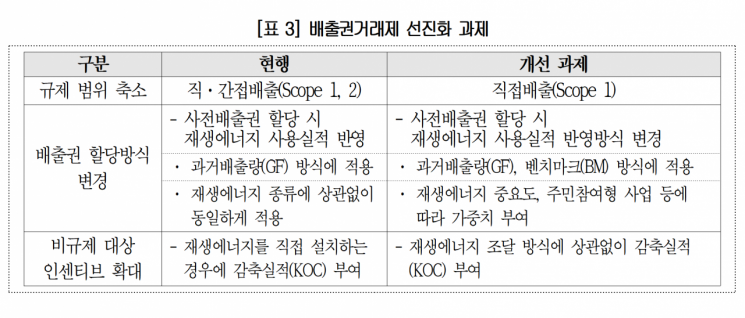 Emission Trading System Advancement Tasks
 [Image provided by Korea Chamber of Commerce and Industry]
Furthermore, to promote the spread of renewable energy, it proposed applying the weighting system introduced in the Renewable Energy Portfolio Standard (RPS) to the emissions trading system as well. The Renewable Energy Portfolio Standard is a system that mandates power producers with thermal power facilities of 500MW or more to supply a certain percentage of their total power generation from renewable energy sources such as solar and wind. In 2023, a total of 25 power producers were designated.
If power producers fail to meet their renewable energy mandatory generation targets, they can purchase Renewable Energy Certificates (REC). Additional weighting is provided for major renewable energy sources or community participation projects in the REC system.
It also proposed that medium and small enterprises that are not participants in the emissions trading system be granted Korean Offset Credits (KOC) when they use renewable energy. Currently, the government grants KOC to companies not participating in the emissions trading system when they voluntarily make reduction efforts, but purchasing and using renewable energy is not recognized as a reduction achievement.
Cho Young-jun, Director of Sustainable Management at KCCI, explained, "The United States, through the Inflation Reduction Act (IRA), significantly expands investment tax credits for renewable energy investment companies and also reduces corporate taxes for companies producing renewable energy-related products." He added, "We ask that these opinions be reflected in the emissions trading system advancement consultative body so that domestic companies making reduction efforts can be given clear incentives and not fall behind in global competition."
© The Asia Business Daily(www.asiae.co.kr). All rights reserved.



















