Apple Pay Arrival
Binding Customers with Easy Payment and Absorbing Galaxy Users
"Market Share Changes Due to Apple Pay Are Limited"
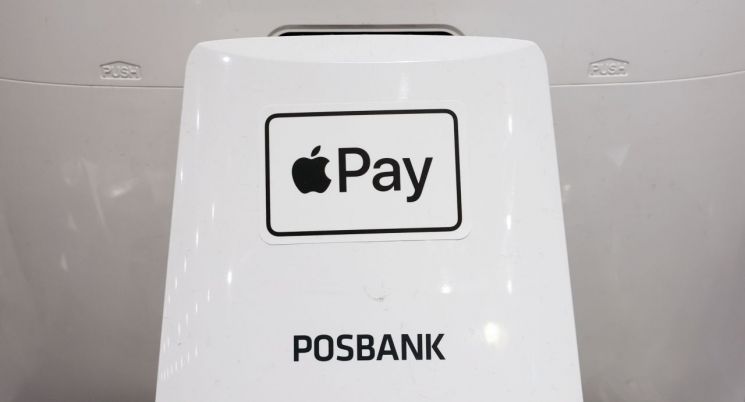
[Asia Economy Reporter Oh Su-yeon] On the 21st, Apple Pay launched its service in Korea. Attention is focused on whether Apple Pay will act as a variable to break the Galaxy dominance in the Korean smartphone market, where Galaxy holds a 70-80% market share.
Before the launch of Apple Pay, telecom companies boosted the atmosphere by significantly increasing the official subsidies for the iPhone 14 series. SK Telecom raised the official subsidy for the first time since the launch of the iPhone 14 series on the 17th. Based on the 80,000 KRW range 5GX Prime plan, the subsidy is 400,000 KRW, and with an additional subsidy of 60,000 KRW, the price of the iPhone 14 (128GB), originally in the 1.2 million KRW range, drops to 783,000 KRW. LG Uplus had already increased the official subsidy for the iPhone on the 3rd. Using the 80,000 KRW range 5G Premier Essential plan, customers receive an official subsidy of 450,000 KRW and an additional subsidy of 67,500 KRW, allowing the purchase of the iPhone 14 for 725,500 KRW.
There is also survey data suggesting that as Apple Pay launches and awareness increases, the number of young people switching to iPhones will rise. According to a survey by Binu Labs targeting 1,000 male and female college students in their 20s using the university community 'Everytime' (541 iPhone users, 419 Galaxy users, etc.), the percentage of respondents who said they would switch from Galaxy to iPhone after hearing an explanation about Apple Pay increased by 10 percentage points (from 26% to 36%) compared to before the explanation.
Kim So-hye, a researcher at Hanwha Investment & Securities, said, "Apple's intention in entering the domestic simple payment market is ultimately to expand smartphone market share," adding, "The introduction of Apple Pay aims to prevent existing iPhone users from leaving and to attract Galaxy users who hesitated to switch operating systems (OS) due to payment convenience."
So far, one of the strengths of Galaxy smartphones in the domestic market has been the simple payment service 'Samsung Pay.' Among Galaxy users, it was not uncommon to hear that they wanted to use iPhones but could not switch because of Samsung Pay. Ahead of the Apple Pay launch, Samsung Electronics enhanced convenience to prevent user churn. They collaborated with major service providers by linking with Naver Pay and Kakao Pay to build a joint front to retain customers.
Although related businesses are on high alert over the Apple Pay launch, its actual impact is expected to be limited. It is forecasted to grow based on iPhone users rather than having broad scalability. In China, which adopted Apple Pay earlier than Korea, local simple payment services such as Alipay and WeChat Pay had already dominated the market, resulting in low usage rates. Japan also introduced Apple Pay in 2016 but was overshadowed by PayPay and QuickPay. According to Counterpoint Research's quarterly smartphone tracker, Apple's market share in Japan and China was 55% and 11%, respectively, at the time of Apple Pay's introduction in 2016. However, one year later in 2017, the market share was 50% in Japan and 11% in China, showing a decline or stagnation.
Lee Yoon-jung, a research fellow at Counterpoint, said, "Since Apple Pay was introduced in Japan and China in 2016, Apple's market share changes in those countries' smartphone markets have been limited," adding, "Separate from the introduction and spread of Apple Pay, market reactions to new iPhone designs and specifications, as well as Apple brand awareness among younger generations, influenced Apple's market share."
© The Asia Business Daily(www.asiae.co.kr). All rights reserved.
![Clutching a Stolen Dior Bag, Saying "I Hate Being Poor but Real"... The Grotesque Con of a "Human Knockoff" [Slate]](https://cwcontent.asiae.co.kr/asiaresize/183/2026021902243444107_1771435474.jpg)















