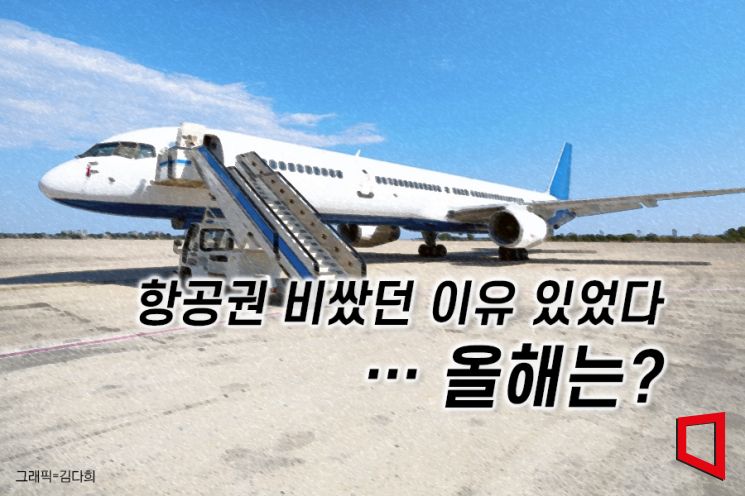
During the COVID-19 pandemic, the number of aircraft operated by domestic airlines in South Korea decreased by about 50. Airlines primarily lease their aircraft. However, due to the decline in passengers during the pandemic, airlines faced difficulties in maintaining their aircraft and returned them without renewing contracts, leading to a decrease in numbers.
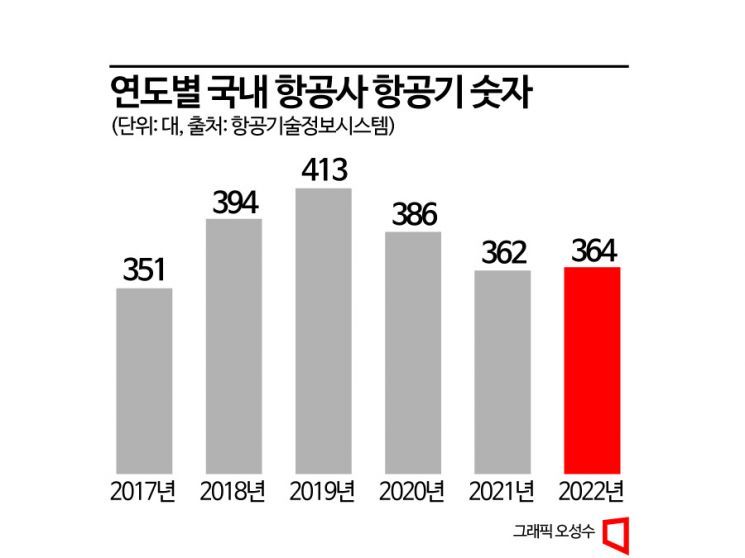
According to the aircraft registration status from the Aviation Technology Information System on the 21st, the number of aircraft operated by domestic airlines increased from a total of 351 in 2017 to 394 in 2018 and 413 in 2019. However, with the onset of COVID-19, the number dropped to 386 in 2020 and 362 in 2021. Last year, with the recovery of international flights, the number slightly increased to 364. This is a decrease of 49 aircraft compared to 2019.
The fundamental reason for the decrease in aircraft is the reduction in passengers. Incheon International Airport recorded 7.23 million transfer passengers in 2019. However, this number plummeted to 540,000 in 2021, directly impacted by COVID-19.
As a result, airlines canceled their aircraft lease contracts. With no international passengers, airlines found it burdensome to pay lease fees. Aircraft acquisition by airlines is divided into purchase and lease (financial and operating leases). Since the price per aircraft exceeds 100 billion KRW, airlines either purchase aircraft directly by securing loans from banks using the aircraft as collateral or lease them from aircraft leasing companies.
The decrease in the number of aircraft operated by airlines has become a burden for consumers. Since the second half of last year, as international flights have become active, there has been a shortage of aircraft. Consequently, fares on routes have risen significantly. The price for the Gimpo~Jeju route exceeds 100,000 KRW. Additionally, popular international routes are priced higher than before COVID-19.
However, as airlines are acquiring aircraft this year, airfares are expected to decrease. Korean Air will introduce a total of 13 new aircraft this year, including six Boeing B787s from the U.S. and seven new Airbus A321neos from Europe. Two A321neos were introduced in January and February. Asiana Airlines operated 85 aircraft in 2019 but reduced to 77 last year; however, it plans to increase to 81 this year. They are introducing next-generation aircraft such as the A350 for medium- to long-haul and the A321neo for short-haul routes. They are also pursuing fleet renewal by returning aging aircraft.
Low-cost carriers (LCCs) are following suit. Jeju Air plans to operate a total of 41 aircraft this year by introducing four new aircraft: two B737-8s and two B737NGs. Jin Air also plans to operate 28 aircraft by adding two new B737-8s. Eastar Jet, which currently has three aircraft, plans to increase its fleet to 10 by the end of the year.
However, contrary to the plans of domestic airlines, there are forecasts that aircraft deliveries may be delayed compared to expectations. While demand for aircraft is increasing, supply remains sluggish. The global aircraft manufacturers Boeing and Airbus delivered a total of 132 aircraft in January and February. However, their delivery targets for this year are 400?450 Boeing B737 Max (33?38 per month) and 70?80 B787 (6?7 per month). Airbus aims to deliver a total of 720 aircraft. Considering this, both companies need to deliver over 100 aircraft per month combined.
Seung-yoon Yang, a researcher at Eugene Investment & Securities, said, "Boeing and Airbus are currently maintaining their delivery targets for this year, but considering the slow start, we should expect an increase in deliveries in the second half of the year." He added, "From a supply perspective, the number of domestic aircraft will see a relatively slower increase in medium- to long-haul routes compared to short-haul routes due to the retirement of medium- and large-sized aircraft and delays in new production recovery."
© The Asia Business Daily(www.asiae.co.kr). All rights reserved.
![Clutching a Stolen Dior Bag, Saying "I Hate Being Poor but Real"... The Grotesque Con of a "Human Knockoff" [Slate]](https://cwcontent.asiae.co.kr/asiaresize/183/2026021902243444107_1771435474.jpg)
















