Slowing Uptrend for 8 Consecutive Months
0.1% Increase Compared to Previous Month
The producer price inflation rate in February fell to the 4% range for the first time in about two years, suggesting a potential easing of inflationary pressures. The producer price inflation rate recorded 7.3% in October last year but gradually slowed down to 6.2% in November, 5.8% in December, 5.1% in January this year, and 4.8% in February.
According to the Bank of Korea on the 21st, producer prices last month rose by 0.1% compared to the previous month. Industrial city gas and livestock products declined, but services such as food and accommodation and manufactured goods increased. However, compared to the same month last year, it rose by 4.8%, continuing the trend of slowing growth for eight consecutive months. This index falling to the 4% range is the first time in 23 months since March 2021 (4.1%).
The index excluding food and energy rose by 0.3% compared to the previous month. Compared to the same month last year, it rose by 2.8%, showing a slowdown in the upward trend. The growth rate of the index excluding food and energy also fell to the 2% range for the first time in 24 months since February 2021 (2.1%).
Seo Jeong-seok, head of the Price Statistics Team at the Bank of Korea, explained, "The producer price index growth rate in February (compared to the same month last year) fell to the 4% range for the first time in 23 months, and the growth rate of the index excluding food and energy also showed the 2% range for the first time in 24 months," adding, "Overall, the slowdown in price increases indicates a trend of easing inflationary pressures."
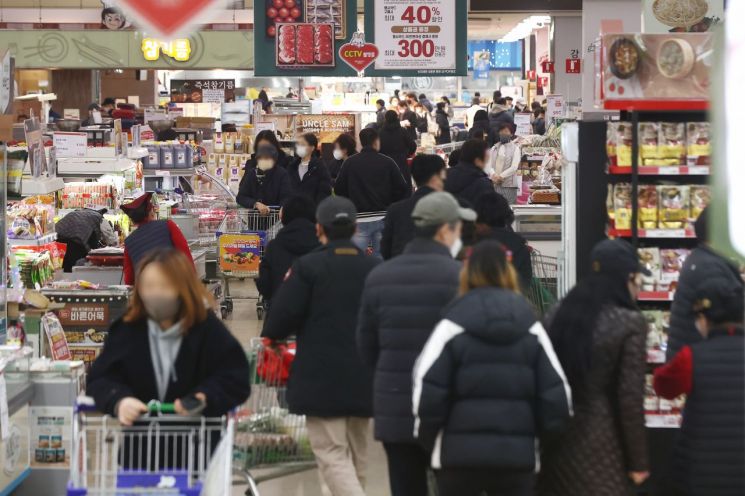
However, producer prices rose slightly compared to the previous month, showing an upward trend for two consecutive months. Service fees increased by 0.3% compared to the previous month, mainly driven by restaurants and accommodation services (0.6%) and real estate services (0.5%). Manufactured goods fell by 1.0% in coal and petroleum products but rose by 0.6% in chemical products, resulting in a 0.1% increase compared to the previous month.
Agricultural, forestry, and fishery products fell by 0.2% compared to the previous month, with livestock products down by 3.2%, but agricultural products up by 1.5% and fishery products up by 2.1%. In electricity, gas, water, and waste, industrial city gas (-1.5%) and steam (-2.1%) declined, leading to a 0.3% decrease compared to the previous month.
Domestic supply prices rose by 0.7% compared to the previous month last month. Compared to the same month last year, they rose by 4.2%. The domestic supply price index measures price changes of goods and services supplied domestically to understand the transmission process of price changes. Raw materials (1.3%), intermediate goods (0.7%), and final goods (0.5%) all increased. The total output price index for February, which adds exports to domestic shipments, rose by 0.4% compared to January.
Team leader Seo said, "Although energy-related producer prices such as petroleum and city gas fell compared to January, overall producer prices rose slightly by 0.1% due to increases in service prices," adding, "The March producer prices will need to be monitored as upward and downward factors related to energy and service prices coexist."
© The Asia Business Daily(www.asiae.co.kr). All rights reserved.
![Clutching a Stolen Dior Bag, Saying "I Hate Being Poor but Real"... The Grotesque Con of a "Human Knockoff" [Slate]](https://cwcontent.asiae.co.kr/asiaresize/183/2026021902243444107_1771435474.jpg)















