Jamie Dimon, chairman of JP Morgan Chase, known as the "Emperor of Wall Street," is leading discussions on additional support for First Republic Bank, which has been plagued by crisis rumors following the collapse of Silicon Valley Bank (SVB). Large banks are expected to continue capital-raising measures to prevent the situation from escalating into a systemic crisis. First Republic's stock price has plummeted by about 90% just this month.
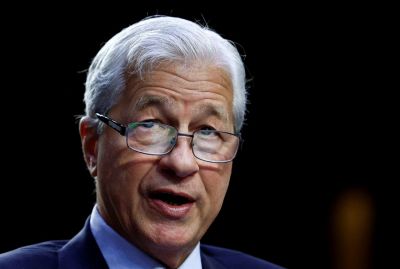
The Wall Street Journal (WSJ) reported on the 20th (local time), citing sources, that CEOs of major U.S. banks, led by Dimon, are discussing ways to increase First Republic's capital. Options currently on the table include sale, external capital injection, and direct investment by these banks in First Republic. There is also talk of converting some or all of the $30 billion deposited by major U.S. banks into First Republic's capital. WSJ stated, "The situation is fluid and rapidly changing," and "Dimon is leading these discussions, striving to restore confidence in the banking system."
Earlier, 11 major U.S. banks, including JP Morgan, injected $30 billion into First Republic on the 16th. This was a measure to strengthen liquidity for regional banks including First Republic and to mitigate financial risks. Dimon reportedly played a significant role in persuading the major banks during this process. WSJ mentioned that John Pierpont Morgan, founder of JP Morgan, resolved the panic of 1907, and referenced the bankruptcies of Bear Stearns and Washington Mutual, highlighting that JP Morgan and Dimon have repeatedly played roles in financial crises.
However, concerns surrounding First Republic persist despite these rescue measures. The news of UBS's acquisition of Credit Suisse (CS) the previous day did not quell fears about First Republic. On the contrary, S&P Global downgraded First Republic's credit rating three notches from 'BB+' to 'B+' and left open the possibility of further downgrades, heightening the sense of crisis. While the immediate fire has been put out, S&P Global's assessment is that the significant issues First Republic faces in business, liquidity, funding, and profitability will not be effectively resolved.
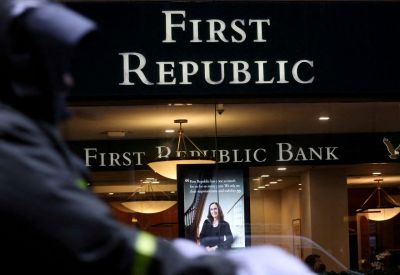
WSJ noted, "After major banks agreed to deposit $30 billion with First Republic, the pace of deposit withdrawals has somewhat slowed," but also pointed out, "There is still a large hole to fill on the balance sheet." Deposits withdrawn from First Republic since the SVB collapse have been estimated at $70 billion. As of the end of 2022, the bank's total assets were $212.6 billion (approximately 279 trillion won), and total deposits were $176.4 billion (approximately 231 trillion won). Additionally, First Republic has been identified as a concern due to its high proportion of uninsured deposits, similar to SVB.
The stock price plunge continues. In the afternoon session of the New York Stock Exchange, First Republic's stock was trading around $12 per share, more than 47% lower than the previous close. Compared to the closing price of $115 on the 8th, this represents a nearly 90% drop. This contrasts with other regional bank stocks such as PacWest Bancorp, which were also swept into the sharp decline following the SVB incident but rebounded and stabilized on this day.
© The Asia Business Daily(www.asiae.co.kr). All rights reserved.
![Clutching a Stolen Dior Bag, Saying "I Hate Being Poor but Real"... The Grotesque Con of a "Human Knockoff" [Slate]](https://cwcontent.asiae.co.kr/asiaresize/183/2026021902243444107_1771435474.jpg)
















