Major indices on the U.S. New York stock market showed mixed movements in early trading on Monday, the 20th (local time), as concerns over banking sector risks eased somewhat following UBS's decision to acquire Credit Suisse (CS), while investors awaited this week's Federal Reserve (Fed) interest rate decision.
As of 10:30 a.m. at the New York Stock Exchange (NYSE), the Dow Jones Industrial Average was up 325.20 points (0.99%) from the previous close, trading around the 32,178 level. The S&P 500, which focuses on large-cap stocks, rose 21.50 points (0.55%) to about 3,938. Meanwhile, the tech-heavy Nasdaq index fell 11.31 points (0.10%) to 11,619.
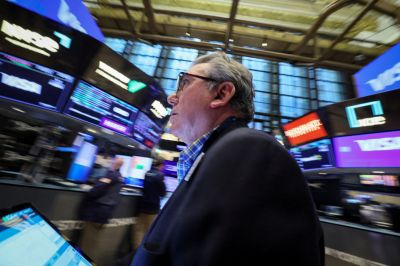
Currently, eight of the 11 sectors in the S&P 500, excluding technology, communication services, and consumer discretionary, are all on the rise. The market's concerns have slightly eased after UBS agreed to acquire CS, which was facing a liquidity crisis, for 3 billion Swiss francs. The Chicago Board Options Exchange (CBOE) Volatility Index (VIX), known as Wall Street's "fear gauge," was trading around 25, down about 1.5% from the previous close.
Earlier, UBS signed an acquisition agreement with CS for approximately 3 billion Swiss francs (about 4.24 trillion KRW). To prevent market disruption, Swiss authorities actively intervened and supported the deal to be finalized before the Asian financial markets opened on the 20th. Following UBS's announcement of the CS acquisition, the central banks of five countries?the Fed, Canada, the UK, Japan, the ECB, and Switzerland?also announced a joint response to increase liquidity through dollar swap agreements. Additionally, news that the U.S. Federal Deposit Insurance Corporation (FDIC) had agreed to sell the assets and liabilities of Signature Bank to New York Community Bancorp further reassured investors.
Art Hogan, Chief Market Strategist at B. Riley Wealth Management, commented on UBS's acquisition of CS, saying, "This is clearly good news amid overall concerns about global banking stability," and noted that "there was an overreaction to regional banks."
The SPDR Regional Banking ETF, which slid 14% last week due to the fallout from the Silicon Valley Bank (SVB) collapse, is now showing nearly a 5% gain. PacWest Bancorp surged 35%, and Zions Bancorporation rose over 7%, leading the rally. New York Community Bancorp, which is pursuing the acquisition of Signature Bank, also jumped more than 39%. Large bank stocks such as Citigroup and Bank of America also rose collectively.
However, First Republic Bank, which faced crisis rumors immediately after the SVB collapse, dropped more than 15% after S&P Global downgraded its credit rating again. Although immediate liquidity support has quelled urgent concerns, the bank faces significant challenges in resolving its practical operational difficulties. Edward Moya, Senior Market Analyst at OANDA, said, "There is still no confidence in the (banking) system," adding, "Despite several measures to contain financial risks, risk aversion will not disappear in the market until there is certainty that the Fed has finished raising interest rates."
Investor attention is focused on the March Federal Open Market Committee (FOMC) regular meeting scheduled for the 21st and 22nd. Since rapid rate hikes are considered to have triggered the SVB collapse, the previously likely "big step" (a 0.5 percentage point increase in the benchmark rate) has effectively been discarded. According to the CME FedWatch tool as of this morning, the federal funds futures market reflects more than a 73% probability that the Fed will raise rates by 0.25 percentage points at the March FOMC. The probability of a rate hold is 26.9%, and the chance of a big step is 0%.
Krishna Guha, an analyst at Evercore ISI, said, "The most likely scenario is a 0.25 percentage point increase," but also noted that the possibility of a rate hold remains due to the enhanced currency swap measures by major central banks announced the previous day.
In the New York bond market, Treasury yields are rising. The 10-year U.S. Treasury yield is around 3.46%, and the 2-year yield is about 3.91%. Jeffrey Gundlach, CEO of DoubleLine Capital, predicted that Treasury yields have more room to fall due to financial risks. He also added that the sharp steepening following the persistent inversion of short- and long-term Treasury yields signals a recession. Earlier, he forecasted that the Fed would continue modest rate hikes this week to maintain the central bank's policy credibility.
International crude oil prices declined. The April West Texas Intermediate (WTI) crude oil price fell 1.44% from the previous close, trading at $65.78 per barrel.
European stock markets showed gains. Germany's DAX index rose 0.99%, the UK's FTSE index increased 0.62%, and France's CAC index advanced about 1.32%.
© The Asia Business Daily(www.asiae.co.kr). All rights reserved.
![Clutching a Stolen Dior Bag, Saying "I Hate Being Poor but Real"... The Grotesque Con of a "Human Knockoff" [Slate]](https://cwcontent.asiae.co.kr/asiaresize/183/2026021902243444107_1771435474.jpg)















