'2022 Second Half Closure Survey'
Businesses Closed Without Recovering Investment Costs

"It has been the worst since last July. When the disaster relief funds given during COVID stopped, both consumers and self-employed business owners were left empty-handed." Junwon Seo (36), who ran a meat restaurant in Uijeongbu, is preparing to close his store. He quit his job four years ago to start a business, but then COVID-19 broke out. It seemed like business picked up briefly thanks to the disaster relief funds, but once those stopped, the store became deserted. No matter how much he calculated, opening the store was a loss. Seo said, "It was my first business, but I ended up with about 100 million won in debt," adding, "Trying to salvage even a penny, I sold kitchenware on Danggeun Market this morning and earned 160,000 won working part-time for Baedal Minjok in the afternoon. After trying it, it seems riding a motorcycle is more profitable than running a business," he said with a bitter smile.
Closed Self-Employed Business Owners' Debt 88.32 Million Won, Increased by 3.35 Million Won from First Half
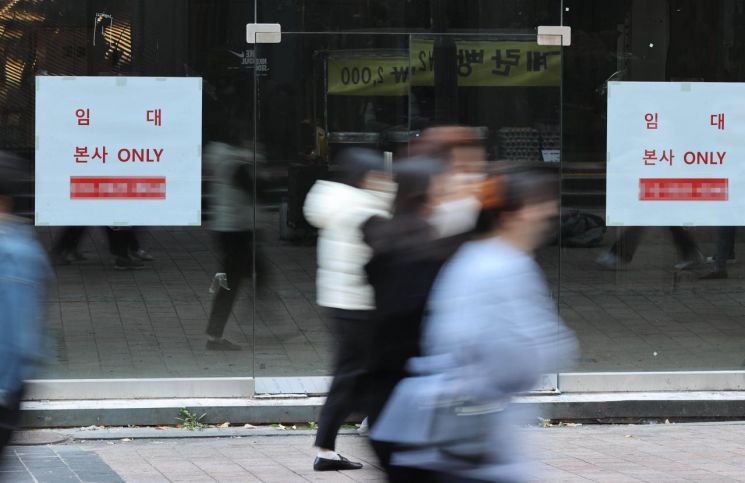
Like Seo, the debt of self-employed business owners who have closed their businesses is increasing. According to the "2022 Second Half Guarantee Support Companies Closure Survey" released by the Korea Credit Guarantee Fund on the 21st, the average debt per closed self-employed business owner was 88.32 million won. This is an increase of 3.35 million won compared to the first half survey (84.97 million won). The most cited reason for closure was "poor sales and profits." The proportion of respondents choosing this reason increased from 79.2% in the first half to 82.7% in the second half, indicating that as the economy worsened, self-employed business owners suffered greater damage.
An official from the Korea Credit Guarantee Fund said, "Starting a small business requires an average initial cost of about 131 million won," and added, "If the pattern of closing businesses without recovering investment costs continues, it could lead to a crisis."
In both the first and second halves of last year, the most difficult issue after closure was "household economic hardship." Notably, as the debt size of closed business owners increased in the second half, the proportion selecting this response rose from 71.1% to 74.1%. Their paths to sustain their livelihood after closure largely fall into two categories: those who work part-time or become salaried employees. The first group includes those "preparing for employment" (12.9%) and those "employed" (26.1%).
Still Starting Over... A Vicious Cycle Unfolds
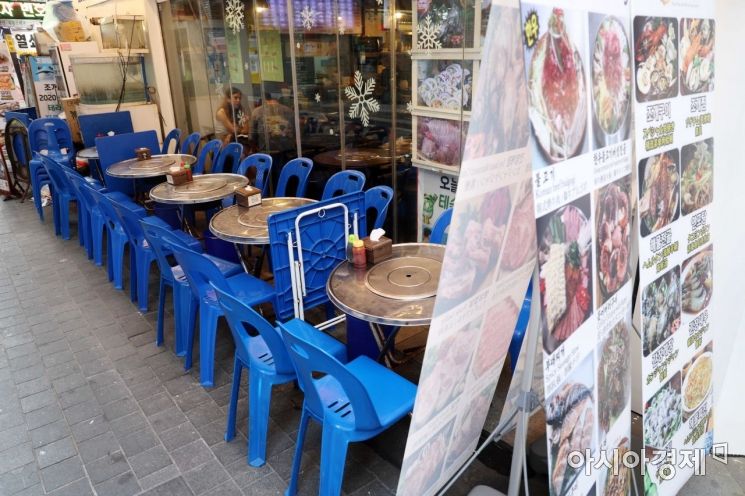 On the 3rd, a restaurant in Myeongdong, Seoul, where self-employed people’s worries are deepening, is quiet. Photo by Mun Ho-nam munonam@
The second group consists of "returning self-employed" who re-enter business with debts exceeding 80 million won. Among closed business owners, 41.2% (16.4% "preparing for re-start" and 24.8% "have re-started") fell into this category. The most common reason for preparing to re-start was "livelihood maintenance" (65.5%). When re-starting, 51.4% responded that they would re-enter the "same industry."
In self-employed communities, it is not uncommon to see posts sharing methods to obtain additional loans among those who, despite being in debt after closure, try to open a store again. Sooyoung Lee (41), who ran a brunch cafe in Seongnam, is also recently knocking on bank doors again for re-starting a business. He said, "I jumped in without knowing much and closed the business after six months, but I still have regrets and want to try again," adding, "I still have about 70 million won in debt after closure, but after consulting with the Credit Guarantee Fund, it seems I can get an additional loan of about 30 million won through the special re-start guarantee."
The Korea Credit Guarantee Fund views those who re-start businesses more seriously than those like Seo who seek employment after closure. The fund analyzed, "Small business owners face oversaturation of the same industry within the same area, leading to oversupply. Oversupply results in decreased sales and leads to a vicious cycle of increasing debt, causing frequent closures and social costs."
This survey was conducted via telephone using questionnaires from November 7 to December 9 last year, targeting a total of 830 self-employed business owners (excluding companies surveyed in the first half).
© The Asia Business Daily(www.asiae.co.kr). All rights reserved.
![Clutching a Stolen Dior Bag, Saying "I Hate Being Poor but Real"... The Grotesque Con of a "Human Knockoff" [Slate]](https://cwcontent.asiae.co.kr/asiaresize/183/2026021902243444107_1771435474.jpg)













