"Obstacle to Korea-Japan Relations? Not Citizens but the Japanese Government"
Chairman of the Justice Memory Foundation, YTN Interview
Kim Tae-hyo, the First Deputy Director of the National Security Office, referred to the rally condemning the Korea-Japan summit as "claims that the Japanese government will not accept," sparking backlash from civic groups.
The Justice Memory Solidarity criticized, saying, "A high-ranking official of the Korean government is aligning with Japanese far-right and right-wing forces," and added, "A so-called proxy from Japan is stepping forward to intimidate victims by saying 'Take this money instead' and labeling those around them as obstacles."
Earlier, on the 18th, in an interview with YTN's 'News Wide,' Deputy Director Kim said, "Citizens can express their opinions on any diplomatic policy, but from the government's perspective, alternatives must be realistic," and added, "If you carefully examine the positions of those holding rallies on the streets, they are making claims that the Japanese government will not accept."
He continued, "In other words, it inevitably equates to the conclusion that it is better to continue neglecting the bilateral relationship, which has been an obstacle and uncomfortable for the past 12 years."
This was in response to the host's question, "At today's rally, voices are emerging that sealing off past issues and promoting the future of Korea-Japan relations is impossible. What is your view?" On the same day, the rally condemning the Korea-Japan summit held in front of Seoul City Hall was attended by 'Korea-Japan Historical Justice and Peace Action,' composed of about 610 civic groups including Justice Memory Solidarity, as well as Lee Jae-myung, leader of the Democratic Party of Korea, and opposition party lawmakers.
Deputy Director Kim's response was interpreted as meaning that the claims made at the rally condemning the Korea-Japan summit are unrealistic for the Japanese government to accept.

Lee Na-young, director of Justice Memory Solidarity, took issue with Deputy Director Kim's use of the term "obstacle in Korea-Japan relations."
On the 20th, on MBC Radio's 'Kim Jong-bae's Focus,' she said, "In the middle, a so-called proxy steps forward to extinguish the rights of victims, grants immunity to perpetrators, intimidates by saying 'I'll give you money instead, so take it,' and labels all those around as obstacles."
She added, "Then they rejoice at receiving praise from the perpetrators. Becoming a henchman of the perpetrators, if anything that gets in the way is treated as an obstacle or problem, how would a reasonable person judge this?" she raised her voice.
She criticized Deputy Director Kim, saying, "It is nothing less than a tragic view of history, nation, and human rights." The implication was that it is inappropriate for an official responsible for South Korea's diplomacy and security policies to place more weight on the Japanese government's position than on its own civic groups.
Director Lee criticized, "How can a high-ranking official of the Republic of Korea government so carelessly disregard the voices of its own citizens and victims while so carefully considering the positions of the Japanese government and its officials? I really cannot understand this."
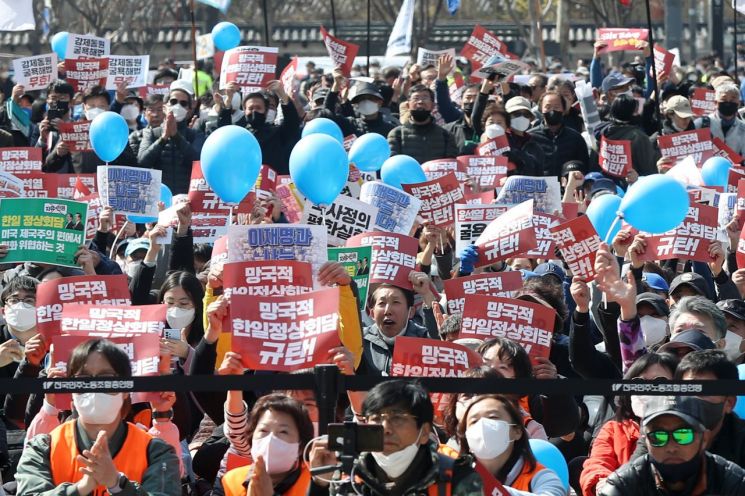 Officials from the Korea-Japan Historical Justice and Peace Action are shouting slogans at the 3rd Nationwide Rally condemning solutions to forced mobilization and the Korea-Japan summit held at Seoul Plaza on the afternoon of the 18th.
 [Image source=Yonhap News]
She also pointed out Deputy Director Kim's remarks that "civic groups and political circles are politicizing the victims' positions." In the interview, Deputy Director Kim said regarding forced labor victims, "I strongly oppose civic groups or political circles representing the bereaved families' positions even though they are not the parties themselves, and distorting or politicizing the issue due to domestic political interests."
In response, Director Lee pointed out, "The Japanese government has consistently denied its illegal occupation of the Korean Peninsula. Despite the illegality being recognized in issues such as forced labor and Japanese military 'comfort women,' the Japanese government has continuously said that 'the Korean government and Korean victim groups are the problem, violating international law and even changing the goalposts,' and has worsened Korea-Japan relations through export controls and other measures."
Director Lee said, "The entire nation probably knows who the real obstacle causing the deterioration of Korea-Japan relations is," and added, "But it is surprising that a high-ranking official of the Korean government uses the term 'obstacle' to criticize and call for correction from the citizens on this issue."
© The Asia Business Daily(www.asiae.co.kr). All rights reserved.


















