Zigbang, Apartment Price Change Rate Compared to Last Year as of February
Incheon Ranks First in Decline Rate by City/Province
Ibgap
Over the past year, the areas in Seoul where apartment prices have dropped the most were identified as Nowon-gu and Dobong-gu. As active catch-up buying occurred mainly in these relatively affordable areas, the downward trend in regions that had experienced steep price increases also deepened.
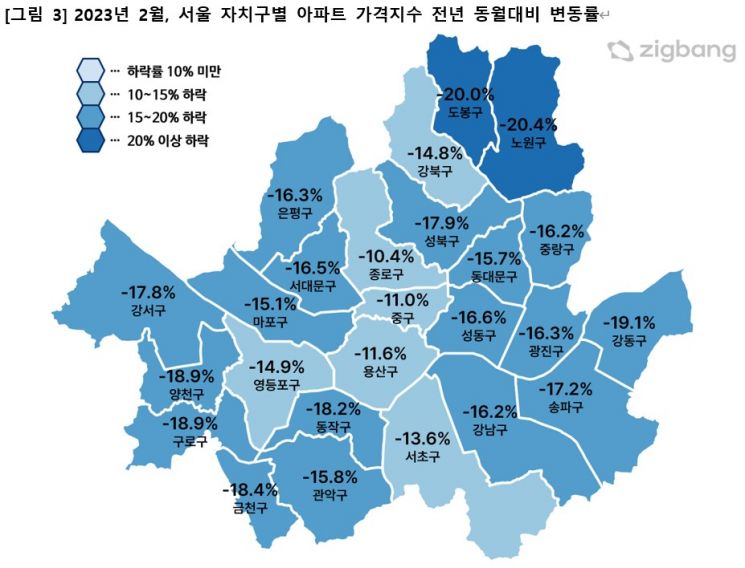
According to Zigbang on the 20th, as of February, apartment prices in Nowon-gu and Dobong-gu in Seoul fell by -20.4% and -20.0% respectively compared to the same month last year, marking the largest declines. Following these were Gangdong-gu (-19.1%), Guro-gu (-18.9%), Yangcheon-gu (-18.9%), and Geumcheon-gu (-18.4%), which also showed relatively high rates of decline. The three central districts (Jongno-gu, Jung-gu, Yongsan-gu) had comparatively lower rates of decline than other areas.
Looking at trends by major regions, in the southeastern area, Seocho-gu showed the lowest year-on-year decline rate as of February compared to other regions. On the other hand, Gangdong-gu experienced the fastest price decline during last year's downturn in the southeastern area, but this year the rate of decline has slowed, and signs of a rebound are emerging. The Nowon-Dobong-Gangdong (No-Do-Gang) area all shifted to year-on-year declines starting in June last year, with Dobong-gu and Nowon-gu, which had previously shown higher price increases compared to Gangbuk-gu, experiencing faster declines during the downturn.
Among provinces and cities, Incheon (-21.5%) recorded the largest decline. This was followed by Sejong (-19.9%), Gyeonggi (-19.8%), Daegu (-18.9%), Daejeon (-18.1%), Busan (-16.6%), and Seoul (-16.6%). Examining the trends, except for Daegu and Sejong which experienced an early downturn, most other regions shifted to a negative year-on-year trend starting from July last year, with particularly sharp declines in Gyeonggi and Incheon, which had strong price increases in 2021.
The three metropolitan areas and Sejong City have shown signs of a slowdown in the decline trend and some rebounds since the beginning of this year, but still recorded significant declines of over -10% compared to the previous year. Other provinces have also seen a slight easing in decline rates compared to 2022 but have yet to show signs of a rebound. The nationwide apartment sales price index for February recorded a year-on-year change rate of -17.2%.
Looking at major subway lines in the metropolitan area, as of February, apartment prices near Line 4 stations showed a change rate of -19.7%, indicating a relatively large decline. Line 3 (-16.6%) showed a comparatively lower decline rate. Time series trends show that apartments near Lines 1, 4, and the Shinbundang Line experienced relatively high price increases during last year's market boom but have sharply reversed into declines during this year's downturn. Conversely, apartments near Line 2 stations, which pass through major business districts in Seoul, showed both lower increases during the boom and lower declines during the downturn, indicating relatively stable price changes.
The common characteristic of areas with large declines is that they had experienced high price increases during the low-interest-rate period. Due to loan restrictions on high-priced apartments making it difficult to secure funds for home purchases, demand concentrated in areas with anticipated benefits from the upcoming GTX opening and those accessible for commuting to central areas.
Ham Young-jin, head of Zigbang Big Data Lab, said, "There was strong buying demand in the relatively affordable outskirts of Seoul and the Gyeonggi-Incheon areas, and as these became regions with relatively high leverage ratios, they were more severely impacted by the US interest rate hikes."
Ham also noted that it is difficult to predict future market trends due to the possibility of continued tightening policies. He said, "At the beginning of this year, signs of some rebound have started to appear due to real estate regulation easing, the launch of the Special Home Loan Program, and the base effect from the rapid price drop over a short period. However, this may be a temporary phenomenon caused by prospective buyers who had to wait in a cautious position due to high interest rates and prices now participating in some transactions."
© The Asia Business Daily(www.asiae.co.kr). All rights reserved.
![Clutching a Stolen Dior Bag, Saying "I Hate Being Poor but Real"... The Grotesque Con of a "Human Knockoff" [Slate]](https://cwcontent.asiae.co.kr/asiaresize/183/2026021902243444107_1771435474.jpg)
















