The Seoul Metropolitan Government is set to ease urban planning regulations on public facilities such as universities and hospitals. The goal is to strengthen the functions of necessary public facilities in Seoul in exchange for relaxing building coverage ratios and floor area ratios.
On the 20th, Seoul announced that it will officially implement the amendment to the Seoul Urban Planning Ordinance, which eases urban planning regulations on public facilities, after a legislative notice period. Previously, Seoul had announced plans to fully support facilities with strong public nature, such as hospitals and universities operated by the private sector, by boldly innovating regulations to enhance their competitiveness. A Seoul city official explained, "Seoul is a city with optimal potential to develop into a world-class city through the growth of universities. However, many universities are located in low-density zoning areas and scenic districts, facing practical limitations such as lack of available space, making it difficult to improve their facilities."
First, the city introduced an ‘Innovation Growth Zone (Facility)’ with no floor area ratio restrictions so that universities can secure space necessary for nurturing future talent, entrepreneurship, research, and industry-academia cooperation, removing the floor area ratio cap. Through this urban planning ordinance amendment, the floor area ratio will be relaxed by up to 1.2 times.
Seoul has completed the revision of the 「Detailed Facility Establishment Plan for Universities - Establishment and Operation Standards」, which includes detailed facility standards and procedures for the Innovation Growth Zone. Once the ordinance is amended and enforced in July this year, universities will be able to expand their facilities as much as needed to strengthen competitiveness. Currently, institutions such as Chung-Ang University, Hongik University, Korea University, and University of Seoul are reviewing facility expansion through this system.
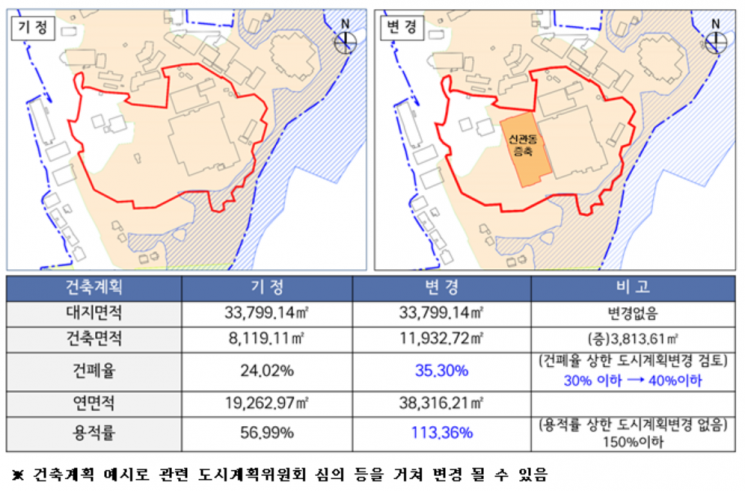
Additionally, the amended ordinance includes provisions not only to relax floor area ratios for universities but also to abolish height restrictions on urban planning facilities within natural scenic districts that were separately managed by the ordinance, allowing for more flexible management. Until now, urban planning facilities in natural scenic districts were generally limited to 3 floors (12m), with some facilities allowed up to 7 floors (28m). However, with this amendment, facilities exceeding 7 floors (28m) will be permitted if there is no impact on the surroundings.
The city plans to thoroughly review the surrounding conditions, landscape, and views for various urban planning facilities, not just universities, and boldly relax height restrictions in natural scenic districts if the impact on the surroundings is minimal. Urban planning facilities such as universities, hospitals, public offices, research facilities, and cultural facilities are managed with height plans considering topographical characteristics through landscape reviews, allowing for additional relaxation after sufficient impact assessment.
Seoul expects that "even within natural scenic districts, when necessary for public interest without damaging nature, sufficient space can be secured for urban planning facilities through height relaxation without lifting the scenic district designation."
Korea University and University of Seoul, located within natural scenic districts, are reviewing facility expansions applying the eased building restrictions. If Korea University’s ‘Jeong Woon-oh IT Liberal Arts Building,’ originally planned for 7 floors, can secure 3 additional floors, advanced science and engineering facilities such as the Smart Mobility Department and Semiconductor Engineering Department will be established.
The easing of regulations on urban planning facilities within natural scenic districts also applies to building coverage ratios. Due to the characteristics of scenic districts, where building coverage ratios are limited to 30%, horizontal expansion was difficult even if there was available land. However, through this regulatory innovation, building coverage ratios can now be applied according to the respective zoning, allowing expansions without increasing the urban planning facility site area.
Meanwhile, the urban planning ordinance easing the floor area ratio for general hospitals by 1.2 times has been amended and enforced since July last year. The city plans to conduct pre-consultations through practical discussions with hospitals that have expansion demands.
Also, detailed evaluation criteria for ‘Publicly Needed Medical Facilities,’ which are conditions for easing floor area ratios for general hospitals, will be prepared within the first half of this year. Hospitals with expansion plans will apply these criteria and begin formal urban planning changes from the second half of the year. The city intends to actively encourage the prioritized expansion of essential medical facilities that are in short supply regionally, such as negative pressure isolation beds and intensive care units.
Jo Nam-jun, Director of the Seoul Urban Planning Bureau, said, “Through regulatory innovation of urban planning facilities, we will significantly strengthen the functions of public facilities in urban areas with limited available land and induce the expansion of various regional necessary facilities. We will continue efforts to innovate urban planning, which is directly linked to enhancing urban competitiveness.”
© The Asia Business Daily(www.asiae.co.kr). All rights reserved.

















