"Adoption of Chairperson's Proposal for Full Committee Discussion"
Includes Majority Support for 'Expansion of Assembly Members'
Also Covers Proportional Representation Expansion and Elements of the Narrow Defeat System
The National Assembly's Special Committee on Political Reform has passed three improvement plans for discussions on electoral system reform. To ensure opportunities for debate in the plenary committee, the Special Committee on Political Reform comprehensively structured the plans based on proposals from the National Assembly Speaker's Advisory Committee on Constitutional Amendment and Political System Improvement. The improvement plans include ▲a single-member district system with regional and parallel proportional representation ▲a single-member district system with regional and semi-compensatory proportional representation ▲a mixed urban-rural large district system with regional and proportional representation.
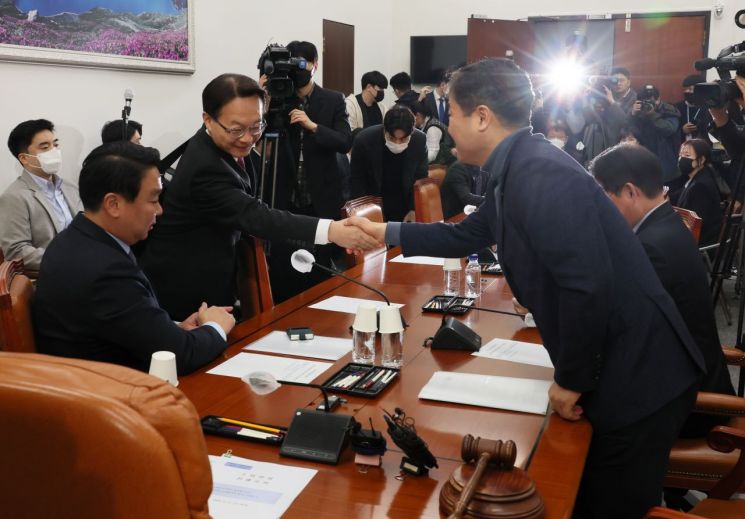
The 2nd Subcommittee of the Special Committee on Political Reform (Subcommittee on Political Relations Law Improvement) held a subcommittee meeting at the National Assembly on the 17th and, after about two hours of closed-door discussions, submitted this resolution proposal.
The three improvement plans were not those previously selected by the Special Committee on Political Reform but were composed based on the three proposals suggested by the Speaker's Advisory Committee. Regarding this, Special Committee member Kim Young-bae said in a back briefing, "During today's draft resolution discussion process, although there were several proposals, the People Power Party decided in their party meeting to focus discussions on the Speaker's Advisory Committee's proposals," adding, "Therefore, to facilitate smooth discussions, it was agreed that the plenary committee would proceed centered on the Speaker's Advisory Committee's proposals while respecting other parties within a broad framework."
The first plan changes the proportional representation seat allocation method from the current semi-compensatory system to a parallel system under the single-member district system. The total number of members is set at 350, comprising 253 constituency seats and 97 proportional representation seats.
The second plan maintains the current method of the single-member district system with the proportional representation seat allocation method as the existing semi-compensatory system. However, it differs in setting the total number of members at 350 seats.
The third plan keeps the total number of members at 300 as before but reduces the number of constituency seats through a mixed urban-rural electoral district system and increases the number of proportional representation seats. It distinguishes between 3-10 member large electoral districts and single-member districts using a large district system. The proportional representation seat allocation method changes from the current semi-compensatory system to a parallel system.
In addition, the Special Committee on Political Reform decided to separately discuss the introduction of an open party-list proportional representation system and the introduction of a dual candidacy system in the plenary committee. It also specified that provisions for social minority consideration, such as mandatory nomination of female candidates, will be discussed together. Each plan also leaves open the discussion of the 'best loser system' element, which allows candidates who lose in constituency elections to simultaneously run as proportional representation candidates.
Before the meeting, Chairperson Cho explained the background of the agreement, saying, "All parties across the political spectrum, as well as the public, share the recognition that the current electoral system does not align with the purpose of political reform," and added, "For the first time in history, more than half of the National Assembly members have come together across party lines to discuss political reform regarding electoral system reform, and the general media and the public have actively participated in the discussions."
Earlier, National Assembly Speaker Kim Jin-pyo proposed holding a plenary committee meeting to reach a bipartisan agreement on the electoral system reform plan. In response, the People Power Party, the Democratic Party of Korea, and the Justice Party each held party meetings the day before and agreed to convene the plenary committee. This has increased the likelihood of a discussion involving all members of the National Assembly.
Once the Special Committee on Political Reform holds a plenary meeting and passes the resolution, ruling and opposition members will begin full-scale discussions on electoral system reform at the plenary committee meeting scheduled for the 23rd. Subsequently, the plenary committee will hold meetings for about two weeks starting from the 27th to continue discussions. Speaker Kim plans to submit the reform plan by the legal deadline for electoral system revision on April 10.
© The Asia Business Daily(www.asiae.co.kr). All rights reserved.
![Clutching a Stolen Dior Bag, Saying "I Hate Being Poor but Real"... The Grotesque Con of a "Human Knockoff" [Slate]](https://cwcontent.asiae.co.kr/asiaresize/183/2026021902243444107_1771435474.jpg)















