Supply Chain Restructuring and Economic Bloc Formation Increase Importance of Bilateral Relations
Opportunity to Expand Export Markets and Strengthen Science and Technology Cooperation
Plan to Restore Ministerial-Level Economic Cooperation Channel
Chief Choi Sang-mok: "Outline to Be Finalized Before Summit"
The Presidential Office announced that it will promptly normalize the economic cooperation framework with Japan in conjunction with President Yoon Suk-yeol's visit to Japan on the 16th and 17th. Given the global supply chain restructuring and the acceleration of economic bloc formation, the intention is for the two countries to establish a mutually beneficial relationship as global supply chain partners.
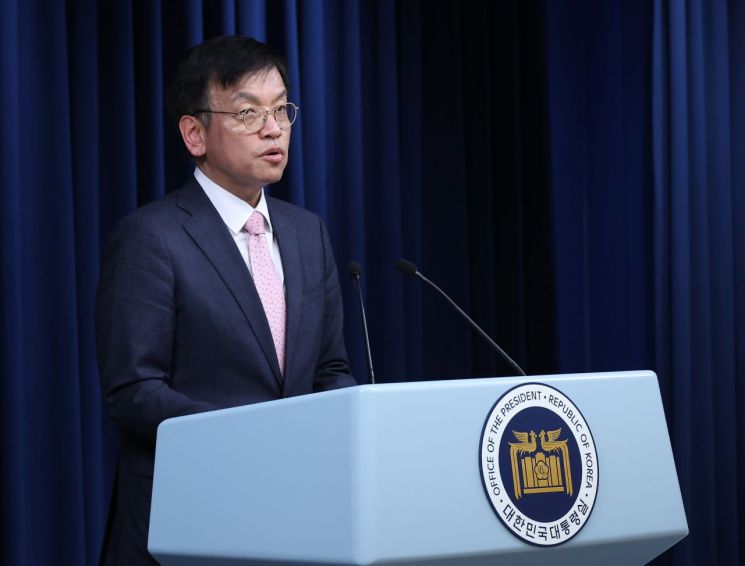
Choi Sang-mok, Senior Secretary for Economic Affairs, stated at a Presidential Office briefing on the afternoon of the 15th, "South Korea is a country that inevitably must find answers for sustainable growth through trade expansion. A structural contraction of global trade is expected, and the supply chain options have narrowed to countries sharing universal values."
He explained the necessity of improving relations with Japan, a key trading partner, amid rapidly changing international circumstances, emphasizing that it is not a choice but a necessity. Choi pointed out, "There is an analysis that the economic loss due to the strained relations with Japan over three years since 2019 amounts to 20 trillion won," adding, "Our economy has already suffered significant losses as Korea-Japan relations have cooled."
He continued, "The future poses an even bigger problem," and added, "According to the International Monetary Fund (IMF) analysis, South Korea is one of the countries most negatively affected by the fragmentation of the global supply chain. The longer the improvement of Korea-Japan relations is delayed, the opportunity cost will grow beyond the losses incurred so far."
Choi also emphasized the need to improve bilateral relations by presenting three reasons: ▲ responding to supply chain restructuring ▲ expanding export markets ▲ strengthening scientific and technological cooperation.
Choi said, "Korea and Japan are core countries in the new economic security system formed among nations sharing values," and pointed out, "If Korea and Japan maintain an uncomfortable relationship and fail to effectively operate supply chain cooperation, the potential losses to our economy and industries could be very large."
He also stated, "As trading partners, Japan will contribute more to our exports in a much more reciprocal relationship than in the past," adding, "Exports to Japan of items such as batteries are expanding, and through the spread of K-pop and other aspects of the Korean Wave, the entry of content consumer goods into Japan is increasing, while strategic partnerships in new industries such as semiconductors and electric vehicles will also be strengthened."
Furthermore, he mentioned, "In the field of science and technology, Japan is the optimal partner for joint research and development (R&D) of new technologies and new industries," and added, "Synergies can be maximized through joint research in strategic technologies such as semiconductors and displays, and basic sciences where Japan has strengths."
Choi particularly elaborated, "In high-cost, high-risk R&D fields, cooperation between the two countries is expected to reduce R&D risks and costs."
The government plans to restore ministerial-level cooperation channels in economic fields such as finance, trade, and science and technology, which have been suspended between the two countries, and to discuss major projects with a sense of urgency to create expected benefits from improving Korea-Japan economic relations, Choi explained.
Regarding the possibility of lifting Japan's export restrictions on South Korea and restoring the whitelist through the Korea-Japan summit between President Yoon and Japanese Prime Minister Kishida Fumio on the 16th, Choi said, "Discussions are underway to revert to the status before July 2019 concerning export restrictions," adding, "The outcome of the talks will be outlined before the summit."
In response to opposition party criticisms that the effect will not be significant because South Korea has largely reduced its dependence on Japan for materials, parts, and equipment (so-called 'Sobujang'), Choi rebutted, "Our companies have experienced various inconveniences and made efforts to diversify import sources and increase domestic production capacity, achieving some results," and added, "Resolving the negative impact on the three export-restricted items is not the entirety of improving Korea-Japan relations."
He emphasized that global trade itself is becoming difficult due to protectionism, regionalization, and trade disputes between the U.S. and China, and that the value of Japan as a trading partner and supply chain cooperation partner has increased, making economic cooperation with Japan inevitable.
Regarding speculation that the Korea-Japan "cormorant economy" will be restored, Choi clarified that South Korea's conditions are not unfavorable as it currently holds advantages over Japan in fields such as semiconductors, digital technology, and content. The "cormorant economy" refers to South Korea's economic structure where most raw materials for exports are imported from Japan, causing Japan to take a significant portion of the profits from exports. Choi said, "The conditions now allow for more equal and reciprocal trade than in the past," and added, "While we will pursue localization in areas where our economic and industrial dependence on Japan is high, leveraging our competitive sectors for cooperation will benefit our national interests."
Choi also conveyed that on the second day of President Yoon's visit to Japan, the president is scheduled to attend a business roundtable hosted by the Federation of Korean Industries and Keidanren (Japan Business Federation), representing the business communities of both countries, to present a vision for economic cooperation.
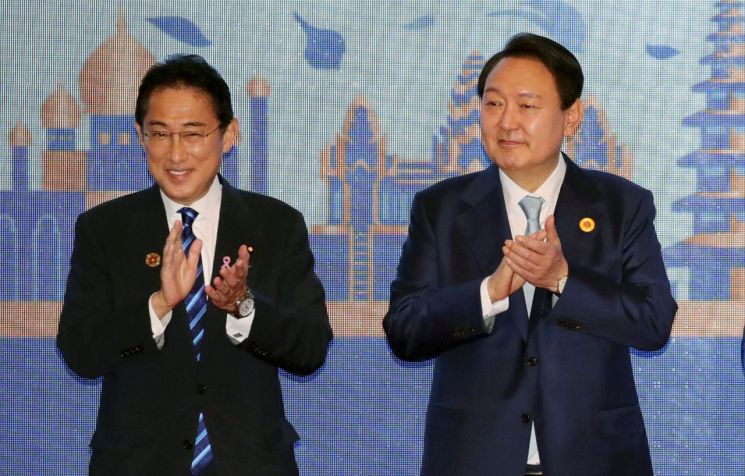 President Yoon Suk-yeol will visit Japan on the 16th of this month to hold a summit meeting with Japanese Prime Minister Fumio Kishida (left). [Image source=Yonhap News]
Meanwhile, Lee Do-woon, spokesperson for the Presidential Office, reported that President Yoon held a luncheon meeting with senior figures knowledgeable about Korea-Japan relations on the same day. The meeting was attended by seven senior social figures well-versed in Korea-Japan relations, including former Prime Minister Lee Hong-gu, Kim Sung-jae, director of the Kim Dae-jung Academy, former ambassadors to Japan Choi Sang-yong, Ra Jong-il, former Foreign Minister (and former ambassador to Japan) Yoo Myung-hwan, former ambassador to Japan Yoo Heung-soo, and Lee Dae-soon, chairman of the Korea-Japan Cooperation Committee.
President Yoon listened to the participants' opinions on the government's announced solutions to the forced labor issue and the direction of Korea-Japan relations on the 6th, and urged them to continue striving for a future-oriented development of Korea-Japan relations.
© The Asia Business Daily(www.asiae.co.kr). All rights reserved.
![Clutching a Stolen Dior Bag, Saying "I Hate Being Poor but Real"... The Grotesque Con of a "Human Knockoff" [Slate]](https://cwcontent.asiae.co.kr/asiaresize/183/2026021902243444107_1771435474.jpg)

















