The Bank of Korea's 'Money and Liquidity' Statistics... Decreased by 6.7 Trillion Won Compared to the Previous Month
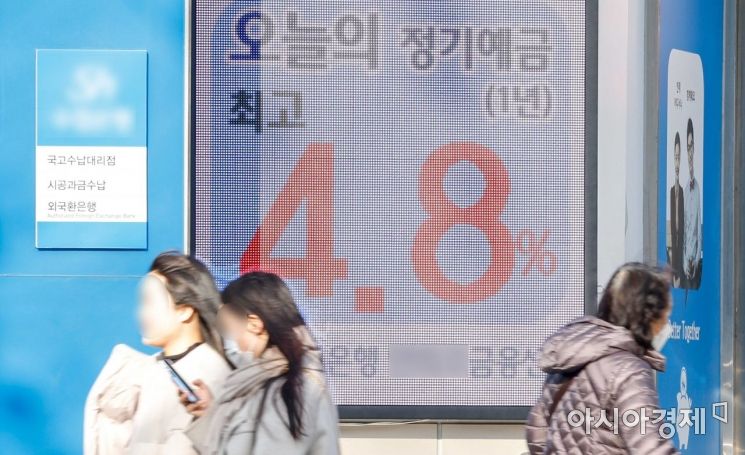
Amid the continued increase in regular savings and time deposits in January due to the base interest rate hike, the money supply in January showed its first decline since August 2013. Additionally, demand deposits for savings accounts recorded the largest-ever decrease as companies withdrew funds for reasons such as VAT payments.
According to the 'Money and Liquidity' statistics released by the Bank of Korea on the 15th, the average broad money supply (M2) balance in January was 3,803.4 trillion won, down 6.7 trillion won (0.2%) from December last year. The M2 money supply growth rate for December last year was initially announced as -0.2%, but after adjustments for regular account changes (targeting 2018?2022), it was revised to 0.1%.
The broad money supply indicator M2 includes cash, demand deposits, and demand savings deposits (all part of M1), as well as money market funds (MMF), time deposits under two years, installment savings, beneficiary certificates, negotiable certificates of deposit (CD), repurchase agreements (RP), financial bonds under two years, and money trusts under two years?short-term financial products that can be quickly converted into cash.
The phenomenon of investors flocking to regular savings and time deposits due to the interest rate hike continued in January. The Bank of Korea explained, "While the preference for safe assets persisted, leading to an increase in regular savings and time deposits, the growth rate slowed due to a slight decline in deposit interest rates. Demand deposits for savings accounts sharply decreased as corporate fund outflows continued due to VAT payment issues."
M2 has been showing a continuous slowdown in growth since December 2021 (13.2%). The year-on-year growth rates were 12.7% in January last year, 11.8% in February, 10.8% in March, 9.5% in April, 9.4% in May, 9.0% in June, 8.3% in July, 7.5% in August, 7.0% in September, 6.4% in October, 5.9% in November, 5.0% in December, and 4.3% in January this year, continuing the deceleration trend.
Looking at M2 by financial product, regular savings and time deposits increased by 18.9 trillion won compared to the previous month, and MMF (15.4 trillion won) and beneficiary certificates (4.2 trillion won) also rose due to the recovery in stock and bond investment demand. On the other hand, demand deposits for savings accounts decreased by 25.8 trillion won, marking the largest decrease ever recorded.
By economic agents, households and non-profit organizations increased by 14.7 trillion won, while corporations decreased by 4.6 trillion won.
Meanwhile, M1 (narrow money), a short-term fund indicator, stood at 1,207 trillion won, decreasing by 33.4 trillion won (2.7%) from the previous month due to a significant drop in transaction deposits. This marks eight consecutive months of decline since June last year (-0.4%). Year-on-year, it decreased by 11.1%, continuing the decline for five consecutive months.
As the money supply turned to a decline for the first time in nine years and five months in January, analyses suggest that the effects of the base interest rate hike are becoming evident. It is believed that the money supply shifted to a downward trend as the impact of the Bank of Korea's 3 percentage point increase in the base rate since August 2021 began to be reflected.
© The Asia Business Daily(www.asiae.co.kr). All rights reserved.
![Clutching a Stolen Dior Bag, Saying "I Hate Being Poor but Real"... The Grotesque Con of a "Human Knockoff" [Slate]](https://cwcontent.asiae.co.kr/asiaresize/183/2026021902243444107_1771435474.jpg)















