Major Corporations Increase from 8% to 15%
Opposition Demands Expansion from Semiconductors to Hydrogen and Electric Vehicles
Ruling Party and Government "Careful Review" Stance but Broad Agreement Reached
The passage of the so-called 'K-Chips Act (Amendment to the Restriction of Special Taxation Act),' which increases tax benefits for facility investments in national advanced strategic technology industries such as semiconductors, is coming into view in the National Assembly. With the Democratic Party of Korea accepting the government's proposal to raise the tax credit rate, legislation supporting advanced industries is expected to gain momentum.
Park Hong-geun, the floor leader of the Democratic Party, stated at the Supreme Council meeting held at the National Assembly on the 15th, "It is important for the ruling and opposition parties to join hands amid the economic crisis in the semiconductor industry and others," adding, "The Democratic Party has accepted additional semiconductor tax credits despite concerns over policy confusion and revenue loss in order to fulfill its responsibility and role as a competent alternative party in the economy and people's livelihood."
In this regard, the National Assembly's Planning and Finance Committee plans to hold a tax subcommittee meeting on the 16th to review and process the amendment to the Restriction of Special Taxation Act, which expands the tax credit rate for national advanced industries such as semiconductors.
In January, the government proposed an amendment to the Restriction of Special Taxation Act to raise the tax credit rate for investments in commercialization facilities of national strategic technologies such as semiconductors from the current 8% to 15% for large and medium-sized enterprises, and from 16% to 25% for small and medium-sized enterprises. The amendment also includes an additional 10% credit for the amount exceeding the average investment over the past three years, applicable only for this year.
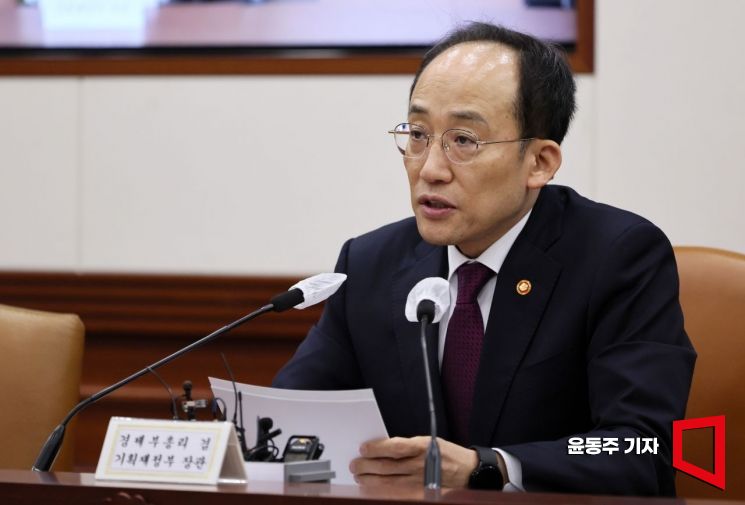 Deputy Prime Minister for Economy Choo Kyung-ho is delivering opening remarks at the Emergency Economic Measures Meeting held at the Government Seoul Office Building on the 8th. Photo by Dongju Yoon doso7@
Less than a month after the amendment, the government and ruling party again pushed for a higher tax rate, while the opposition continued to oppose it. However, the Democratic Party announced after a closed-door meeting the day before that it would accept this proposal. They also suggested expanding the scope of national strategic technologies eligible for tax credit benefits. The proposal is to broaden the existing four fields?semiconductors, secondary batteries, vaccines, and displays?to include renewable energy, green hydrogen, and future vehicles (electric vehicles).
Additionally, the scope of strategic technology projects, currently determined by enforcement ordinances, is expected to be elevated to a legal statute. Shin Dong-geun, the opposition floor whip of the Planning and Finance Committee from the Democratic Party, plans to submit an amendment containing this provision to the National Assembly. In a phone interview, Shin explained, "This reflects the meaning that the legislative branch should provide opinions because the Ministry of Economy and Finance arbitrarily determines the projects."
However, while the government and ruling party are optimistic about the bill's passage, they hold a cautious stance regarding elevating the designation of national strategic technology scope to a legal statute, so difficulties are expected during the discussion process. A government official said, "It is true that promising new businesses such as future vehicles and renewable energy are source technologies," but added, "It is questionable whether they can be classified in the same category as semiconductors, which are considered from a national security perspective." The Ministry of Economy and Finance plans to explain the purpose of national strategic technologies in detail at the tax subcommittee to facilitate review. Ryu Seong-geol, the ruling party whip from the People Power Party, also stated, "We will discuss it thoroughly at the tax subcommittee."
The K-Chips Act was designated as a budget-related bill last year and passed as originally proposed by the government, but after criticism from the Presidential Office that the tax rate was too low, an amendment to raise the rate was introduced, drawing opposition from the opposition parties. However, given the increasing difficulties faced by the semiconductor industry and the repeated criticisms that national support is grossly insufficient, the opposition appears to have shifted its stance.
Although there are some disagreements regarding the expansion of eligible items, the ruling and opposition parties have reached a broad consensus. If a conclusion is reached at this tax subcommittee, the amendment is likely to be processed at the full Planning and Finance Committee meeting on the 22nd and then at the plenary session scheduled for the 30th.
© The Asia Business Daily(www.asiae.co.kr). All rights reserved.
![Clutching a Stolen Dior Bag, Saying "I Hate Being Poor but Real"... The Grotesque Con of a "Human Knockoff" [Slate]](https://cwcontent.asiae.co.kr/asiaresize/183/2026021902243444107_1771435474.jpg)















