4 Core Goals: Smart 15-Minute City, Global Hub, Youth Vitality, Carbon Neutrality
Reorganization of 10 Specialized Core Areas by Function in Downtown and Sub-Center Zones
Busan City has finalized and announced the "2040 Busan Urban Master Plan," the highest-level urban spatial plan that will shape Busan's next 20 years.
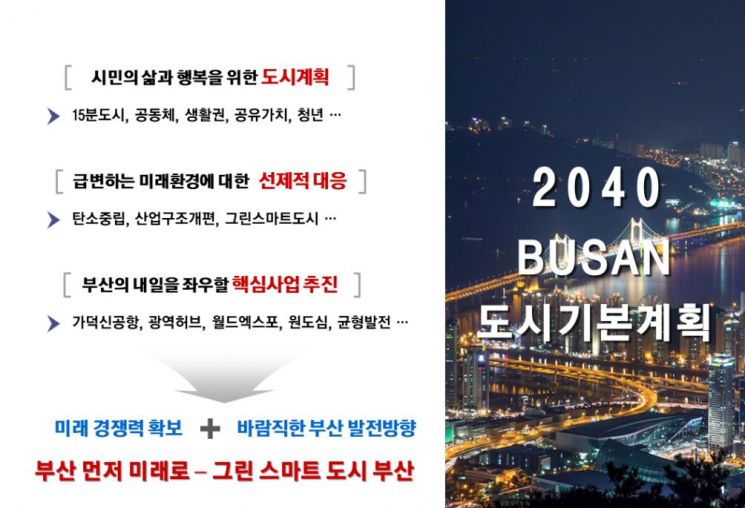
This Busan Urban Master Plan presents a future vision and development strategy for Busan, reborn as a city where people want to live again, by systematically and flexibly responding to the new paradigm of the digital transformation, the changes in modern society entering an era of low growth, low birthrate, and aging population, as well as global issues such as climate change, infectious diseases, and the 4th Industrial Revolution.
◆ Future Vision of the City and Reorganization of Urban Spatial Structure
The plan sets the city’s future vision as “Busan First to the Future - Green Smart City Busan” and includes the reorganization of the urban spatial structure for balanced regional development.
Specifically, regarding the reorganization of the urban spatial structure, the existing hierarchical central place system composed of downtown and sub-centers will be changed into a multi-core structure with 10 functionally specialized cores to drive balanced regional development. A “Central Place Development Plan” will be established to advance the functions of each center.
Through the Central Place Development Plan, directions and strategies for fostering central place functions will be set, and active urban planning support such as zoning adjustments, density increases, and district unit plan guidelines will be promoted accordingly.
For Busan, the city of water, a “Waterfront Specialized Basic Plan” will be established for the coastal and river areas. This aims to revitalize land use in waterfront areas and secure publicness, transforming the urban spatial structure into a waterfront-centered city that reflects the lifestyle of Busan citizens.
Centered on 130 urban railway station areas, a “Station Area Activation Plan” will be established to prepare zoning adjustment standards and public contribution measures by station area type in connection with central places. By analyzing surrounding living zones, necessary social overhead capital (SOC) facilities such as care and cultural facilities will be provided as public contribution facilities to make citizens’ daily lives more convenient.
An “Industrial Area Activation Plan” will also be promoted to reorganize aging industrial areas into clusters for Busan’s strategic industries and leading manufacturing, future new industries, and urban service and mixed-use areas.
In February, the city held a public hearing after establishing the nation’s first draft of the 2030 Busan Urban Industrial Area Basic Plan. The plan includes designating industrial innovation zones to enable complex industrial land use where single industrial function spaces can integrate industry, commerce, residential, and cultural functions.
◆ Four Core Goals and Development Strategies
Four core goals reflecting future competitiveness and desirable development directions for Busan were also presented: ▲Smart 15-minute City ▲Global Hub City (super-regional economic network, Gadeokdo New Airport, 2030 Busan World Expo, introduction of metropolitan and new transportation networks, etc.) ▲Youth Vitality Future City (youth housing and jobs, relocation of the Korea Development Bank, etc.) ▲Carbon-neutral Healthy City (eco-friendly green healing spaces, publicization of the Baptism Hospital, specialized pediatric emergency hospital, etc.).
◆ Establishment of Living Zones
To reflect the urban spatial structure for realizing the city’s future vision and to promote balanced regional development, the concept of medium living zones was introduced.
Previously, development directions were established for three major large living zones, but to reflect regional characteristics that cannot be secured by the existing large living zones alone and to form a basic unit for balanced regional development, six medium living zones were set. Development directions for each living zone and guidelines for setting small living zones were presented together, laying the foundation for realizing a Busan-type 15-minute city and establishing a multi-core urban spatial structure.
◆ Land Use Plan
▲To respond to the era of population decline, a compact-network strategy was pursued to functionally concentrate the urban spatial structure by spatial hierarchy, aiming to improve efficiency in the use of urban functions and facilities. A land use plan linked with the supply of living infrastructure facilities tailored to lifestyles at the living zone level was established.
▲Regarding demand by land type, residential land is 149.882㎢, commercial land is 28.682㎢, industrial land is 65.793㎢, and planned urbanization land is 52.978㎢.
◆ Planning Indicators
Additionally, reflecting the era of population decline, the Busan Urban Master Plan sets a planned population of 3.5 million by 2040, and includes planning indicators for sustainable urban growth and development such as expanding urban parks to 21.5㎡ per capita, expanding 250 village health centers, increasing renewable energy power self-sufficiency to 40%, and reducing greenhouse gas emissions by 73.5% compared to 2018.
Im Kyung-mo, Director of the City Planning Bureau, said, “The significance of the 2040 Busan Urban Master Plan, the highest-level urban spatial plan, is great in securing regional balanced development and urban competitiveness and leading Busan’s future.” He added, “With this plan, we will take the lead in creating Busan as a global hub city that responds to the unipolar system of the metropolitan area.”
The 2040 Busan Urban Master Plan can be viewed through the Busan City Urban Planning Division, the urban planning departments of each district and county, and the Urban Planning Agora website.
© The Asia Business Daily(www.asiae.co.kr). All rights reserved.
![Clutching a Stolen Dior Bag, Saying "I Hate Being Poor but Real"... The Grotesque Con of a "Human Knockoff" [Slate]](https://cwcontent.asiae.co.kr/asiaresize/183/2026021902243444107_1771435474.jpg)















