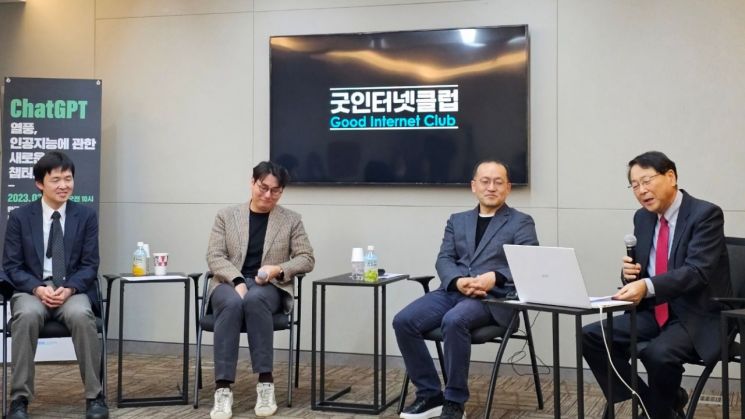
 On the 14th, the 84th Good Internet Club was held at the Korea Internet Corporations Association in Seocho-gu, Seoul, with ChatGPT as the theme. From the left: Eunsoo Kim, Ph.D. from Seoul National University; Youngjin Yoon, leader at Naver Cloud; Youngjun Choi, professor at Yonsei University; Jinhyung Kim, emeritus professor at KAIST.
Concerns have been raised that the digital divide will deepen with the advent of the artificial intelligence (AI) era. It is explained that the living standards between those who can utilize AI technology and those who cannot will greatly diverge amid the rapid development of AI technology.
On the 14th, the Korea Internet Corporations Association held the "84th Good Internet Club" under the theme "The ChatGPT Craze, the Beginning of a New Chapter on Artificial Intelligence." The Good Internet Club has been a platform since 2014 where experts exchange information on major issues once a month.
This Good Internet Club was moderated by Professor Emeritus Jin-Hyung Kim of KAIST. The panel included Professor Young-Jun Choi from Yonsei University’s Department of Public Administration, Dr. Eun-Soo Kim from Seoul National University’s AI Policy Initiative, and Young-Jin Yoon, a leader at Naver Cloud.
Professor Choi compared the global ChatGPT craze to a massive wave. He said, “It is not advisable to go against the huge wave called AI,” adding, “It is time to discuss how surfers can ride and overcome this enormous wave well.”
At the same time, Professor Choi raised concerns about the digital divide. He explained, “In the AI era, the ability to read and understand data will become extremely important. If only a few advance ahead with this ability while the majority fall behind, a gap in national capabilities will emerge, making proactive education necessary.”
Dr. Kim agreed with this view. He said, “Before ChatGPT, AI was not something people could feel directly, but now it has started to be felt firsthand,” adding, “As the technology level rapidly changes, a sense of crisis about the information gap is felt. The role of government agencies is necessary.”
Professor Emeritus Kim emphasized the need for legal and institutional support from the government, saying, “Everyone agrees on the importance of AI, but the reality is that there are not yet enough people prepared to teach it.”
Leader Yoon added, “There are many concerns about using ChatGPT to produce assignments or reports, but just as having computers and calculators does not mean we stop teaching arithmetic, we need an approach on how to effectively utilize generative AI tools going forward.”
Regarding the development of the AI industry, opinions were expressed that market-driven regulation is necessary.
Dr. Kim said, “If AI industry regulations are introduced prematurely, they could block the unforeseen potential of the technology. Instead of lowering the will to develop at the development stage, it is important to create an environment where problems could arise and quickly discuss how to regulate when actual problems occur.”
Professor Choi explained, “Research on innovation over the past 20 years shows that Nordic countries have better startup environments than the United States,” adding, “This results from the absence of resistance to technology, and it is not advisable to start by worrying about regulations for new technologies.”
© The Asia Business Daily(www.asiae.co.kr). All rights reserved.
![Clutching a Stolen Dior Bag, Saying "I Hate Being Poor but Real"... The Grotesque Con of a "Human Knockoff" [Slate]](https://cwcontent.asiae.co.kr/asiaresize/183/2026021902243444107_1771435474.jpg)















