[Aftermath of Forced Labor Solution]
Hardline Approach vs. Realism Competing in Japan-Korea Relations
Must Resolve Future-Oriented Through Compromise Approach
‘Hardline Response vs. Realism’
The solutions to the historical issues in Korea-Japan relations, exposed through the announcement of the forced labor resolution, can be summarized into these two approaches.
The hardline approach argues that from our perspective, the 1965 Korea-Japan Claims Agreement system, which is the ‘first misaligned button’ of Korea-Japan relations, should be completely abolished or revised. It involves taking the issue to the International Court of Justice to settle the legality or illegality of colonial rule once and for all. The realism approach acknowledges the parallel lines of unresolved historical issues over the 58 years since diplomatic relations were established and focuses on a future-oriented relationship in areas such as economy and security. The Yoon Seok-yeol administration, which adopted the ‘third-party subrogation payment’ method, can be seen as choosing the latter.
Experts diagnose that regardless of which solution is pursued, if a future-oriented Korea-Japan relationship is to be sought, the issues should not be viewed through a dichotomy or zero-sum game. Choosing either realism or hardline should not be hastily interpreted as being ‘pro-Japan (chinil) or anti-Japan (bannil).’ The logic of ‘if Korea loses, Japan wins, and if Japan loses, Korea wins’ cannot untangle the complex Korea-Japan diplomacy like a tangled thread.
Full-scale Battle Over Interpretation of Korea-Japan Claims Agreement... Hardline Response
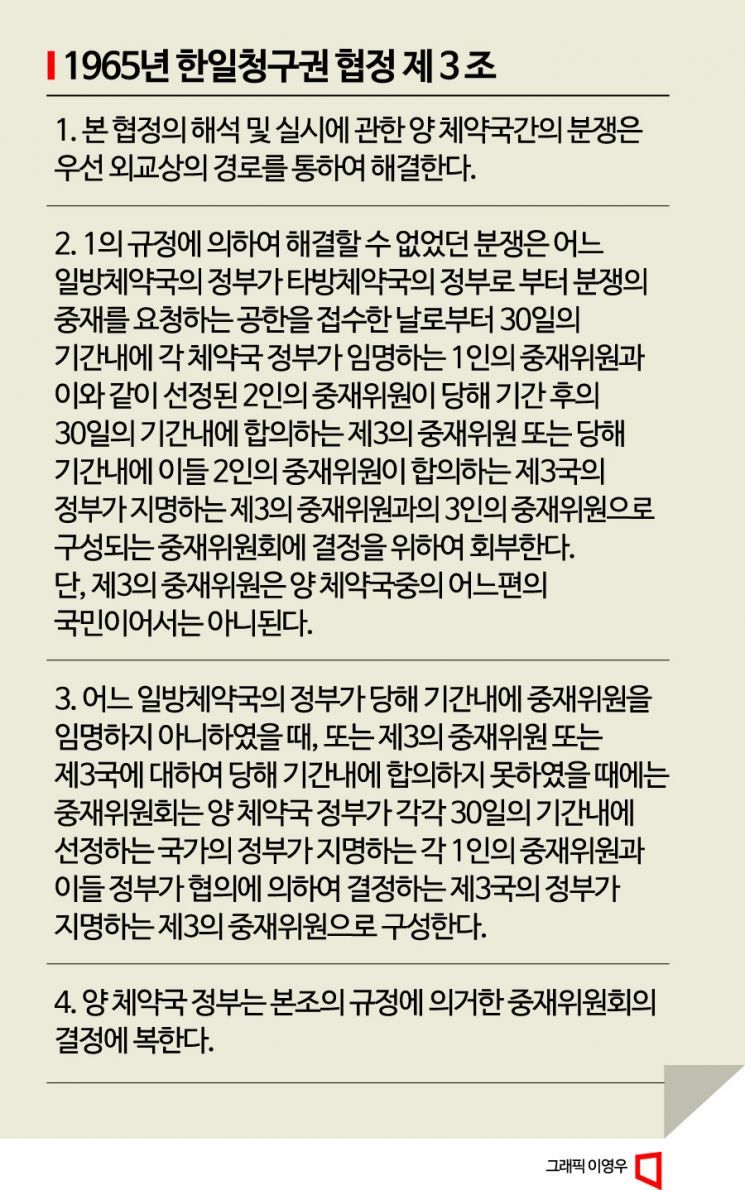
The hardline response argues that the 1965 Korea-Japan Claims Agreement, which was unfairly concluded from our perspective, should be revised and supplemented. It demands ‘direct’ compensation and ‘direct’ apology from the wartime perpetrator companies without compromise.
The endpoint of the hardline approach could be to bring the issue of the legality or illegality of colonial rule to the International Court of Justice (ICJ). Since rulings from the Korean Supreme Court and the Japanese Supreme Court conflict, the matter would be examined under international law. Beyond this, it is even conceivable to convene a dispute arbitration committee under Article 3 of the 1965 Korea-Japan Claims Agreement. The agreement at the time stipulated that if there were differences in treaty interpretation between the two countries, they should reach an agreement through arbitrators appointed by a third country’s government.
However, even if the case goes to arbitration, it is uncertain whether the outcome would be favorable to Korea. The procedures?from acceptance of the arbitration request, appointment of third-country arbitrators, to setting the arbitration agenda?are not simple. Since both countries must unconditionally accept the result, any outcome would provide diplomatic grounds to persuade the domestic audience, which is an advantage. However, the existing international legal order is centered on Western countries that had colonies, which is a variable. In fact, the Moon Jae-in administration rejected Japan’s 2019 request to convene a dispute arbitration committee under the 1965 Korea-Japan Claims Agreement for these reasons.
Recognize Fundamental Differences and Look to the Future... Realism
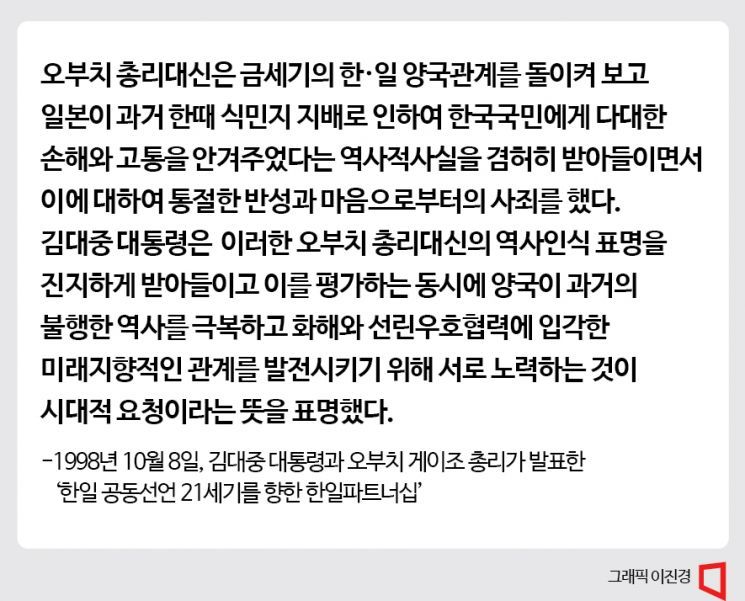
The opposing view is realism. It holds that if the fundamental differences in historical recognition are only disputed, Korea-Japan relations will drift for a long time, and neither side can pursue practical benefits, so resolving the strained relations should come first. The pragmatism that says ‘We cannot sever diplomatic ties with Japan over historical issues’ and ‘We must objectively evaluate the perspective that views Korea-Japan relations solely through ethnic pride’ originates here.
Realism positively evaluates the Yoon Seok-yeol administration’s ‘third-party subrogation payment’ plan as a proactive solution from our government regarding the forced labor issue that froze bilateral relations.
This also reflects the reality that all colonial powers, including Germany, have never officially recognized the right to claim compensation for war crimes. China is also a precedent. Instead of claiming war reparations, reconciliation and compensation were achieved through exchanges between companies and civilians. China declared the waiver of compensation claims in Article 5 of the 1972 Joint Communiqu? normalizing diplomatic relations with Japan. This was also evaluated as a ‘virtue repays resentment’ (以德報怨) diplomacy.
Professor Lee Won-duk of Kookmin University said, “Japan’s advances and retreats in recognizing its past depend on how we handle Korea-Japan relations and the function of progressive forces within Japan, so realistic conditions must be considered. It is a difficult problem to solve by going only in a hardline confrontational direction.”
Must Overcome the Unreasonable 1965 Korea-Japan Claims Agreement System
Whether hardline or realism, experts agreed that the 1965 system must be surpassed and that bilateral relations should reach a new turning point. However, they diagnosed that this requires Japan’s ‘sincere response’ at the Korea-Japan summit on the 16th-17th and an agreement on historical recognition beyond the 1965 system.
Professor Lee said, “Korea-Japan relations have not remained stagnant but have continuously evolved since the 1965 Korea-Japan Claims Agreement, but Japan has not yet reached the point of recognizing the illegality of colonial rule. It must also be acknowledged that this issue is difficult to compromise under 21st-century norms,” adding, “Under such realistic foundations, it is important to solve problems one by one.”
Kim Sook-hyun, senior researcher at the National Security Strategy Institute, said, “This forced labor resolution should be seen as a political decision, not a matter of negotiation, and since President Yoon made a proactive decision that Prime Minister Kishida could not make, it will be difficult to reach a satisfactory agreement without active cooperation from the Japanese government.” Professor Park Cheol-hee of Seoul National University said, “If we consider the historical issues in Korea-Japan relations as finally and completely resolved, it is a failure. It is important to create a starting point with various reflections. We need to look at what we can obtain from Japan through the summit on the 16th-17th, the G7 meeting, shuttle diplomacy, and other processes with a longer-term perspective.”
© The Asia Business Daily(www.asiae.co.kr). All rights reserved.
![Clutching a Stolen Dior Bag, Saying "I Hate Being Poor but Real"... The Grotesque Con of a "Human Knockoff" [Slate]](https://cwcontent.asiae.co.kr/asiaresize/183/2026021902243444107_1771435474.jpg)
















