'The Impact of Eating Alone on the Happiness of Children and Adolescents'
Negative Effects Are Greater for Middle-Class Children Who Eat Alone
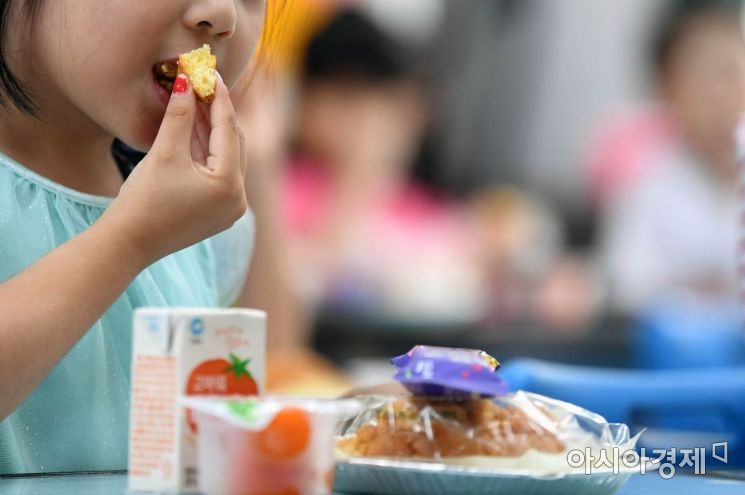 A study found that the more children eat alone (honbap), the lower their sense of happiness becomes.
 [Photo by Asia Economy]
It was found that the more children eat alone ('honbap', eating meals alone), the lower their sense of happiness becomes. This can be interpreted to mean that children who are relatively not poor are more vulnerable to the negative effects of eating alone.
According to the paper "The Effect of Eating Alone on the Happiness of Children and Adolescents" (Jeong Ikjung, Lee Sujin, Jeong Sujeong, Lee Wonji), published in the latest issue of "Korean Social Welfare Studies" on the 14th, the more children eat alone, the lower their happiness.
This study analyzed data from 570 children aged 11 to 17 nationwide who responded to the "2021 Child Happiness Index Survey" conducted by the Green Umbrella Children’s Foundation, specifically those who had all six meals over two weekdays.
Respondents rated their happiness on a scale from 0 (not happy at all) to 10 (very happy).
As a result, among the 570 children, the average happiness score of 326 children who did not eat alone was 7.14. However, the average happiness scores decreased in the order of 7.01 for children who ate alone once (94 children), 6.60 for twice (100 children), and 6.44 for three or more times (50 children).
Previous research has shown that the most representative factor lowering children's happiness, including eating alone and academic burden, was parental income level. Residential poverty caused by low economic status of parents itself triggers family conflicts, shrinks peer relationships, and negatively affects both mental and physical health.
The research team then investigated the relationship between eating alone and children's happiness according to household income. For this, the children surveyed were divided into poor households (below 50% of the standard income) with 152 children and non-poor households with 418 children for analysis.
The study found that when the number of times eating alone was zero, children from non-poor households had higher happiness than those from poor households. However, as the frequency of eating alone increased, the happiness of children from non-poor households became lower than that of children from poor households.
The research team explained, "Children who are not poor are more vulnerable to the negative effects of eating alone, as the frequency of eating alone tends to increase mainly near private academies."
© The Asia Business Daily(www.asiae.co.kr). All rights reserved.
![Clutching a Stolen Dior Bag, Saying "I Hate Being Poor but Real"... The Grotesque Con of a "Human Knockoff" [Slate]](https://cwcontent.asiae.co.kr/asiaresize/183/2026021902243444107_1771435474.jpg)















