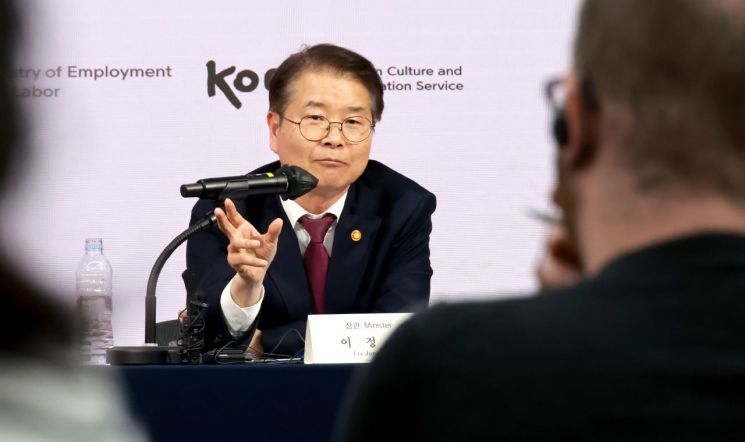
 Lee Jung-sik, Minister of Employment and Labor, is speaking at a policy discussion meeting for foreign correspondents held on the 9th at the Korea Press Center in Jung-gu, Seoul.
 [Image source=Yonhap News]
On the 14th, after President Yoon Suk-yeol instructed a supplementary review of the working hours system reform plan, the Ministry of Employment and Labor stated, "We will gather opinions from various sectors and devise supplementary measures."
The ministry explained, "Regarding the system reform plan, there have been some misunderstandings based on unrealistic assumptions. In particular, the younger generation is expressing concerns that extended working hours might increase without proper compensation and whether they will actually be able to rest after working, fearing potential abuse of the system."
Earlier, on the 6th, the Ministry of Employment and Labor announced the working hours system reform plan and issued a legislative notice for the government's bill. According to the reform plan, the government decided to allow choosing between a maximum weekly working hour of 69 hours or 64 hours instead of the existing 52 hours. If an '11-hour continuous rest' between working days is guaranteed, the maximum is 69 hours per week; otherwise, it is 64 hours per week.
The intention was to move away from the rigid working hours system, allowing more work during busy times while reducing total working hours to increase four-day workweeks or long vacations. However, among workers, concerns surged that "vacations would be impossible, and only overtime would increase."
The 'Saerogochim Workers' Council,' which aims to be an 'MZ generation union,' also opposed the government's reform plan, stating that it "contains elements that regress or reverse the international community's efforts and historical progress in raising minimum labor standards."
As the controversy grew, President Yoon Suk-yeol instructed on the same day, "During the legislative notice period, carefully listen to the diverse opinions of workers, especially those of the MZ generation, and review points for improvement regarding the bill's content and communication with the public."
Through a statement on the same day, the Ministry of Employment and Labor said, "We will strive to realize the purpose of the working hours system reform with the understanding and consensus of the public," adding, "Since this is the legislative notice period for the current bill, we will listen attentively to the diverse voices of the public, including youth, and actively engage in communication."
They continued, "We will provide thorough and accurate explanations about the reform plan's content and the concerns raised," emphasizing, "We will also devise various supplementary measures based on gathering opinions from all sectors to ensure that the working hours system reform becomes an opportunity for workers to have control over their time and for innovation in corporate culture."
In particular, the ministry added, "We will strongly respond to the misuse of the comprehensive wage system that leads to 'free overtime' without proper compensation to restore labor order."
© The Asia Business Daily(www.asiae.co.kr). All rights reserved.
![Clutching a Stolen Dior Bag, Saying "I Hate Being Poor but Real"... The Grotesque Con of a "Human Knockoff" [Slate]](https://cwcontent.asiae.co.kr/asiaresize/183/2026021902243444107_1771435474.jpg)















