Professor Moon Juho's Yonsei University Research Team
Unveils Chiral Phase Transition Mechanism
Successfully Develops Metal Oxide Photoelectrode
Domestic researchers have developed a technology that can dramatically improve the efficiency of solar-powered green hydrogen production.
The National Research Foundation of Korea announced on the 14th that Professor Moon Ju-ho's research team at Yonsei University identified the deposition mechanism of chiral oxides and developed a chiral photoelectrode based on metal oxides with enhanced performance.
The solar water-splitting system, which produces hydrogen using the infinite natural energy of sunlight and water, is gaining attention as an eco-friendly future technology. Chirality refers to asymmetry, describing molecular structures that cannot be superimposed on their mirror images.
The solar water-splitting system using photoelectrodes is theoretically more economical and efficient than conventional solar cell-electrolysis systems due to inexpensive materials and simple system design. However, it has limitations in actual performance improvement because the electrodes recognize electrons merely as simple charge carriers. Although quantum mechanical improvement methods involving the integration of chiral materials into photoelectrodes were proposed, they faced challenges such as low operational stability and were limited to organic materials with catalytic activity, making it difficult to overcome existing limitations.
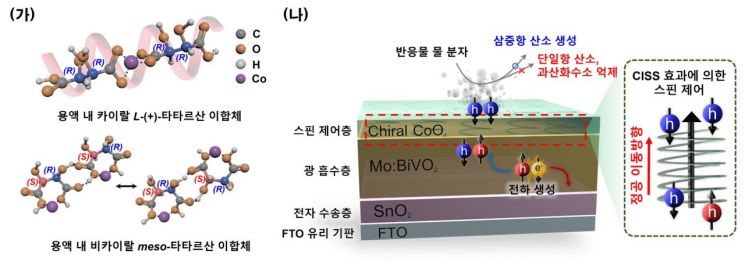 Figure 1 (a) (top) The dimer with chiral L-(+)-tartaric acid has one metal ion and a unidirectional structure, while (bottom) the dimer with achiral meso-tartaric acid is fully chelated* with the metal ion and has a multidirectional structure. The difference in molecular structure due to the chirality of the organic molecule can impart chirality to the final deposited metal oxide.
 * Chelate: A complex ion formed when a single ligand forms coordinate bonds with a metal ion at two or more sites
- Figure 2 (b) Photogenerated charges at the photoelectrode pass through the spin control layer composed of chiral metal oxide, where spin alignment occurs due to CISS. This suppresses the generation of singlet oxygen and hydrogen peroxide, favoring the generation of triplet oxygen at low overpotential. Photo by Juho Moon, Yonsei University.
The research team aimed to apply chiral materials based on metal oxides to photoelectrodes by elucidating the chirality transition mechanism in metal oxide synthesis and developed a new photoelectrode based on this understanding. Chiral materials based on metal oxides exhibit higher chemical resistance and superior electrochemical properties compared to organic materials, and they form heterojunctions with photoelectrodes to enhance charge separation efficiency.
Based on this principle, they synthesized chiral materials based on metal oxides with long-term operational stability and high catalytic activity and developed chiral metal photoelectrodes. By imparting chirality to metal oxides and controlling the electron spin, recombination at the electrolyte-catalyst interface was suppressed, and photocurrent density was improved, resulting in the suppression of performance-inhibiting byproducts and enhanced oxygen evolution efficiency.
Experimental results showed that the new chiral metal photoelectrode improved photocurrent density and O2 generation efficiency by approximately 23% and 20%, respectively. During continuous operation for 80 hours, the efficiency of the chiral electrode was 85.1%, higher than the 73.2% of the non-chiral electrode.
Professor Moon said, “Understanding the chirality transition in the deposition solution can be applied to various substrates and materials, extending beyond photoelectrodes to catalysts, secondary batteries, displays, and a wider range of applications. We plan to focus on developing materials with higher chirality effects and catalytic activity to enable implementation at an industrial scale.”
The research results were published on January 25 in the international environmental journal Energy & Environmental Science.
© The Asia Business Daily(www.asiae.co.kr). All rights reserved.
![Clutching a Stolen Dior Bag, Saying "I Hate Being Poor but Real"... The Grotesque Con of a "Human Knockoff" [Slate]](https://cwcontent.asiae.co.kr/asiaresize/183/2026021902243444107_1771435474.jpg)















