Fed's Opposite Move Fails to Prevent Losses
Risk Officer Position Vacant for Over Six Months
CEO Sells Shares Amid Company Crisis
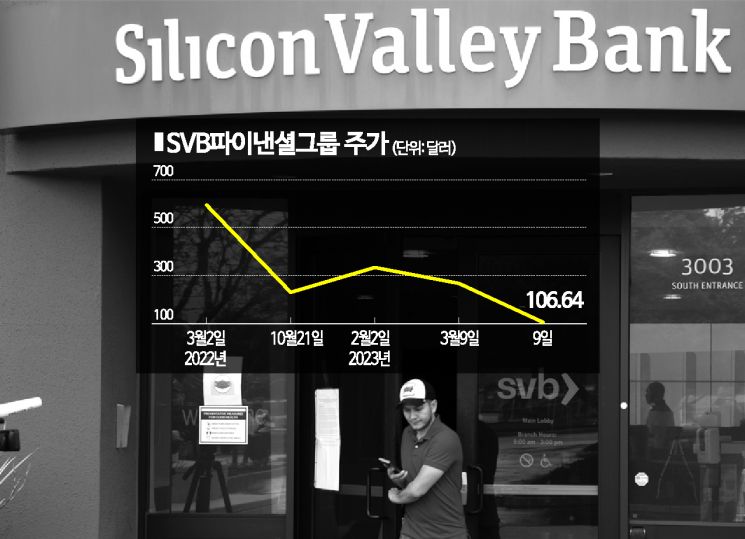
The sudden 'bank run' that led to the closure of the Silicon Valley Bank (SVB) in the United States after more than 40 years of operation was revealed to have involved betting on falling interest rates last year. This was a move completely opposite to the Federal Reserve's (Fed) aggressive tightening trend. Criticism has been raised that SVB's bankruptcy was caused by risk management failures relying on overly optimistic forecasts, including asset concentration in tech companies and misjudgment of market conditions.
On the 13th (local time), the Wall Street Journal (WSJ) cited SVB's year-end financial report, reporting that the bank terminated interest rate swap contracts on bonds worth more than $14 billion last year alone. Although the bond holdings increased significantly, it was pointed out that the bank virtually did little interest rate hedging.
Banks typically diversify interest rate risk through interest rate swaps and similar instruments. In 2021, SVB hedged interest rate risk on bonds worth $10 billion through interest rate swaps. However, in 2022, out of $26 billion in available-for-sale securities, the bank entered into interest rate swap contracts on only $563 million, drastically reducing the scale of interest rate hedging.
Although bond prices fell due to rising interest rates, the bank did not defend against unrealized losses from large-scale bond investments by reducing the scale of interest rate hedging. This is why there are criticisms that the bank should have diversified interest rate hike risks through interest rate swap products and others.
This was also contrary to the Fed's moves. Until mid-last year, SVB told investors that it was "moving toward managing sensitivity to falling interest rates" and would take effective protective measures in preparation for another rate cut. While the Fed embarked on rapid rate hikes due to global high inflation, SVB predicted falling interest rates.
SVB's prediction was completely off. The U.S. benchmark interest rate, which was 1.75% in June last year, rose to 4.75% at present. Considering that indicators showed the U.S. economy was stronger than expected and that the Fed's rate hike cycle could be longer until just before the SVB incident, the prediction was wrong.
Internal controls were also at a 'failing' level. After Laura Izurieta, the risk officer, stepped down in April last year, SVB did not appoint a successor until January this year. The risk officer position, crucial in a bank, was vacant for more than half a year. This fact was only revealed after SVB was closed last week.
The management's awareness was also complacent. CFO Daniel Beck stated at a meeting last month that the business structure concentrated in tech, healthcare, and life sciences industries would not pose a risk to the bank. However, as the tech industry faced increased funding costs due to rate hikes and began withdrawing deposits, SVB ran out of liquidity and closed just 36 hours after disclosing this fact. It is difficult to avoid criticism that the management's awareness was too complacent in the conservative and cautious financial sector. CEO Greg Becker also appeared before the Senate in 2015, claiming that "SVB's business model does not pose systemic risk" and advocated for deregulation of small banks. Only a few years later, this statement also became empty words.
The confident CEO Becker, CFO Beck, and other executives who claimed there was no risk were the first to sell their shares and take profits when the company was pushed into crisis.
However, investors wary of SVB began to increase gradually in the market. The company's stock price surged 54% in 2020 and 75% in 2021 but fell 66% last year. Short selling betting on stock price declines also increased. According to S3 Partners, one year ago, 1.4% of the company's total shares were shorted, but by the end of last year, this rose to 6.7%.
WSJ pointed out, "SVB's management consistently maintained optimism in the cautious banking industry," adding, "CEO Becker stands at the place of SVB's rapid rise and now even faster fall."
© The Asia Business Daily(www.asiae.co.kr). All rights reserved.
![Clutching a Stolen Dior Bag, Saying "I Hate Being Poor but Real"... The Grotesque Con of a "Human Knockoff" [Slate]](https://cwcontent.asiae.co.kr/asiaresize/183/2026021902243444107_1771435474.jpg)
















