The Korean Association for Contemporary Japanese Studies Holds a Forum on "Evaluation and Significance of Solutions to Forced Labor"
At the emergency forum titled "Evaluation and Significance of the Forced Labor Solution," held at the Press Center on the 13th by the Hyundai Japanese Studies Association, various evaluations and prospects were exchanged regarding the forced labor solution announced by the government on the 6th.
The government had earlier formalized a plan for compensation to victims of forced labor under Japanese colonial rule, proposing a "third-party payment" method using donations from Korean companies. The core content is that the Foundation for Supporting Victims of Forced Mobilization under Japanese Imperialism (hereinafter the Foundation), under the Ministry of the Interior and Safety, will pay the court-awarded damages and delayed interest to the plaintiffs of three Supreme Court final rulings in 2018, and if the ongoing related lawsuits are confirmed in favor of the plaintiffs, the Foundation will also pay the awarded damages.
However, this plan faced criticism as "humiliating diplomacy" and "subservient diplomacy" because, even in the government's final announcement, there was no direct "apology" or direct "compensation" from the Japanese side.
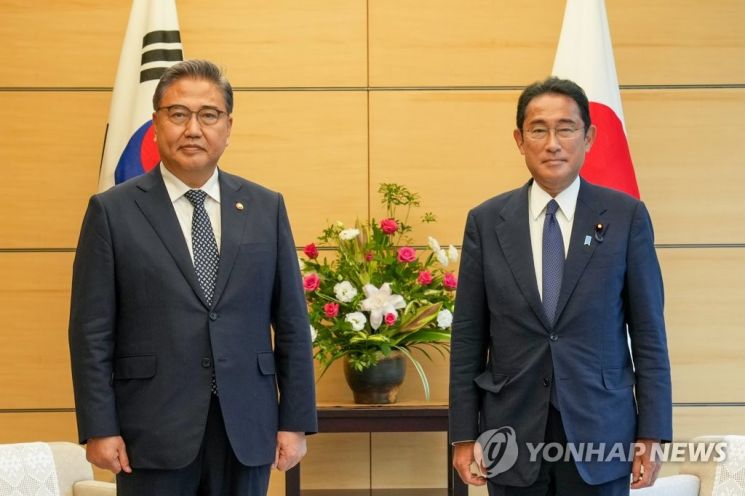 Park Jin, Minister of Foreign Affairs, who is visiting Japan, paid a courtesy call on Japanese Prime Minister Fumio Kishida at the Prime Minister's Official Residence in Tokyo on the afternoon of July 18 last year. The minister and Prime Minister Kishida pose for a commemorative photo.
 Experts attending the forum unanimously agreed that the future response of the Japanese government is crucial. Eunmi Choi, a research fellow at the Asan Institute for Policy Studies, emphasized, "Korea has extended a significant hand, and Japan must respond." Choi added, "That response should specifically include expressions of reflection and apology. The defendant companies should also actively and proactively participate in efforts to develop Korea-Japan relations and in the compensation process."
Professor Cheolhee Park of Seoul National University also said, "The media overlooks that this compensation solution announcement is not the end but the beginning of problem-solving," adding, "Korea has made a bold decision and passed the ball to Japan, and now Japan must respond."
There were also criticisms regarding the public opinion that "the negotiation was absolutely disadvantageous to our country." Changsoo Jin, director of the Japan Research Center at the Sejong Institute, said, "Japan felt a crisis that if it conceded on 'principles' in Korea-Japan relations, its postwar policy would collapse," and viewed that "the apology and reflection Korea initially expected are difficult to obtain."
Director Jin particularly stated, "We must critically evaluate the political slogan of returning Korea-Japan relations, built on international law, to the starting point to regain pride," adding, "Until now, Korea-Japan relations have been able to develop through the supplementation of the 1965 Basic Treaty."
Professor Wondeok Lee of Kookmin University said, "The forced mobilization issue is a problem of 'state violence,' a human rights issue, and a matter of victim relief," and added, "The fact that our government has proactively pursued a solution to this issue can be highly evaluated from the perspective of international human rights."
He continued, "If Japan makes statements denying state violence, it would be losing in the war of international norms," and said, "From the perspective of the international community, Japan could be criticized for being trapped in a dead-end. Statements from Japan at the G7 and summit meetings could serve as criteria for judgment."
There were also remarks pointing out that significant remaining issues such as lawsuits invalidating the deposit and claims for subrogation rights remain. Professor Heesik Choi of Kookmin University predicted, "Those who do not wish to receive the court-awarded damages through third-party payment can file lawsuits to invalidate the deposit, and the judiciary will determine its validity, which will decide the sustainability of the forced labor solution." Professor Choi diagnosed, "It is also uncertain whether the Ministry of Foreign Affairs will maintain its unwillingness to exercise subrogation rights after a regime change, which could also be a trigger."
© The Asia Business Daily(www.asiae.co.kr). All rights reserved.

















