Last Year Online Food and Beverage Transactions 28 Trillion
3 out of 4 Online Food Transactions Are Mobile
As online grocery shopping, which emphasizes convenience, becomes a daily routine, food transactions through online channels are also experiencing rapid growth. In particular, distribution companies are continuously alleviating consumers' doubts about purchasing fresh food online through fast delivery and quality control, and this year, the online food transaction volume is expected to exceed 40 trillion won.
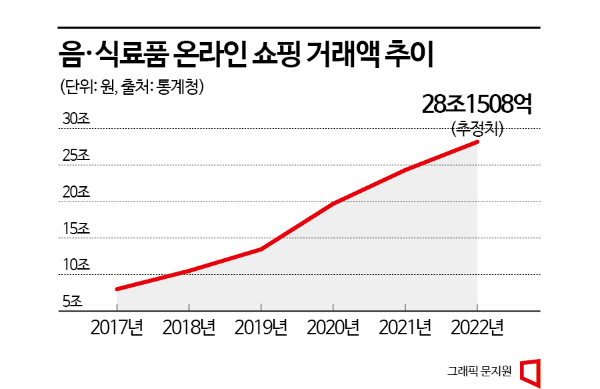
According to Statistics Korea on the 15th, the estimated online shopping transaction amount for beverages and foodstuffs last year was 28.1508 trillion won, an increase of 15.9% (3.8559 trillion won) compared to 2021 (24.2949 trillion won). The online shopping transaction amount for beverages and foodstuffs, which was around 7.997 trillion won in 2017, surpassed 10 trillion won the following year, and due to the impact of COVID-19 in 2020, it surged to 19.679 trillion won, a 46.3% increase from the previous year (13.447 trillion won). In 2021, it grew by more than 20%, reaching nearly 25 trillion won, marking a 252% growth over the past five years. The shift to online purchasing of agricultural, livestock, and fishery products is also progressing rapidly. Last year, the online shopping transaction amount for agricultural, livestock, and fishery products was 7.9817 trillion won, up 12.2% from the previous year (7.1164 trillion won).
Food is also the fastest-growing product category leading the recent growth in online shopping. Last year, the total online shopping transaction amount was 206.4916 trillion won, a 10.4% increase from the previous year. Although the transaction amount exceeded 200 trillion won and maintained double-digit growth, the fashion category, which previously led online shopping growth, grew by only 3.3%, and the home electronics category slightly decreased by 0.2%.
On the other hand, as online purchases of beverages, foodstuffs, and agricultural, livestock, and fishery products increased, the total online food transaction volume last year reached 36.1325 trillion won, a 15.0% increase compared to the previous year (31.4114 trillion won). Among this, mobile transactions accounted for 74.7% of the total transaction amount, totaling 27.0036 trillion won, indicating that three out of four online food transactions were made via smartphones or other mobile devices. As of January, the online shopping food transaction amount was 3.6216 trillion won, a 7.8% increase from a year earlier. Having recorded an all-time high, it is expected to exceed 40 trillion won this year.
The rapid increase in food purchases through online channels is attributed to the normalization of online grocery shopping via smartphones during the COVID-19 pandemic, which has effectively eliminated the psychological resistance that fresh food must be seen before purchase. Additionally, sustained high inflation has increased demand for home-cooked meals, and the quantitative and qualitative growth of home meal replacement (HMR) products such as meal kits has also had an impact.
Riding this trend, online distribution companies like Kurly and Oasis, which emphasize early morning delivery of fresh food, are also experiencing rapid growth. Kurly's sales, which were 452.9 billion won in 2019, more than tripled to 1.5614 trillion won in 2021 during the COVID-19 period, and Oasis also recorded its highest sales, increasing from 142.4 billion won to 356.9 billion won during the same period.
As online food purchases continue to grow, the focus of existing distribution companies such as large supermarkets and convenience stores is shifting from offline to online. According to sales trends of major distribution companies from the Ministry of Trade, Industry and Energy, online sales of distribution companies increased by 9.5% last year compared to the previous year, showing a higher growth rate than offline sales (8.9%). The proportion of online sales is also threatening to surpass the majority. Online sales of distribution companies, which were 35.0% in 2017, exceeded 40% in 2019 (41.4%), surged by 5.1 percentage points to 46.5% in 2020 when COVID-19 became widespread, and continued to grow, reaching 48.6% last year, up 0.2 percentage points from 2021, marking a 13.6 percentage point increase over five years.
Professor Eunhee Lee of Inha University’s Department of Consumer Studies explained, "In the current economic downturn and high inflation environment, consumers naturally look for the cheapest purchasing channels, and online shopping offers a wider range of products and price points compared to offline, which seems to be a strong advantage." She added, "Especially for food, which is purchased frequently, price is important, and the relatively diverse discount events centered on online shopping also appear to influence the recent increase in purchases."
© The Asia Business Daily(www.asiae.co.kr). All rights reserved.
![Clutching a Stolen Dior Bag, Saying "I Hate Being Poor but Real"... The Grotesque Con of a "Human Knockoff" [Slate]](https://cwcontent.asiae.co.kr/asiaresize/183/2026021902243444107_1771435474.jpg)















