KOSPI 200 Operating Profit Expected to Decrease by 174 Trillion Won This Year
Possibility of Profit Increase After March...Focus on High-Performance Stocks
As the earnings season for the fourth quarter of last year came to a close, a significant number of companies delivered disappointing results as expected. A contraction in growth for the second consecutive year appears inevitable. Profit estimates for this year are also being revised downward. However, the prevailing view is that the downward adjustments are nearing their end. Accordingly, there is growing optimism that corporate profits will hit bottom and rebound starting in March.
Worse than Expected... Fourth Quarter Earnings Shock
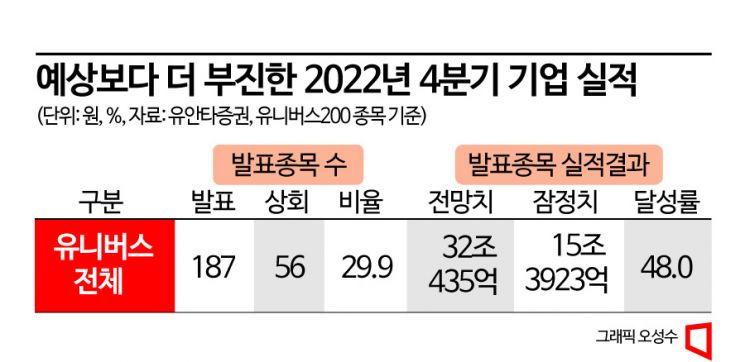
According to the financial investment industry on the 14th, earnings announcements for 187 companies selected from the Universe 200, representing key sectors of the KOSPI and KOSDAQ, have been completed for the fourth quarter of last year. In terms of value, 97% of announcements have been made. Practically, most large-cap companies have reported their results. Smaller and mid-cap companies have yet to announce, but over 90% of listed companies have completed their earnings disclosures. Based on this, the fourth-quarter results were worse than expected.
Yuanta Securities stated, "The earnings achievement rate for Universe 200 companies that have completed their fourth-quarter earnings announcements was 48%, which was below expectations, and the earnings surprise ratio was only 30%." They estimated that "the fourth-quarter operating profit for Universe 200 companies will be between 16 trillion and 17 trillion KRW." Yeom Dong-chan, a researcher at Korea Investment & Securities, analyzed, "If the combined operating profit estimate for KOSPI 200 companies in the fourth quarter is set at 100, the actual profit as of the fourth week of February was 59% of the estimate, and net profit (excluding Samsung Electronics) was 15%, the lowest since 2011." This is even smaller than the 2019 fourth-quarter net profit, which was only 17.4% of estimates due to asset depreciation issues. Conservative accounting standards and provisions have resulted in historically low net profit levels.
Representative companies with larger-than-expected losses include SK Hynix, LG Display, and Daehan Petrochemical. Many companies that were expected to post profits instead reported losses, such as S-Oil, Hotel Shilla, POSCO Holdings, Hyundai Steel, SK Innovation, and SKC. Several companies shocked the market by missing expectations significantly, including POSCO Chemical, LG Electronics, HanAll Biopharma, and Eugene Technology.
Due to the poor earnings reports, a contraction in growth for the second consecutive year following 2021 is unavoidable. Expectations for this year's earnings are also bleak. Researcher Yeom Dong-chan noted, "Current estimates suggest that both operating profit and net profit this year will be lower than last year." For the KOSPI, the fourth-quarter operating profit announced so far is in the 21 trillion KRW range, about 10 trillion KRW below consensus. As a result, the fourth-quarter operating profit is expected to finish approximately 45% lower than the same period last year.
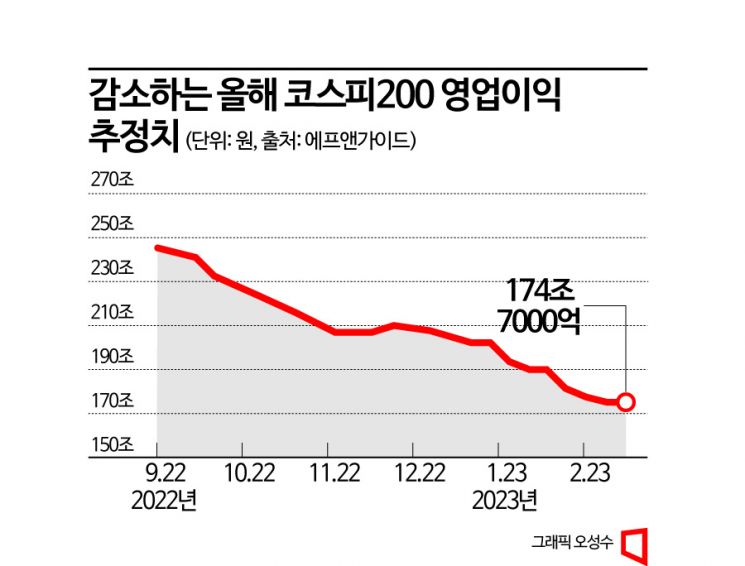
The fourth-quarter earnings shock last year has led to downward revisions in profit forecasts for this year. Choi Jae-won, a researcher at Kiwoom Securities, explained, "Due to cost burdens from high inflation and other factors, corporate profitability has deteriorated, leading to a continued downward trend in operating and net profits since last year. Concerns about a global demand slowdown have also caused sales forecasts to be revised downward, reflecting recession fears in corporate earnings." He added, "For the KOSPI 200, the sales forecast for this year has been lowered from 2,701 trillion KRW at the beginning of the year to 2,647 trillion KRW, and the operating profit forecast has dropped from 203.2 trillion KRW at the start of the year to 175.2 trillion KRW, and further to the 174 trillion KRW level by the end of February."
Limited Stock Price Declines Despite Poor Earnings
Despite the disappointing earnings, stock price declines were generally limited. This phenomenon occurred because concerns about poor earnings had already been priced into the market. Furthermore, the fact that stock prices did not fall significantly despite weak earnings suggests that the period of earnings weakness may have passed.
Accordingly, the attractiveness of the Korean stock market remains high, according to the securities industry. The possibility of confirming a rebound in profit forecasts this month is increasing. Last week, the 12-month forward operating profit for the KOSPI recovered to 200 trillion KRW. Cho Chang-min, a researcher at Yuanta Securities, said, "Considering that the 12-month forward earnings per share (EPS) level for MSCI Korea is near its bottom, it can be expected that the timing to confirm the earnings bottom is gradually approaching."
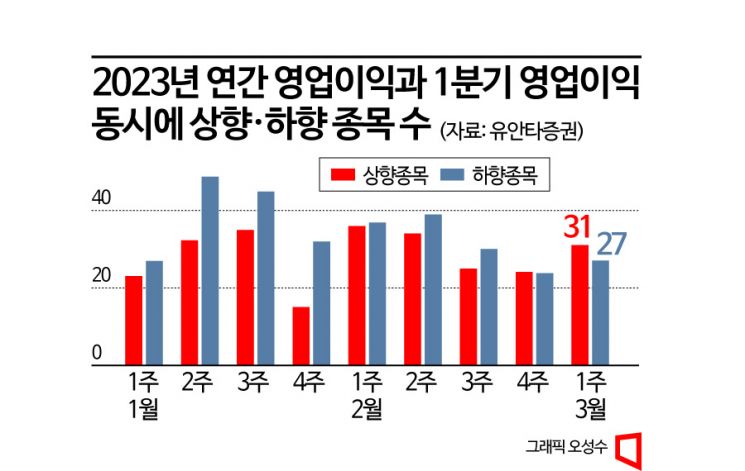
Changes are also being detected based on the Universe 200 stocks. In the first week of March, for the first time since the beginning of the year, the number of stocks with improved operating profit forecasts for both the first quarter and the full year exceeded the number of stocks with downward revisions. Researcher Cho Chang-min noted, "A rebound in operating profit forecasts for the semiconductor sector, which accounts for a large portion of market earnings, has not yet been confirmed. However, from a market-wide perspective, it is likely that earnings rebounds will be confirmed as we move past March."
The magnitude of earnings forecast revisions has approached levels seen in past recessionary periods. During the global financial crisis in 2008 and the 2018-2020 period marked by the US-China trade dispute and the COVID-19 outbreak, the KOSPI's 12-month forward operating profit forecast fell more than 30% from its peak. Currently, it is down about 27% from the peak. Researcher Choi Jae-won explained, "Considering that past declines occurred during times of systemic crises, the current adjustment likely reflects a significant portion of the downside risk to earnings forecasts. While there is room for further short-term downward revisions, the magnitude is unlikely to be drastic."
Seol Tae-hyun, a researcher at DB Financial Investment Securities, pointed out, "Market direction is being influenced more by changes in valuation driven by expectations and disappointments regarding the monetary policy direction of the Federal Reserve and other global central banks than by earnings themselves." He added, "Based on the 12-month forward price-to-earnings ratio (PER), companies identified as undervalued relative to the historical bottom 10% include Dongyang Life Insurance, Korea Gas, Hyundai Home Shopping, and Industrial Bank of Korea. Companies with high 12-month forward PER and expected increases in operating profit for the first quarter, second quarter, and full year, with upward revisions to first-quarter operating profit consensus compared to the beginning of the year, include Industrial Bank of Korea, Shinhan Financial Group, and LG HelloVision."
© The Asia Business Daily(www.asiae.co.kr). All rights reserved.



















