K-ICS Implementation Postponement 'Grace Period', 19 Insurance Companies Apply
36% of insurance companies have applied for a temporary exemption called the "transitional measure" for the new solvency evaluation indicator, the 'New Solvency Capital Requirement System (K-ICS)'. It was found that not only small and medium-sized insurers but also relatively capable mid-sized and large insurers applied.
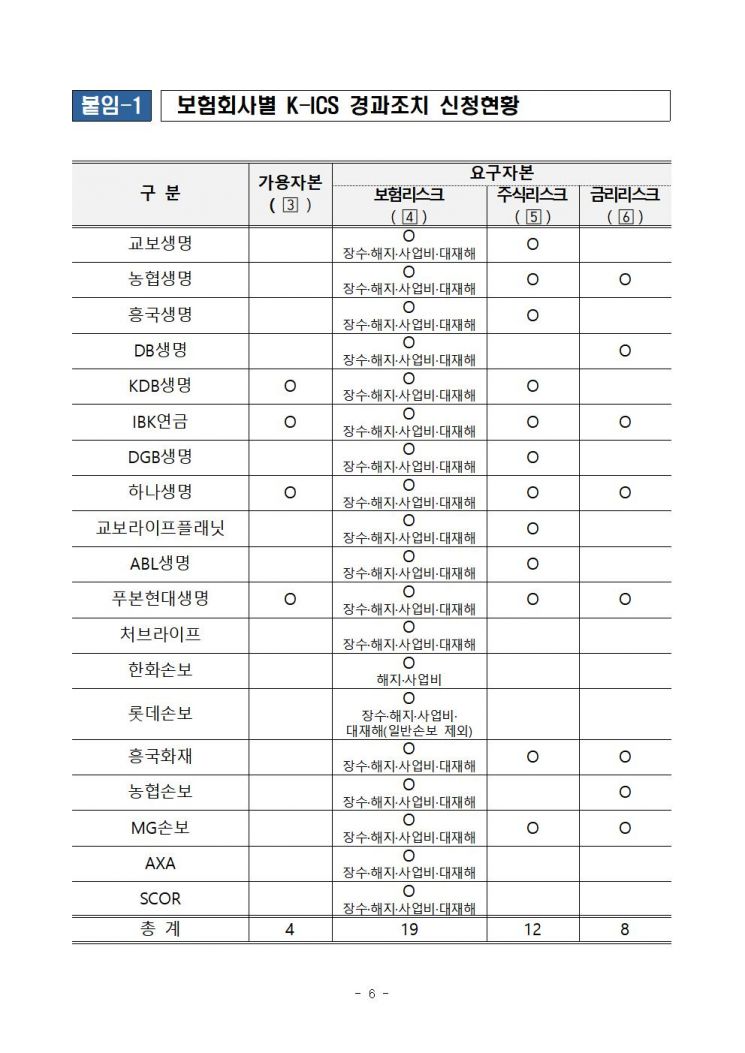
According to the Financial Supervisory Service (FSS) on the 13th, 19 insurance companies reported applying for the selective transitional measure. This accounts for 35.8% of all insurance companies (53 companies). Among life insurers, more than half, 54.5% (12 companies), applied. Six non-life insurers (30%) and one reinsurance/guarantee insurer (9.1%) also reported applying for the transitional measure.
It was found that not only small insurers with somewhat limited capacity but also some of the largest insurers in the industry, such as Kyobo Life Insurance, applied. The FSS explained, "Many insurers whose K-ICS ratio exceeded 150% as of the first half of last year also applied for the transitional measure," adding, "It appears to be a strategic purpose such as reducing capital costs and flexibly responding to changes in the financial environment."
Unlike the past solvency (RBC) ratio, which evaluated some assets and liabilities at cost, K-ICS evaluates all assets and liabilities at market value. Therefore, insurers' solvency indicators may temporarily decline, so the authorities have put in place measures to allow K-ICS to have a soft landing with some leeway.
Capable Insurers Also Applied... "As a Measure Against Uncertainty"
The financial authorities accepted applications by distinguishing between available capital and required capital aspects for the transitional measure. Four life insurers with a large proportion of long-term insurance liabilities (KDB Life Insurance, IBK Pension Insurance, Hana Life Insurance, Fubon Hyundai Life Insurance) plan to apply the transitional measure for gradual recognition (up to 10 years) of capital reduction due to market valuation of assets and liabilities. On the other hand, non-life insurers and reinsurance/guarantee insurers did not apply for the transitional measure for capital reduction.
Also, all 19 companies that reported applied for the transitional measure regarding the measurement of new insurance risk from the required capital perspective. Twelve and eight insurers applied for the transitional measures for stock risk and interest rate risk, respectively.
An FSS official said, "If an insurer applies with the necessary documents stipulated by law, it will be accepted without additional conditions and notified to the insurer within this month," adding, "However, the applicability and amount of the transitional measure will be re-examined after the K-ICS financial information is finalized at the end of this month, and accurate figures will be analyzed after confirming the before-and-after effects."
"Report Solvency Improvement Plans to Authorities... Termination Is Free"
Companies that applied for the transitional measure can gradually recognize the decrease in available capital due to market valuation of assets and liabilities, and the increase in required capital due to strengthened measurement standards for new insurance risk and interest rate/stock risk for up to 10 years. If the RBC ratio as of the end of this month is 100% or more, even if the K-ICS ratio (after applying the transitional measure) is below 100%, corrective action may be deferred for up to five years.
All insurers applying the selective transitional measure must submit a CEO verification report on the appropriateness of the transitional measure application results by the quarterly business report submission deadline. Companies with a K-ICS ratio below 100% before applying the transitional measure (as of the end of this month) must submit a financial improvement plan to the Financial Supervisory Service by the end of August and report the implementation status of the improvement plan (including any changes) annually. Additionally, they must disclose the K-ICS ratio before and after applying the transitional measure, and excessive dividends will reduce the remaining transitional period by half.
Furthermore, insurers that receive a deferral of corrective action because their K-ICS ratio after applying the transitional measure (as of this month) is below 100% must sign a management improvement agreement with the FSS governor and report the implementation status quarterly.
The transitional measure can be stopped by notifying the FSS before the end of the transitional period. Also, the FSS governor can notify the suspension of the transitional measure if the insurer does not implement the improvement plan or if the possibility of financial soundness improvement is very low.

© The Asia Business Daily(www.asiae.co.kr). All rights reserved.
![Clutching a Stolen Dior Bag, Saying "I Hate Being Poor but Real"... The Grotesque Con of a "Human Knockoff" [Slate]](https://cwcontent.asiae.co.kr/asiaresize/183/2026021902243444107_1771435474.jpg)
















